Friday, March 23, 2007

Dog tired


I know how you feel, Wiley. I know how you feel. It's hard sleeping on the floor of my study for days on end while I work non-stop from waking until sleep for week after week, isn't it?

OK, for those of you keeping track, here's what I've accomplished in the last two weeks. Note the passive voice -- I don't feel like I've been doing anything very actively:

  • Book proofs have been corrected, FedEx'd to India, and received there.
  • The book index has been written, e-mailed to India, and received there. It remains to be seen if they send it back to me, telling me it's an incompetent piece o' crap and that I might as well have said "see entire book" for most of the entries.
  • 25 Shakespeare essays have been graded.
  • 30 short close-reading exercises on Marie de France's Lais have been graded.
  • Classes have been taught -- some well, some not so much.
  • The Master's Exam has been written (1/2 by me; 1/2 by Victoria) and proctored (by me); all 11 exams have been carefully read; and as of today, the fates of these 11 souls have been determined.
  • The graduate committee has met and decided on the major round of admissions and funding for graduate students next year.
  • Offer letters have been drafted.
  • Students with incomplete files have been contacted.
  • Many miles have been run.
  • Guidelines for student research projects in the medieval class have been written and distributed.
  • Feedback on failed application for an NEH Summer Stipend has been requested and received. Grumbling has been done, followed by realization that the feedback is actually very useful, even if it doesn't come with $5000.
Things remaining to be done in the next week:
  • Grade 30 essays on various medieval subjects turned in on the 15th.
  • Grade 30 close-reading papers on Sir Gawain and the Green Knight.
  • Contact and give feedback to 11 souls who did or did not pass Master's Exam.
  • Send out offer letters to admitted grad students.
  • Run 20 miles tomorrow.
  • Celebrate 38th birthday on Saturday night or Sunday (the actual day) -- if there's time and energy to do so. At least open presents. Thank people.
  • Buy cards and presents for April birthdays.
  • Write to recommenders for NEH Stipend to tell them I didn't get it. Feel like loser even though the feedback was really useful.
  • Dammit, reserve hotel for K'zoo already!
  • Buy airline tickets for summer London trip before prices go up to $1500 instead of a mere $1200.
  • Once again start pulling my weight on things like cooking, cleaning, and grocery shopping.
  • Take Wiley to the park on Sunday if weather is gloomy (because that means fewer other dogs and fewer instances of me having to restrain an insanely barking Wiley).
  • Sleep. Maybe.
  • Continue teaching classes, perhaps with more energy. Try not to let discussion of I Henry IV suck as much as discussion of King Lear did. Try not to let enthusiastic but odd dude dominate discussion with bizarre theories. Write blog post about such students and what to do about them.
  • Watch final episodes of Rome (forever! boo-hoo!) and Battlestar Galactica (thank god it's just a season finale, not a series one).
  • Shut down computer for entire day tomorrow for Shutdown Day.
  • Catch up with blog reading. (OK, how on earth is it that Dr. Crazy has some 30-odd new posts that I haven't read yet? UPDATE: Good god, it's actually 40-almost-50-something new posts! 49 at the moment, in fact, and that's just in the last 20 days!)
  • Drink lots of wine.
  • Collapse.
But now I'm going to run out and buy some Gu energy gel for my run tomorrow, and *then* I'll get started on the rest of that list.

Wednesday, March 21, 2007

Attention! Important Announcements! Read This NOW!

OK, now that I have your attention...

First, sorry for the silence. Chatter will resume shortly.

In the meantime, here are the Very Important Announcements:

  • The Pastry Pirate is blogging again! All hail the Pastry Pirate! And note that she's got a new URL.
  • If you don't regularly read In the Middle, or, if you're like me and fall way behind on blog reading at regular intervals, then you may have missed this announcement about a Very Special Episode of In the Middle planned for April. You know, April, with his shoures soote... when longen folk to find out the secret identities of very popular and funny psuedonymous bloggers. I have a theory and evidence to go with it. I think I'm right. I should put some money on this. UPDATE: OK, I was doing some "wishful reading" here. GC is not revealing his secret identity. However, the writer behind GC's blogging persona is going to write in his 21st century guise, albeit anonymously. Still worth watching for (or adding In the Middle to your RSS feed so you don't miss it).
Substantive blogging will return shortly, probably with a post about what to do with that student who always derails discussion.

Monday, March 12, 2007

Endurance editing

It's a good thing I'm marathoner, used to pushing through exhaustion to get through that last stretch of miles, because that's how I feel about correcting my book proofs and writing my index. It's like I've got 3 miles left to go and it's all I can do to keep one foot moving in front of the other, or in this case, not to get all glassy-eyed.

  • Miles 1-23 = Correcting the proofs and drafting the index -- DONE!
  • Miles 24-26.2 = Editing, polishing, and formatting the index -- still chugging along.
Of course, a marathon only takes me 3 3/4 to 4 1/4 hours (depending on how well I've trained). I've been working on the damn book stuff for about a total of 50 hours now over the course of the last 7 days. And my back and legs are just about as sore as after a marathon as a result. (Or maybe that's the result of my 20-mile training run yesterday. Who can tell at this point?)

I've got until Friday to finish up, but I've also got teaching -- oh yeah, that! -- grading (sigh), and grad director stuff galore this week. So send me some virtual "You can do it!" and "Almost there!" and "Looking great!"* cheers this week. And be patient with me if blogging is light for about the next week.


*Yes, people really call this last one out to marathoners in the last few miles and it never sounds sincere. In a good race it makes me laugh [ETA: because I wouldn't call dried sweat-salt on my face, visible chafing, and a plodding run "looking great"]. If I'm having a bad race, it makes me want to punch whoever is saying it. [ETA: But I wouldn't do that, of course. I know they mean well, even if I look like crap and feel miserable. Though it would be funny if someone shouted, "You look like hell but hey, you've just run 23 miles!" Te-hee.]

Thursday, March 8, 2007

Man, even the Library of Congress thinks I'm a historian

I'm back from my conference trip and hard at work on correcting my book's page proofs and writing my index. It's a good thing they left me 24 pages for it, because it's going to be close to that when it's done. I'ts ridiculously long because I went and wrote a book with overlapping categories of concepts that need separate lists as well as cross-listing. Damn me for being complicated. And can I just say that for some of the index entries I really, really want to say, "see the entire frakkin' book." Te-hee!

Anywho, now that I have the proofs, I can see the Library of Congress number I've been assigned. And it's an HQ number, putting me in the cultural history category that is indeed, a major subject of the book. But I think of it as first and foremost about a particular genre of medieval literature. That designation, according to the Library of Congress, however, comes second among all the categories listed. (Well, at least someone doing a search by LC subjects in literature will still be able to find it by the appropriate category.) Maybe being in the HQs will bring me readers I wouldn't already have -- people browsing the shelves in that subject of cultural history -- but I'm kind of bummed I'm not with my literature peeps in the PRs.

And I'm having an identity crises. Blog categorizing sites think this blog is a history blog, and now the Library of Congress thinks my book is primarily a work of cultural history. And meanwhile, I'm finding that a lot of what's been written relevant to my newest project on a certain manuscript and its owners is done by historians. (Hello, Dr. V., there's a reason why it's called the history of the book! Duh!) And at this weekend's conference, the two keynote speakers were both historians, but their work seems awfully close to the kind of stuff I do and think about. Hm. Sure, I do have a new historicist approach to literature, but I thought I was a literature person first.

Maybe I'm the academic equivalent of an adopted kid, and I'm now just realizing that my "parents" aren't really my parents! This is all rather shocking. I mean, I'm sure my "real" parents, historians, are great people and all -- heck, maybe they're cooler than the literary people I thought were my parents -- but who am I?

You know, next time our admins give lipservice to how it's the age of interdisciplinary work and we need to be doing it (without, of course, any institutional structures to support it), I'm going to pipe up and say, "Well, I'm in an English department, but everyone thinks I'm a historian, so there you go."

And PS -- Just out of curiosity, where do you fall in terms of the "a historian" vs. "an historian" usage?

PPS - This is my 300th post, just so you know.

Thursday, March 1, 2007

Miscellaneous mentionables

I'll be away for the weekend at a conference and visiting with some friends, and I won't be back until Tuesday, so don't be alarmed by my silence here. Posting may be sketchy for the next few weeks after that, as well, since I'm getting the book proofs this weekend and have two weeks to write the index (and yes, I'm writing it myself -- there are good reasons why). The good news is that we're on break next week, so the index can be my full time job for the moment.

In the meantime, if you haven't already seen this announcement on other blogs, go check out News for Medievalists, a great compendium of recent news articles of interest to medievalists both academic and independent. The host of the site, Peter Konieczny, also edits the site for De Re Militari: The Society for Medieval Military History.

And now you have the time to read my monstrous post on the process from dissertation to book!

Have a good weekend everyone.

Wednesday, February 28, 2007

On keeping a research journal

In response to my rambling post below on how my dissertation became a book, What Now? brought up something worth responding to on the front page. She wrote in the comments:

I was particularly interested to read that you do your research upfront and then turn to the writing, since I just made the decision this weekend that I've been trying to write too soon and need to step back and immerse myself in research for awhile. And this is counter to some writing gurus who say "Write before you're ready."
It's true that I tend to frontload the research and do the "real" writing closer to the end of the process, and I'm one of those people who likes to get the whole argument in her head before she writes, at least in outline form. I find that then I write pretty quickly. However, I do a lot of other kinds of writing throughout the process. First of all, when I'm taking notes, I write questions and responses to the scholars I'm reading. Things like "This is compelling, but what about...?" That way my process really does take the form of a conversation with the scholars. That sometimes happens with the primary texts, too. There's a name in the attestation of ownership of the manuscript I'm currently working on, which I have circled in my printout of the microfilm. Next to it I've written, "Who are you?"

So there's that kind of short-form writing. And I also keep a "work-in-progress" or research journal, and in that I write longer-form but informal essays on ideas I have during the research. Sometimes they start with questions such as "Could I say...?" or "What if I argued...?" Sometimes they're about texts I'm teaching or reading in other contexts which might have something to say about the current project, and so I do a kind of reading response to save for future reference. I don't always turn back to what I've written, but the process of writing, I think, helps me test ideas and keeps them more actively in my thought than just thinking about them would. It's because of such a journal that my dissertation project changed from issue X in texts A & B to issue Y in them. And I did go back to that journal for my reading of one particular segment of those texts. So it has real, concrete value, as well as process and practice value.

I realize as I write this that these kinds of writing -- marginal notations, notes, journals, reading response -- are exactly the kind of things that Writing Across the Curriculum experts urge us to put into practice in our WAC (and non-WAC) courses. I never had WAC courses as an undergrad nor taught them as a graduate student, but somehow I've been using WAC methods in my own writing all along. Huh. Who knew? I must remember to bring this up in my WAC courses, to show students that this isn't just cant, that regular writing practice of all forms does actually help you think through writing.

So, yes, I save the "formal" writing for later in the process, but really, I'm writing all along.

Monday, February 26, 2007

From dissertation to book: a saga (but not in the medieval sense)

Last week, Dr. Crazy wrote a narrative of the process that got her from her dissertation to her new book deal (congratulations, Dr. C!) and asked others to chime in with their narratives and advice. (She's been answered as well by jbj at The Salt-Box.) There are elements of my story that are similar to Crazy’s, but with enough difference that I’ll give you my narrative. Much of the advice that Crazy and jbj both give is advice I would repeat (and some I wish I'd had).

Like Dr. C, I think I should start back with the dissertation process because that’s where the book started, and also like Dr. C., I always thought of it as a book (though I did cull parts for a couple of articles first). This is not the case with everyone. Bullock has a friend in rhet/comp who wrote a pretty quick, get-it-done style dissertation and then wrote something completely different for her first book. And maybe there are literature folks like that, too, but both Bullock and I turned our dissertations into our first books (he’s in a humanities-like part of the social sciences). In fact, we both had dissertation directors who referred to our dissertations as “the book.” If Bullock had a blog, he could tell you his story; I’ll stick to mine. My director, who is a generous and kind man, but also very private, non-confrontational, and a little shy, was a very hands-off kind of director. I think he really, sincerely believed in letting his students “find their bliss” so that they wouldn’t become reproductions of him. In the long run that seems to have worked for him and his students because his former students are an astonishingly accomplished, impressive, academically famous lot, but also very different from each other in their approaches to literature and scholarship. A little more direction – deadlines, for example – might have gotten me out a year earlier, but otherwise I respond pretty well to that sort of freedom. When it came time to submit things to him, that’s when he gave his full and careful attention to everything I wrote. Everything. In that way, he was an exacting task-master, but like Crazy’s director, he hit that sweet spot between fully-fledged “real” book and dissertation on its way to the book. He often wrote comments in the margins that asked questions or suggested I consider such-and-such, but then added, “You don’t need to do this now, but you’ll need to take it into consideration for the book.”

But that’s all after I started writing chapters. Let me go back a bit to the process that got me there, because I think that’s worth considering in this narrative, too. I’m kind of weirdly practical when it comes to deciding on things like areas of specialization and dissertation topics. I became a medievalist because I thought I’d have more to contribute to the scholarly conversation than in my other areas of interest where I loved the literature but didn’t have much new to say about it. When I love something too much, I have a hard time writing about it. For instance, I may never write anything about either Gawain and the Green Knight or Chaucer. So when I was fishing for texts and topics for the diss, I went to the texts that puzzled and interested me, that I had questions about rather than emotional attachments to. I think Bardiac has mentioned somewhere on her blog that when she teaches first year undergraduates how to do research, she emphasizes that the best research starts with a good question, one you don’t know the answer to. That’s something I’m going to emphasize with my juniors and seniors when we discuss how to do research, and it’s definitely something I somehow kind of knew when I started into my own research, although I didn’t express it to myself so directly. Instead, I started with the texts I was curious about, that I had questions about, and did MLA Bibliography searches on them to see what other scholars were talking about and if they’d answered these questions. In doing that, I realized one of the texts – or rather, set of texts -- had had much less written on it than the others, despite being pretty canonical, and no one seemed to be writing on the questions I had about it. So that’s how I figured out a plan of action for beginning my research. I had texts I was interested in and had questions about, and I found that no one was really talking about the topic my questions addressed, even though I thought it was pretty obvious and important.

So now you’re probably thinking, “Really? That’s all you did to come up with your dissertation/book topic and argument?” No, of course not. See, originally, my questions were about issue X in texts A & B, but as I started doing my research I realized that issue X was not really what these texts were all about. Plus, the way I was thinking about issue X, I soon realized, was really ahistorical. But luckily, the research I was doing gave me new inspiration and I realized that the questions that I really should be asking were about issue Y – although X still had something to do with Y, so all that research on X wasn’t useless.

That whole process – of researching and refining my topic and the argument that eventually would come out of it – took about a year, at the end of which I produced a 40-page prospectus of the dissertation/book it would become, complete with chapter breakdowns and sample readings of selected parts of texts A & B for each of those mini-chapters. At my graduate institution, we defend the prospectus rather than the finished dissertation, which seems like a totally humane thing to do, since there’s a lot more room to change things at the prospectus stage. But I suppose that if I’d had a dissertation defense, I might have had a better sense of what needed to be done to make it into a book. Still, the ways in which even the dissertation changed from prospectus to finished dissertation at least prepared me for being able to chuck out whole ideas and segments when I revised the dissertation into the book. Because, see, that prospectus originally outlined 5 chapters, but in the end I wrote only 4, folding the idea of the fifth chapter into the work as a whole. Call the subject of that proposed chapter issue Z, because I realized, during the research and writing process, that it really was a separate issue, with separate theories and history, although I think it played a part in shaping issue Y. So, from an original idea about issue X on texts A & B, then a proposal about issue Y and Z in texts A & B, the dissertation became a work on issue Y on texts A & B, with some intertwined forays into the cultural matrix that is X, Y, and Z. Oh, and at one point there was going to be some discussion of text-group C – a different genre that I thought was perhaps shaping issue Y in texts A & B – but it became pretty obvious that that had the same problems as issue Z: different theories and histories plus a separate genre of texts. I had to focus.

Ultimately, after that prospectus defense, it took me another two years to research and write the dissertation. Most of the first year was about research, the next year about writing, both of them on dissertations fellowships. Yeah, it really shouldn’t have taken me so long. Actually, the first chapter was the longest to write. When I went on the market the first time, in the fall of my last year of graduate school (the second time I was finished and had a lectureship), I had two chapters written by MLA. And then from January to filing in August, I wrote the final two chapters and revised and polished the whole thing. So basically, it took me about 12+ months to get the first two chapters done and half the time to get the next two written and the whole thing revised. Again, it was that first chapter that was the real bitch, and I want to tell you about that, because it’s also key to how I turned the diss into the book.

As I started writing the first chapter, I encountered the problem that many a first time scholar encounters: I wanted to include everything I knew. And after all that research on issue X, I didn’t want to let it go, even though I was now doing issue Y. Anyway, as I was writing that first chapter – which was the new historicist, cultural contexts, reading-the-documents kind of chapter – it kept growing and growing and growing into the Chapter That Would Not End. When it reached 120 pages (!!) I told my director about its length and he suggested that I turn parts of it into an appendix if I couldn’t bear to let it go. He added that someday that would be a good repository of knowledge if I needed to turn to it in revising the book. So that’s what I did.

Some of the following chapters were pretty long, too, but not nearly as gargantuan as that first beast was. But also, they came much, much, faster in the writing, especially by chapters 3 and 4. Although I’m not nearly as speedy a writer as Crazy is, my writing process is similar. I spend a lot of time doing the research and conceptualizing the thing as a whole before writing, so that when it comes down to the writing, I know where I’m going. Also, I don’t angst over individual turns of phrase or sentences in the initial writing – I save that for later, for revisions. So my screenwriting neighbor and I would have these daily writing contests in which we announced our page tallies at the end of the day. We decided that a page of my text was worth ten of his, given the margins and the spacing and imaginative process of a screenplay versus the density of argument of a dissertation. One day I came out at 5pm (our deadline) and announced that I had written ten pages. “Damn!” he said, “That’s worth a whole screenplay!”

Anyway, in the end, I had a ridiculously long dissertation with an appendix of “stuff I just couldn’t cut” that came to nearly 500 pages. Clearly it was not ready to be published as is! I let it sit for my first year on the TT job and turned to it the next summer. I got a research award from my university to revise it into a book, and I took the six-week salary award seriously, making editing and revising my full-time job for those weeks. Here’s what I did with that appendix: anytime a footnote in a chapter said “See Appendix,” I decided if my close reading of the historical documents was necessary for the argument I was making and, if it was, I folded that bit into the main text. If the stuff in the Appendix was just a paraphrase or quotation of someone else’s work, all I kept was the footnote to them. The rest I chucked. And I set aside that first chapter and re-read the following chapters, trying to decide how much of that first chapter was needed to make sense of the following one. And I tried to pair down chapters 2 and 3, which were also pretty overwhelmingly large. And through all of this, I tried to use other recent books on texts A & B to guide me from dissertation to book. I didn’t know about Germano’s From Dissertation to Book, unfortunately, but I’ve always done a pretty good job using others’ work as models to imitate. I think imitation is a powerful tool for learning, in fact; it’s certainly how many a writer honed his or her craft. Sure, it can veer into the repetitious and the parodic and the tiresome. But the conventions of any genre, including the academic book, come from the texts themselves in conversation with and reflection of others like them, not from some set of “rules” out “there” in the sphere of the Forms of Genre.

I should say that throughout this, I had no explicit advice from my former director or committee member, other than those mightily helpful notes my director left me about what needed to be considered when it became a book. I’m not upset about this in the least. Like I said, he lets his students follow their bliss, and he also seems to believe that when they leave the nest they need to find their own way. He’s a bit like my own mother that way, and so it’s a style I respond to and understand. I think it’s part of the reason why I can throw myself into some project and just decide I have to do something, as in “OK, now I have to turn this into a book,” etc. I’m surprised I didn’t look for a book like Germano’s, though, since whenever my mom wanted to know how to do something she went to the library and found a book about it. Heck, when I decided to start running and training for marathons, I got a book, too! (Seriously: The Runner’s Handbook. Love it.)

After that initial process of revising, that’s when I said, “OK, now to get this thing published.” I knew it wasn’t totally finished, but I’d done as much as I could, and now I needed an editor or a reader to tell me what else it might require. So I started talking to the book editors at conference book exhibits. I brought along a newly-written one-page abstract of the book and an offprint of an article that came from material in one of the chapters, as well as a copy of my CV. Some of them took that material; some of them gave me their proposal forms; some of them asked me to send a formal query letter; none of the editors gave me all that much concrete advice. But one of them really interviewed me – as if for a TT job – which I totally wasn’t prepared for. He asked and said things such as “How is your book different from So-and-So’s book?” (which, btw, is a cultural history book on issue Y – why does everyone think I’m a historian???) and “Why do you think the field needs your book?” and “Convince me it’s not just a slightly more polished version of your dissertation.” He scared me. But he also taught me a little of what to expect when publishers looked at my proposals. In the end, I got two rejections from the presses who’d taken my materials at the conference as informal proposals/queries, and they were nice rejections, but they didn’t give much feedback. So other than Scary Editor’s interview, I was back at square one, still hoping at least to get the book to the reader stage and not knowing exactly why I was getting rejected and if it had to do with my topic and ideas or just with economics, luck, and timing.

And then a friend told me about the presses that give “advance contracts,” where the press gives you a contract based on a very detailed proposal, and then sends your completed manuscript to a reader. There’s a clause in the contract that gives them the right to reject the book based on the reader’s report, so it’s still a peer-reviewed book. And one of my friends pointed me to one press in particular with the reputation for working quickly. At the time I was in my second year on the tenure track, so I thought that sounded like a great idea. If worse comes to worst, I thought, and I get rejected after all that, I’ll have a reader report showing me how to improve the book and I’ll also know how to ‘sell’ it through the proposal process.

Y’all know this story ends happily, so I’ll just hit the highlights here. The acquisitions editor and the series editor (the academic with her name on the series in which my book appears) both gave me tons of feedback on the initial proposal I sent them, the form for which I got from their website. (The web is an excellent source of information in this process as most presses have a page all about their submissions process.) They were clearly interested and wanted the proposal to be the best it could be for the pitch to the board. Writing and revising that proposal also helped me further shape the final book, since there would be more editing down the road. I got the contract ultimately, which included a due date six or nine months away (I forget which) at which point I was supposed to provide them with the final manuscript, post peer-review. So that meant I had to get the manuscript ready for peer review pronto. This made me glad I’d already done some revision prior to submitting proposals, but there was still more to be done, since the press had a strict 90,000 word limit (including notes) and my book was currently about 110,000 words, I think. So more text came out, in addition to the stuff I’d taken out earlier. (When I started getting down to those final 1000 words or so, I started changing phrases like “the R of Q” to “Q’s R,” I was that desperate.) And then I shipped it off to the press to send it to the reader.

And then the reader’s report came back, with only about a month and half before the deadline. And it was mixed. And there was much gnashing of teeth and rending of clothing. But I defended the book to the series editor where I thought the reader was actually mistaken, and I promised the changes that s/he was probably right about. And the series editor was convinced. And I was on leave from teaching and I write quickly, so it was do-able. And all was good.

And so I sent off the final manuscript. And I waited. A year later I got the copy-edited version. Now, there was correspondence in between, so it’s not like my publisher disappeared on me. For whatever reason, my book was pushed back a year – probably for budgetary reasons, I imagine. Well, so much for the fast-moving press, but still, had they rejected me after the reader’s report, that was only my third year on the tenure track and I would’ve had time to find another publisher, since I’d only exhausted three possibilities. And if the press had stayed on the original plan, I would’ve been trying to see my way through the production process while my mom was in and out of the hospital, slowly dying, and that would’ve been disastrous. So the delay ended up a good thing, too.

And now I’ve got an Amazon page of my own. And two scholars I admire – one a rising star, another an established figure of renown – have blurbed the book, and soon I’ll have the proofs to review. And in June there will be a real book to hold in my hands, not quite 5 years after I filed the dissertation.

And that’s how my dissertation became a book.

Coming soon: substantive post! Watch this space!

I just drafted a HUGE post about how I turned my dissertation into a book, in response to Dr. Crazy's post here. It's not quite as long as the dissertation was (um, that was almost 500 pages, thank you very much) but relative to blog posts, it's pretty massive. So I need to edit it. And when I do I'll post it. In the meantime, if you haven't already, go read Dr. Crazy's post.

Also, here's a post in response at The Salt-Box on jbj's own experience.

Sunday, February 25, 2007

Weekend fluff: places I have been

My brother and mother had a race to see who could visit all 50 states first. I forget who won, but I think both of them got there. I'm way behind, but I'm 15 years younger than Fast Fizzy, so that's not such a big deal. He says I should make my goal to visit them all by the time I'm 50 (which is when he got his last, I think). I told him his new goal should be a marathon in all 50 (plus D.C.). I'm not going to compete in that particular contest!

Anyway, here's a map of the states I've been to. In June, Bullock and I are going to a wedding in Portland, OR, so I'll add another. I like how a number of the states I haven't been to are conveniently grouped in pairs or clusters, except for Alaska, of course. And if I just go to the Four Corners, I could get Utah and New Mexico in together.


create your own personalized map of the USA

And now here's a map of the places I've been in Europe. I like the bare space of Switzerland in the middle of western Europe -- like its political stands, it's neutral. (I've been to the airport in Geneva, but in my rules that doesn't count.) But I really do need to get to the eastern parts of Europe, don't I? That big wash of sickly grey on the right of the map is just sad. And Iceland is calling to me. Hmmm...maybe I should study Old Norse there on a sabbatical year?


create your personalized map of europe

And finally, here's a view of the whole world, which makes me seem (appropriately) much less traveled in perspective -- I've only been to 8% of the world's nations, after all. But I think it's hilarious that it makes it look like I've been to all of Canada, all of Mexico, and all of China, when I've only been to Toronto and Vancouver, the Baja peninsula (not T.J., at least), and Beijing, Shanghai, Xian, Guilin, and Hong Kong. And you know I haven't been to all of the United States, either.


create your own visited country map

Monday, February 19, 2007

Update on London travel plans - lodging

First of all, thanks to everyone who provide helpful suggestions regarading London accommodations in this comment-thread and by e-mail. Following all of your suggestions, I considered and contacted Hughes Parry Hall of the University of London, Alexander Fleming Hall at the University of Westminster, Campbell House of University College London, and the student rooms of Goodenough College. (By the way, I know Goodenough College is named after a person, but that name just cracks me up. No offense meant to the good people of the college -- I'm just easily amused. Someone please tell me it's pronounced 'good-no' of 'good-noff' or something like that.)

Anyway, in the end I chose Goodenough. (If it's good enough for them, it's good enough for me. OK, I'll stop now.) Seriously, two recommendations from my readers helped, as did the fact that it's a post-graduate college that caters to people on research or sabbatical trips. It just seemed more grown-up. Plus, you can eat in the subsidized dining halls without locking yourself in to a dining plan (as some of the othere places required) and there's supposed to be a fridge in my room and a shared and equiped kitchen, so I can eat cheaply at 'home' if I like. There's also network and wifi access galore, and the location can't be beat for me, because it's in between the numerous archives and libraries I'll be using, either walking distance or a quick tube ride.

And the price isn't bad since I was offered the student rate as long as I have a letter from my institution saying I'm there to do research. (I guess the visiting academic rate is for those who are being paid to visit. I did identify myself as a professor in my e-mail.) It will still be a chunk of change -- 40 pounds per night when VAT and other taxes are added -- and I have to pay for the entire 28-day stay in advance (!), but it's cheap by London standards in general, and I'll have a desk at which to work when I'm not in the library. I have no idea what the rooms look like, but I'm sure they're like other modern English student rooms I've seen -- usually slightly nicer than American ones, but student rooms nevertheless -- but the pictures of the college itself show it to be quite lovely. And right in the heart of London!

Sunday, February 18, 2007

A Virago rant: the latest children's book controversy

Have you seen this article in the NYT about the latest controversy over a Newberry-winning children's book? (Note: subscription required to read link.) The book is The Higher Power of Lucky and children's librarians and bookstore buyers are all in a tizzy because, in a book aimed at 9-12 year-olds, the word "scrotum" appears on the first page.

Oh, no, not scrotum! Not the technical, latinate word for a part of the body! Next thing you know, they'll be teaching kids words like clavicle and femur! The horror!

And get this -- here's the context:

The book’s heroine, a scrappy 10-year-old orphan named Lucky Trimble, hears the word through a hole in a wall when another character says he saw a rattlesnake bite his dog, Roy, on the scrotum.

“Scrotum sounded to Lucky like something green that comes up when you have the flu and cough too much,” the book continues. “It sounded medical and secret, but also important.”
"Medical and secret, but also important" -- exactly! It is medical, and it is important, and it's because of the easily shocked sensibilities of people like these school librarians that it's still very much something that sounds "secret." Oh, the irony. And it's not even a human scrotum; it's a dog's scrotum. (Honestly, people should be more upset that these fictional characters are not neutering their fictional dog. Do they want to see more fictional puppies end up in the fictional pound?) So forget its connection to human sexuality -- they're worried about kids knowing about dog body parts? Or are they making misreadings that tell us more about them than about kids' potential reactions (see below).

And seriously, age 9-12 is when kids are supposed to be learning about these things, because by the end of that period they'll be going though puberty and needing sex education. Heck, when I was 10, my mom took me to the library, got me a stack of sex ed books for children and adolescents, and I read away, learning all about the scrotum, the penis, the vagina, ovaries, fallopian tubes, and all sorts of other "shocking" body parts and their medical names.

But this book depicts a kid using the proper name for a dog's body parts and school librarians faint across the nation and refuse to stock it in their libraries. Good lord.

But here's the part of the article that had me laughing out loud at the way in which a school librarian can live up to the stereotypes of her profession:
Ms. Nilsson, reached at Sunnyside Elementary School in Durango, Colo., said she had heard from dozens of librarians who agreed with her stance. “I don’t want to start an issue about censorship,” she said. “But you won’t find men’s genitalia in quality literature.”

“At least not for children,” she added.
Good thing she added that "at least not for children," because I was about to write to her and suggest she read some Chaucer and Shakespeare. But I still have half a mind to send her a friendly, non-threatening e-mail or letter that points out that it's not men's genitalia being depicted. If it were, that might indeed be kind of weird and creepy for little kids. But it's a dog's scrotum. And what better way to learn about body parts than through the non-threatening figure of a dog? I mean, for pete's sake, there were scrotum galore on the Westminster dog show last week.

And what about the boys? Are Ms. Nilsson and the other librarians quoted in the article assuming that only girls will read a book about a girl? Because I'm pretty sure the boys have noticed that they have a scrotum, even if they don't know what to call it as the boy with the dog Roy does.

So clearly the librarians are only worried that little girls might make the connection between a dog's scrotum and a man's. God forbid we don't keep the sexes complete mysteries to each other for as long as possible. Because, see, if they're mysteries, the kids won't think about it all. No, they won't think that such mysteries sound "secret, but also important" and then want to find out all they can in their own ways.

I don't know why I'm so worked up about this. Maybe it's because I grew up in a household where you used the proper words for things, not silly euphemisms. Or maybe it's because I met men in college who thought women didn't fart because they'd been so sheltered. Or maybe it's because I know children's librarians who are actually really cool and I hate it when people live up to stereotypes and make my friends look bad by association. I don't know what it is, but this really bugged me.

Friday, February 16, 2007

Speaking of adorable....

...This is Bullock when he was a professionally cute kid doing local and national commercials. This picture is in fact a still from a Kellogg's Corn Flakes commercial.


Ain't he cute?

Wednesday, February 14, 2007

Sometimes students are just so darn adorable!

An actual sentence from a piece of informal student writing:

Textual evidence from the poem indicates there is no heir to Beowulf.
I don't know why, but I find this utterly charming.

For those of you who don't have Beowulf fresh in your minds, the hero, in his dying moments, actually says, outright, that he would give his armor to a son if he had one. It's not exactly a textual puzzle, even in Old English, and certainly not in the translation my students are reading. I think this is coming from my tendency to write "you need textual evidence here" in the margins when students says something interpretative or analytical without evidence. But this is factual -- it just needs line numbers for reference (which he doesn't provide, but oh well). Apparently I've trained them too well already and now they're salivating when a bell rings!

Vellum, paper, computer screens, and teaching with technology

ETA: I changed the title of the post so that you can see right away that this post involves students and teaching, as well as slightly more abstract ideas about the technologies of text.

So a comment Heo Cwaeth left me on yesterday's Snow Day post and a post over at the Valve got me to thinking about the relative (in)accessibility of manuscripts, books, and the World Wide Web today and in their respective heydays and salad days. (And the Westminster Dog Club show got me thinking about the General Prologue to Chaucer's Canterbury Tales. More on that later, but the point is: any topic A has an easy chance of making me think of medieval-related topic B.)

Heo Cwaeth commented that she, too, had a snow day, but she organized an online discussion so that her students didn't fall behind on the syllabus. I didn't do that and it's not just because I was happy to have the day "off" (which I spent grading and writing paper topics, so it was still a "teaching" day). I didn't do that because I'm not sure I could've gotten the message out to my students and because I'm not sure they all would've had access to be able to participate. Many of them don't have computers or online connections at home. Seriously. *Many* of them. they and their families see it as a luxury. They rely on campus computers and public libraries, both of which were closed yesterday. Medieval Woman wrote the other day about students text-messaging and checking e-mail during class, which is not a problem I have at all, and not because my students are so polite and respectful of authority. (Actually, many of them are. Too much so. That has its own frustrations.) Too many people make way too many assumptions about the multi-tasking, technology-wise Millenials: those are not my students. In my classroom, *I'm* usually the most techy person in the room. And it's because I've had access to a computer in my home for 15 years now (although I didn't go online until about 10 years ago). And I've had that access not because I was particularly rich (um, yeah, those were my paralegal and grad student days, when I was getting poverty discounts on my utilities) but because I'd come from a culture -- middle class, professional, whatever -- that saw technology as a necessity, not a luxury, and so even when I had precious little money, I bought computers when I needed them. Sometimes I got by on relatively ancient technology, but I had the basics and I kept up at least in theory with what could be done with better equipment. But that's not my students.

Now, there are some people in my university who think that all students should learn skills related to communicating online and therefore that every student should be required to take at least one DL course. I think there are better ways of doing this -- how about a F2F course with a web component? How about a series of courses on "The Web in X discipline"? -- they're right that our students don't know how to do these things. Every semester a handful of them don't know how to send attachments, for example, and many of them read e-mail on the web and don't realize that there are mail readers that will download and archive their mail. But what they're wrong about -- very wrong -- is the requirement, which essentially will serve as a tax -- either figurative or literal -- on those many students who will have to drive to computer labs and libraries to participate in the class, or else finally buy a computer and subscribe to a cable connection at home. At that point, you might as well have a F2F class with all students having to be there.

This brings me to the post at the Valve, written by Tedra Osell by way of introducing herself as one of the newest members of their fold. At the end of the post, she writes:

Apparently the oldest title still in (continuous) circulation has just left off printing entirely, becoming a purely online publication. I don’t read Swedish, so I can’t decipher a word of the thing, although “logga in” is both obvious and, to anglophone ears, funny.

Poor Hans Holm, the paper’s editor for twenty years, thinks it’s “a cultural disaster.” I think it’s fabulous. A readership of a thousand people was huge three hundred years ago; now it’s miniscule by newspaper standards. If the most important effect of print culture was its democratizing potential (answer: yes), then online publication--cheap, self-archiving, and available worldwide--expands the project exponentially.
I'm glad she wrote "democratizing potential" and not something that suggested an immediate change, because certainly it's not like Caxton opened up his print shop one day (to give an English example) and the masses rallied around saying "Huzzah! We can now afford and read books and newspapers must not be far behind! Long live our new democratic nation!" (Although, as an alternate universe picture of the late 15th century, this cracks me up.) Anyway, I digress. Yes, print had a democratizing potential, but that was in part because it was cheap. The web, meanwhile, while "self-archiving" and "available worldwide" is not, pace Tedra, "cheap." The computer I'm writing this on cost me about $2000 (it's a small notebook - more expensive than desktops) 2 1/2 years ago, and I only finished paying off the credit card debt it was lumped in with last year. To me, that was a drop in the bucket, an investment in myself and my work, and worth every penny. And to most of the Swedish nation who'd read the paper Tedra refers to, it wouldn't be a big expense, either, since Sweden has an extraordinarily high standard of living. To my students -- who aren't exactly living in squalor -- it's a luxury. A newspaper or a book is a lot cheaper, epsecially if it's the free weekly or a used paperback. Heck, many of my students don't even have cable because it's too expensive -- which explains why they don't get my references to The Daily Show, The Colbert Report, and Battlestar Galactica.

And over at The Valve, the commenters pointed out the technological obsolesence problem of electronic archives, and I have to agree with them. Bullock has a bunch of writing from graduate school that's saved in AmiPro, which no word processing program today can open. He also has letters from his grandparents from the 1930s which he can read just fine, but reel-to-reel tape recordings of them from the 1950s which he can't access because he doesn't have the hardware. I'm sure some specialist could solve both of these problems, but that's not exactly democratizing, is it? There might be a kind of Ockham's Razor-like theory of technology here -- that the more complex the text-archiving machinery, the more likely it is to be inaccessible to the average person in subsequent generations, and so the simpler you make an archive, the better it will survive. This is why I keep thinking about printing out (on acid free paper, natch) and binding the years of e-mail I have saved from various friends, especially the Pastry Pirate. I have boxes and boxes of long letters from friends all around the world from high school and college, but in grad school I moved entirely to e-mail. Someday a cultural historian or archeologist might find those letters from my youth, but they probably won't find the e-mails, unless I get around to that printing and binding project.

My reference to acid-free paper brings me to another issue of the archives and the survival of print text. There's many a 19th century print object -- books, periodicals, etc. -- that's in much worse shape than the manuscripts that Sir Robert Cotton preserved, and *he* had a fire! And it's all because of the acid in the paper. Vellum's tougher and lasts longer. Of course, vellum wasn't exactly simple or cheap to make. A full size Bible could cost a whole herd of sheep or goats, and the man hours involved to turn those animals into page and those blank folio into inscribed text -- well it's beyond my ability to reckon at the moment. And then there's the whole animal ethics issue involved, and while I'm not a vegetarian, I can see how books made out of animal skin might be a problem for some people today. So no, I'm not one of those wacky medievalist who think everything was better back then. What's more, the Beowulf manuscript was badly damaged in Cotton's fire, and continued to deteriorate over time as a result. If it weren't for Grímur Jónsson Thorkelin's transcriptions -- on paper -- in the late 18th century, and for the use of incandescant and fiber-optic light in the 19th and 20th centuries, much of the text would have been permanently lost to us, having crumbled or faded away. So yes, subsequent technologies have helped recover the older technology of writing on vellum.

But that doesn't mean that new always equals better. Electronic archives can and do supplement physical ones (whether vellum or paper or whatever) and they can make rare items more accessible -- in a kind of translated form -- to those who might not otherwise be able to travel to them, but as manuscript scholars constantly tell librarians, digitization doesn't replace the original and we still need to see it. Bringing it back to my students, where I started all of this: in my mediated classroom I can show them all sorts of manuscripts online, and I can archive the syllabus and handouts on our course homepage in case they lose the hardcopies I gave them, and so I make use of such technologies, very frequently, in fact. But I also try to keep the cost of textbooks down because I know they barely scrape by, and I'm no longer horrified that they don't write all over their texts so that they can sell them back at the end of the semester (no more "What? An English major who doesn't keep his or her books?! The horror!). The books cost about $100 and they might get $25-30 back at the end of the semester. If they see that as a windfall, no wonder then that they don't want to pay $50/month for a cable modem or $1000 for a new computer capable of high-speed connections.

In some ways I wonder if our own age doesn't look a little more like a pre-print age than we realize, with only the "gentry" and the upper classes able to afford the technologies that give them wider or at least more convenient access to some kinds of knowledge and information. Books are still around -- for now -- and I think the reports of their death have been gorssly exaggerated, but there's a serious access-gap with online technologies that we have to keep in mind at institutions like mine, even as we gently urge students to learn how to use these tools.

Tuesday, February 13, 2007

Love me please

As seen at Dr Crazy's...

My Valentinr - drvirago
Get your own valentinr

Yes, I know begging for Valentines isn't attractive. But send me one anyway so I don't have that embarrassing 0 there anymore. And then sign up and post one on *your* blog and I'll send you one! See, it's all about *sharing* the love.

Woo-hoo! Snow day!

The university cancelled all classes starting at 12:30 pm and later today because of the 20-bazillion feet of snow that are supposed to be dumped on the region this afternoon and evening. Guess when my first class is? Yup -- 12:30.

This is the first ever snow day I've had in my entire history in higher ed, as a student or instructor or professor. Of course, that could have something to do with the fact that 3 years were spent an a residential university in a city with an underground transportation system, 1 year was spent at a university in a part of England not known for tons of snow, and 9 years were spent in a place where it hasn't snowed (except in the nearby mountains) since 1940-something, and that was a total freak event.

But still -- woo-hoo! Snow day!

And yet...I'm completely spazzing about how I'm going to rearrange the reading and assignment schedules in my classes to deal with this. There's one class where it will be relatively easy -- we'll just read one the plays over one fewer day than originally planned. But my medieval survey class is *tightly* planned and consists of a lot of short texts over the next few weeks. Do I throw one out? Or rush through it on the same day as another assigned text?

Ack! Remind me next winter to allow some give in the schedule for snow days!

Monday, February 12, 2007

Darn, they got me

The Googlers forced me to migrate to the new Blogger, which I'd be putting off for fear of messing things up. Still have to look around and see that everything made the jump (yes, I've been watching too much BG.) Meanwhile, it seems that every time someone does this, old posts show up as new in feed readers like Bloglines. So no, I haven't done 35 new posts over the weekend or whatever your aggregator is telling you. Go ahead and mark them as read (unles you're really that behind on my blog!).

Friday, February 9, 2007

Friday insanity and dysfunction blogging (RBOC*)

*Usually this means Random Bulletpoints of Crap (coined by Ianqui, I believe), but today, for me, it means Random Bulletpoints of Craziness.

Argh. I have *nothing* under control. I am a mess. To wit:

  • There are unwashed dishes all over the kitchen counter; magazines, bills, and tax documents covering the dining room table; and dog hair everywhere.
  • I am not sleeping well and may need to resort to the Ambien again.
  • Perhaps if I take Ambien again I will stop having bizarre stress dreams such as the one last night about trying to make churros which keep getting cold before I can serve them, inspiring my dream-self to rationalize that it's OK because churros are just a kind of donut and donuts are served cold.
  • I just realized that I was supposed to review an article for a journal and give them my notes/response by last week. Fuck. I think I said yes to this back in December. It's really quite a miracle that I remembered now, since I'd left it off all to-do lists and calendars. And when I remembered, for a moment I thought it was perhaps just another stress dream I'd had. I e-mailed the editor and promised to do it today. I hope she doesn't hate me.
  • I've got a conference to go to and speak at in three weeks and the paper I'm giving is supposed to be an expansion of last year's K'zoo paper. I've done little if any new work on it. If I'm lucky I'll get a page of new material into it. Please keep your fingers crossed for me that the people who heard it at K'zoo and will be at this conference, too, will decide to see another panel in my time slot.
  • I'm supposed to be planning a research trip to London this summer but haven't even started. Does any body have any good ideas about affordable places to stay for 3-4 weeks in London?
  • I've got stacks of grading to do. Of course. I should've had some of it done by now. Of course.
  • I have no clean underwear except thongs.
  • I can't remember the last time I shaved my legs.
  • Wiley needs a good brushing in his 'arm pits' and around his back haunches because he's starting to get a wee bit matted in those places. I'm a bad foster-mom.
  • I still haven't sent out my change of address to friends and family who haven't specifically asked for it. I moved in July! (Nope, didn't get Xmas cards sent this year.)
Argh!

Monday, February 5, 2007

No, Virginia, honesty *isn't* always the best policy

What do students hope to gain when they say to professors such things as, "To be perfectly honest, I'm not really interested in [your subject matter]; my main interest is [something completely different, usually very contemporary]. No offense." Seriously, what? Am I supposed to reward them for their honesty? Would they expect an equal reward for saying, "To be perfectly honest, I think your shoes are ugly. I prefer mine"?

And what am I supposed to say? What I really, really want to say is, "It's too bad you have such narrow tastes and a lack of curiosity about anything older than your lifetime." But what I usually say is, "That's OK -- it's not for everyone, and you can learn it without liking it." True enough. And at the end of the day, if they learn how to approach older texts and their scholarship, and realize that the novel or the short story and their conventions do not define all of literary history, then I've done my job.

But I also want to shake them and say, "Way to win friends and influence people, bozo!" Seriously. Are they going to say something similar on a job interview ("To be honest, I just need a job, and this will do, even though your business isn't really interesting to me")?! I mean, I would never hold this kind of comment against a particular student when I grade their work, but some others might, consciously or not. It's just not a particularly good life skill to insult the interests of people in a position of power over you. But as I've said many a time before here, students don't seem to get that college and all its experiences teach you more than the subject matter of the courses you take. I swear, next time a students says something like that to me, I *am* going to say, "That's really not a very politic thing to say -- here's why." I'll do it nicely, but they really need to get out of this habit of thinking that honesty is always going to be rewarded and commended.

Thursday, February 1, 2007

*This* close to outing myself...

...so I can show off my book cover to y'all. For those of you who know my real name, it's on Amazon so you can see it there. (It's the third hit down if you search my first name and last name and narrow to "books" category. Apparently I also wrote a novel in the 1950s, I think, and I don't know what that second hit is there for.)

So the cover illustration isn't *exactly* what I write on -- it's of something later and, I think, continental, but it's pretty close. It hits a lot of the right marks. And I dig the way the title and my name look. Plus, as a bonus, the color pretty closely matches my office walls at school! How did they know?! :)

And can I just say -- woo hoo! I'm on Amazon!

But, um, dear Amazon folks, my book is not a history book. It's histori*cal* (or rather, historicist -- of the newish variety) but not history. And it's certainly not sociology! Wtf?

Query for the blogo-medieval-sphere (and you early modernists, too)

So in today's discussion of Beowulf, a student asked if Grendel's descent from Cain meant that he had the "mark of Cain -- meaning dark skin." I told him that as far as I could recall, no reference to or representation of Cain in the Anglo-Saxon period or the late Middle Ages depicted him as darked skinned, and that for these periods he was largely associated with wandering and exile, as being "other" in terms of social relations (outcast, foreign, belonging to no place) rather than race.

What I didn't say was where and when that association with race likely started, because I wasn't sure. I think, but I'm not sure, that such interepretations of the "mark" (which is nothing more than a vague "mark" in the Bible) didn't arise until Europeans were colonizing and enslaving Africa and trying to justify doing so. So tell me, oh wise Blogospherians and Netizens, am I right?

If the Anglo-Saxonists, medievalists, and early-modernists among you know of any such interpretations of mark-as-race in those periods, I'd love to hear about it. I'm pretty darn sure that's not the association the Beowulf poet was going for (especially since exile and wandering loom much larger in the poem and in OE poetry in general), but I'm just generally curious now.

Wednesday, January 31, 2007

Argh. Stupid frustration of the day

Somewhere in my files I have a paraphrase of and notes on a relatively short poem that's in the manuscript I'm thinking and writing about. Somewhere. The question is: where?

The fall semester started so soon after I moved in with Bullock that I still haven't really set up a filing or organizing system of any kind here, especially since I'd been going without filing cabinets for the previous three years, except in my office at school. Now I have them, but I haven't really set them up right. And I can't find anything unless it's in one of the active piles on my messy desk.

Grrr. So frustrating! I have the thoughts I wrote about it for a conference paper, but where are those original, fuller notes, darnit!

Yeah, I really should have more sympathy for when my students flake or lose something.

Tuesday, January 30, 2007

Just go on without me - really - I insist!

It seems that over the weekend our BMOC (in the official sense) here at RBU had a relatively minor, though no doubt painful mishap that has put him under a doctor's care. So he released a press announcement to the entire campus. It's not so much the press release that I think is a little melodramatic (hence my subject line) or unnecessary -- after all, he's a busy man and an important man and lots of people probably were counting on meeting with him this week. However, there was a bit in the press release that assured us all that the business of the university would continue without him.

Really? Are you sure? Because I just don't know how I can go on teaching my classes without our fearless leader!

All sarcasm aside, this otherwise innocuous announcement is one of the less disturbing ways he has shown his failure to understand that the fundamental "business" of our university is teaching, and that the faculty and students are the primary consituents in that business. Earlier this semester he sent out an announcement to everyone including the faculty reminding us (read: himself) that students are our reason for being here and that we should say hello to them and greet them by name. Perhaps I should invite him to my classes and demonstrate that I have all 70 of my students' names memorized already? I mean, seriously, maybe he's never been in anything except a giant lecture or something, and doesn't realize how we teach on this campus. And if that's the case, that's our failure.


[PS - The post title could also refer to the fact that I haven't blogged in over a week! Ack! Sorry about that!]

Tuesday, January 23, 2007

The book inches ever closer

Whew.

I just e-mailed the electronic "typescript" files of my manuscript back to the copy-editors, having spent most of January going through it line by line and either excepting or rejecting their changes, or just rewriting the damn sentence from scratch (the latter happened a couple of times). Generally I think I'm a fine writer, but apparently I don't know my "thats" from my "whiches" and I abuse commas and scare quotes. Oh, and I use "like" when I should use "such as," though sometimes I really meant "like" -- I think my editor got used to correcting most of them and automatically over-corrected ones that didn't need it. But man, medieval subjects throw the copy-editors off. My subject includes texts with generic names as character names -- similar to referring to the Wife of Bath as simply the Wife, for instance, only this wasn't about her specifically -- and my editor made them all lowercase! Ack! About halfway through she realized that these were indeed character names and stopped. And one time, I wrote something along the lines of "this story was also popular in France, Germany, Italy, Spain, and Persian romance" (I'm making up the "Persian romance" part for the purposes of this illustration) and she changed it to "French, German, Italian, Spanish, and Persian romance." Now why would she do that? Those sentences say two different things! And her version makes it sound like the whole list of languages modifies "romance," which it shouldn't. Moreover, how does she know the texts I'm talking about aren't in Latin?

But, whatever. Those kinds of mistakes, though tedious, were easy to fix with a "stet" or, if there were some changes that were OK, going back in and changing it myself. That's the beauty of the electronic file -- "Track Changes" kept track of who changed what without having to sqeeze things in between lines. And more often than not, even if she changed a sentence in a way that changed the meaning, it was a sentence that needed rewriting anyway.

My experience definitely wasn't as stressful as Anne of Fernham's experience, and both of our books were edited by the same Indian company hired by the same publisher. Perhaps I got lucky, or maybe my series gets the sharper editors simply because the medieval stuff is tricky. I don't know, but keep your fingers crossed that they know what to do with the special characters, and that my "yoghs" actually look like yoghs and not the 3's I put in as placeholders!

The academic circle of life continues

ETA: Thanks for all your helpful suggestions in the comments, everybody! I'm going to take Dr. Crazy's advice first of all, and tell the *director* to send my contact info on to the student, and let him take it from there.

I've been asked to be an outside reader on a dissertation committee (at my university, but a different departement -- the only humanities departement with a Ph.D. program). The dissertation is on a medieval English subject, though way out of my part of the period*, but I thought I might as well say yes for the following reasons:

  1. I'm the outside reader, so really, my opinion comes last in the hierarchies of opinion, which means I have the easiest job. And anyway, he's not going to have something written until 2008, so there's plenty of time to plan ahead.
  2. I'll learn something.**
  3. Such requests will come up rarely enough that it's not like this one will open up the flood gates.
  4. Dude! I was finishing my own dissertation a mere 4 1/2 years ago and now I'm advising/reading one! How cool is that?! That also means I probably the only one on the committee with a clear memory of what it's like to be a dissertator. I think my best role in this case is to be the sympathetic junior faculty member who can offer concrete advice on the *process*, rather than the content. In fact, I think that's how I can be of the most value to this student, since his topic is fairly far out of my expertise.
So here's a couple of questions for you all: I haven't met the student yet, since he's in another department (his diss director knows me and asked me to be on the committee) -- should I e-mail him and invite him for a coffee on campus just to chat about his topic and his interests in it or something low-key like that? And also: my outside reader didn't really do anything -- it was a pro forma role in my case -- and I know really the chief advising is the director's job, which is fine, since I know very little about this student's subject, but can the outside reader actually be useful for something? (For example, I was thinking maybe I'd be good for giving him a taste of whether or not he was reaching an audience of medievalists broader than those who specialize in his area. Plus, like I said, I might be a more sympathetic ear about the process.) What do you think?


*Let's just say that the student's topic is as distant in time from the subject of my forthcoming book as we are from my book's topic. In case y'all haven't noticed, the Middle Ages is huge!
**Yes, I know, I ranked managing my workload over learning something. So sue me -- I have a job to do and managing my time means I do it better.

Sunday, January 21, 2007

No wonder my students think I'm a Christian...

You know the Bible 95%!

Wow! You are awesome! You are a true Biblical scholar, not just a hearer but a personal reader! The books, the characters, the events, the verses - you know it all! You are fantastic!

Ultimate Bible Quiz
Create MySpace Quizzes


As seen at Bardiac. And as she says: not bad for an atheist!

And yes, I will return to substantive posting. Blogger and old man Time both got in my way this week. But I will prevail! Besides, I have stuff to say that's actually obliquely related to this quiz!

Sunday, January 14, 2007

Hey, why are people starting to leave?

First Michael Bérubé.

Then Ancrene Wiseass.

And now New Kid.

More and more of the bloggers who got me into this thing -- indirectly or directly -- seem to be taking blogging sabbaticals. And Eileen Joy at In the Middle asked if we all had blog ennui, or what?

I have to say, I'm a little bit with all of these folks in some way or another. Bérubé talks about how much mental time blogging takes up -- even when you're not doing it; Wiseass* says she worries that blogging has become "something rather more official, high-profile, and authoritative than it used to be," and therefore not what she needs it for (and Eileen takes this up in her post); and New Kid suggests that she feels guilt when she doesn't blog.

I get it. I totally get it. At one time or another I have felt all those things. And now I feel a bit like I'm being a hanger-on at a party that's winding down, especially since Wiseass is most directly the reason I got into blogging, first by reading a now defunct blog she had some time ago when I was in my first year on the tenure-track and just trying to keep in touch with all my far-flung friends. And it's her blog that led me to Bérubé and New Kid.

But, of course, there are still a lot of you lovely people out there and new blogs popping up all the time -- just look at my blogroll! -- and my RSS feed is constantly updating. So this party certainly is not over yet.

Besides, I have lots of stuff to talk about, including topics that may actually interest other people. For one thing, I had a *great* teaching week this past week and I felt great energy in the classroom, and I wondered if undergraduate teaching, which is all I'm doing this semester, just does that more than graduate teaching (which is all I did last semester). Maybe I'll post more on that tomorrow, because there are other factors involved and of interest (like class size and setting).

And in other news, next week I'm meeting with my chair to talk about planning for possibly going up for tenure a year early next year, and planning all that out. I may also still go on the market again -- at the same time -- next year, depending on just how unwelcome our new administration continues to make folks feel who aren't in applied sciences or professional programs, and how Bullock and I would be able to swing it. There's a lot to talk about there, both personal and professional.

And I'm still trying to figure out how to talk about what makes me cranky about stuff around here -- and how it's really not just local, either -- without shooting myself in the foot. My "speaking for the dead" post was just a start.

So I've got things to say and I'm sticking around. But sometimes it takes me a little while to formulate it or to find the time to say it. My blog has always been a once-every-few-days blog, but I thought I should re-iterate that, given all these other leaves of absence.


*I know most people address her as Ancrene, but I'm a pedant here. The title she puns on, Ancrene Wisse, means roughly "A Guide for Anchoresses," with "Wisse" being the guide. So therefore, "Ancrene Wiseass" should mean "A Wiseass for Anchoresses," thus making the blogger Wiseass. Besides, she *is* a wiseass. :)

Friday, January 12, 2007

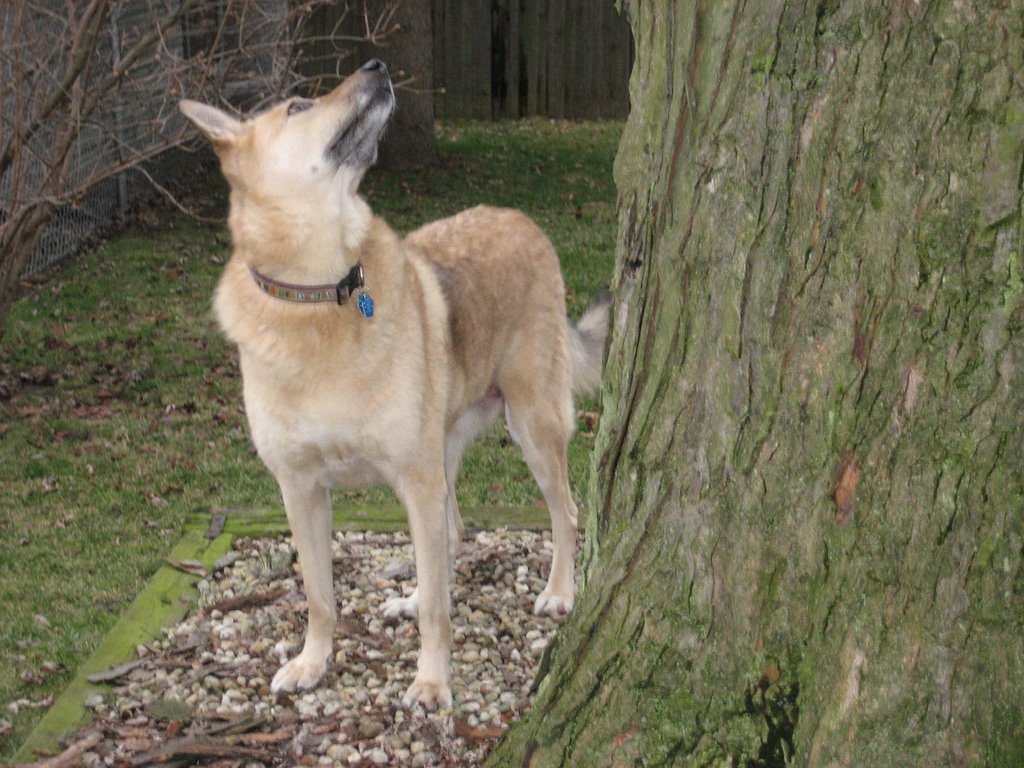
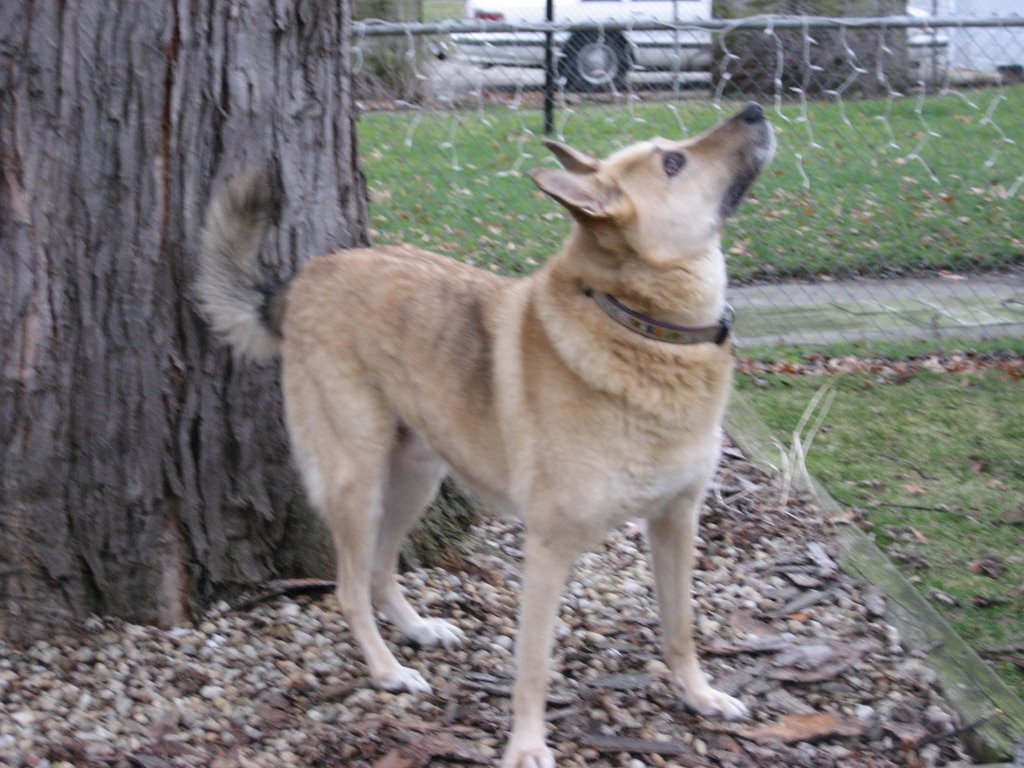
Friday Dog (and Squirrel) Blogging

Wiley, where's the squirrel?! Find the squirrel!


Is it over there...? Nooooo...


Around there? Noooo....


Ooh, maybe up there? Not quite....


Or how about up here? Getting warmer.....

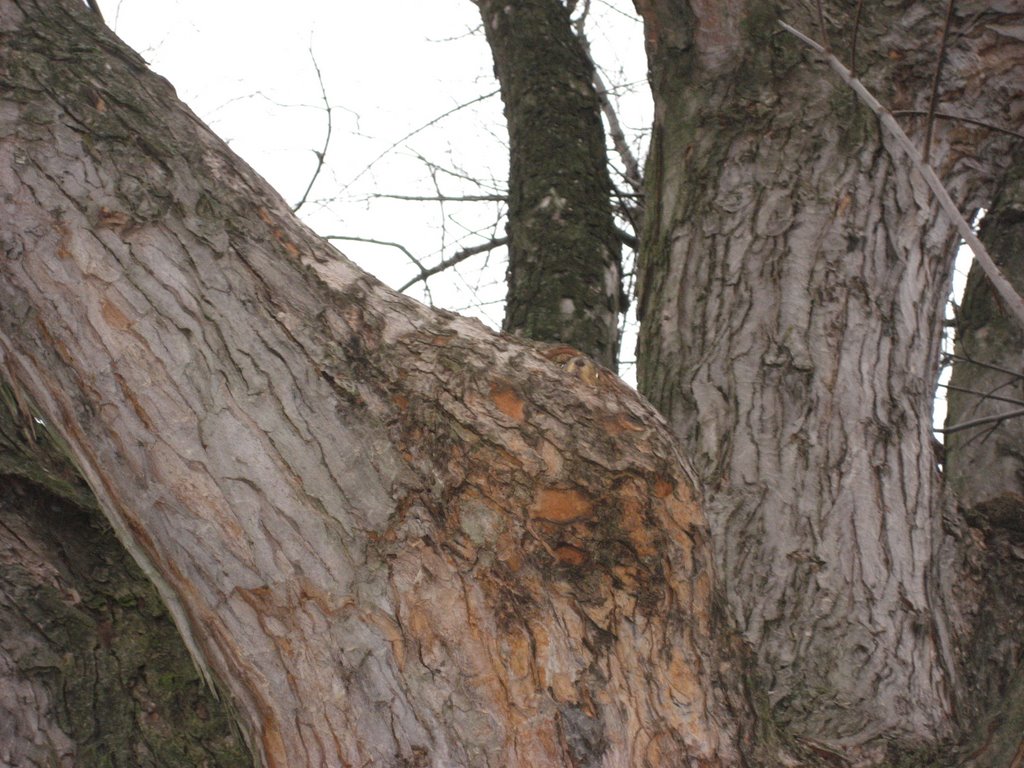
HERE it is...


(Look at the center of the knot in the tree, and you'll see its little head peeking out. Click on the picture and magnify if necessary.)

Monday, January 8, 2007

Look what I'm in for!

(Edited for clarity)

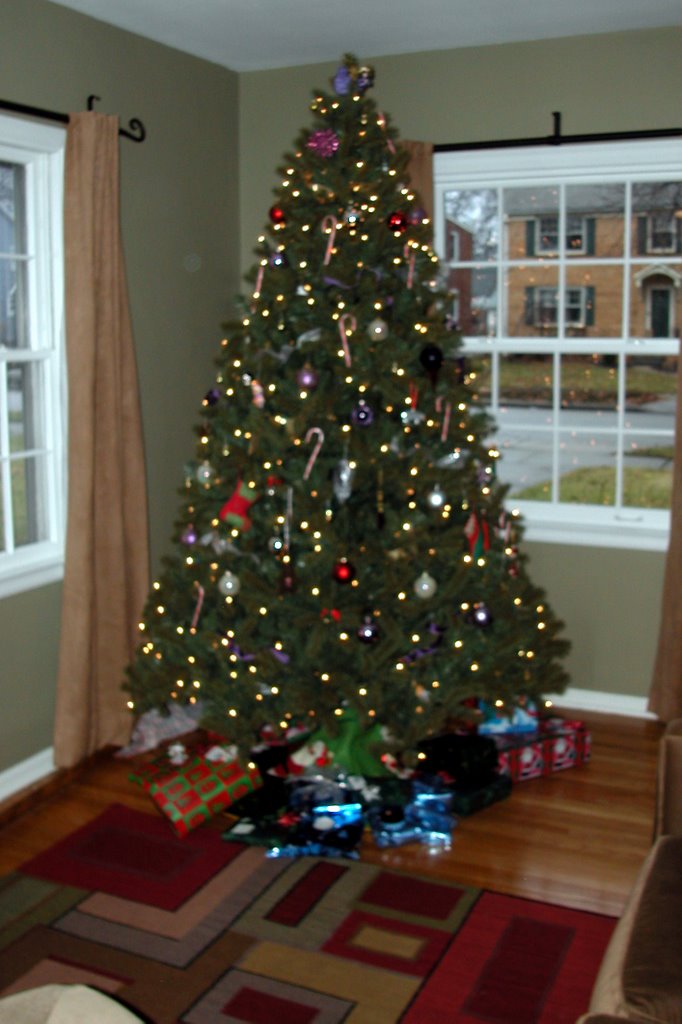
Yesterday I packed up the Christmas ornaments and disassembled the Christmas tree. That must mean today is the beginning of the new semester for Rust Belt U!

As I write, Bullock has started his first class of the day. My first class starts tomorrow -- both of mine are in the exact same time slots as his but on opposite days, weirdly. It's a good thing they don't start until tomorrow, since I'm currently in pj bottoms and a minor league baseball t-shirt over long underwear. Nice!

Anywho, I spent the morning finishing up my review of the editor's comments on chapter 2 of my book. 3 more chapters and the works cited to go before January 25. I was kind of hoping to power through it before the semester began, but clearly that didn't happen. And now I have to plan for the first day of classes tomorrow. The syllabuses are written and copied, but I still have to make some short poetry handouts -- because, yes, I *do* use the whole class on the first day of school! -- and figure out just how much time to spend on various tasks on the first day. Every year I change what I do. In the medieval lit survey, for example, sometimes I ask students what they think of when they hear the word "medieval." Or I put a timeline on the board. Or I just jump right into some lyric poems. In Shakespeare tomorrow, I might talk about Will's life and times, or I might just jump right into a sonnet. In the classroom I'm often as New Historicist as I am in my work, but I'm starting to realize that sometimes students need a little bit of New Criticism first, and I'm trying to build in more close textual work, even when they're reading stuff in translation. So it might be good for me to start there in each of my classes tomorrow and get them to start participating and doing it themselves right away.

But so far, we're just talking about tomorrow. My subject line actually refers to what I'm "in for" for the whole semester. Last semester I had two graduate classes with a total of 25 students (though, keep in mind that that meant about 400 pages of grading at the end of the semester and a greater level of reading and other scholarly preparation on my part). This semester, I have two undergraduate courses with a total of 70 students (35 each). In one class they'll be writing 3 medium-length papers. In another, they'll be writing 6 2-page responses, a short paper, and a research paper with an additional proposal-and-bibliography aspect.

What have I done to myself?!!!!

Oh, and did I mention that I took on an independent study student? Or that I'm training for the Boston Marathon (on a more intense, but less time-consuming-than-usual 3 day/week schedule)? Or that it's admissions season and I'm the Grad Director? Or that Bullock and I will have Wiley with us until April? And then there's the little matter of my book, which I'll be indexing myself as I review the proofs in March (thank the FSM that that's supposed to arrive over Spring Break!).

Woo boy. By K'zoo time in May, those of you who are medievalists should expect to see a very exhausted Dr. V. But at least I won't be giving a paper there this year and can just use it as a well-deserved fun-but-still-professional reward at the end of the term. I'm going to need it!

Wednesday, January 3, 2007

"Student centered" does not mean "At the student's whim"

Just as I was feeling all warm and fuzzy about the impending start of the semester, one bozo does something to put me in a sour mood.

I went to campus today and while checking my mailbox there, the pre-semester stillness of the usually buzzing mailroom offered me the chance to notice a tidy little computer-printed sign that one of my colleagues had affixed to her mailbox, effectively blocking access to the box itself. The sign said something along these lines:

The semester is over. The deadlines have passed.
Don't even think about turning in your paper now.
- Dr. So-and-So

Heh heh. Not something I would have done myself, but I appreciated the tired if sarcastic sentiment of it (especially knowing that the colleague was a composition instructor with a heavy load). But that's not what put me in a sour mood. I then noticed another, smaller sign stapled to the first one, with the following neatly handwritten message in block letters:

ANOTHER
STUDENT CENTERED
PROFESSOR

Oh for crying out loud. Since when does imposing a strict deadline signify that the professor is somehow not "student centered" (and by implication, supposedly only concerned with him/herself)??

Here's what I want to say to that student: I'm sorry, but when the university talks about being "student centered" they don't mean just you. I know, I know, it's in the singular, but it has a kind of allegorical ring to it -- like "Everyman." Just as he is every man, the "student" in "student centered" is every student. There are actually other students here at Rust Belt, and they turn things in on time, finishing their work in the time allotted to them. Should we be less centered on them and more centered on you? Should we, perhaps, forget our own deadline for turning in grades and let you turn in your work at your whim? Yes, that's right, we have deadlines to meet too. In fact, that's often why people create deadlines -- so that the work that has to be done subsequent to your part can get done on time. And when it comes to grading, most of us like to grade work from a single class all in one bunch; that way, if there's a problem or essay question or whatever that's flawed in some way, we see the patterns and cut students some slack. It's also a kind of norming, giving us a sense of what students in a class are capable of. So see, our silly, whimsical, self-centered deadlines really *are* about students. And exactly how do you think this flexible attitude towards deadlines will fly in, say, the world of law, or at the IRS, or commerce, or wherever? Do you think you'll suddenly and magically develop good habits when you leave school? Are we really doing you a service if we let you do work when you feel like it?

Sigh.

You know, what gets me is that so many of our students are totally instrumentalist in choosing majors -- they want something "practical," that will give them "real world" skills -- and yet so many (often the same ones) miss some of the most fundamental "practical" lessons that college is supposed to teach you or at least give you time to perfect: time management, responsibility, independence, and self-motivation. I could be teaching you the most bizarre, esoteric, obscure subject (and some might argue that I do!) and my class would still be giving you a pretty low-stakes way to hone those skills. And I'm sure my colleague's class is the same.

I don't often rant on this blog, but that little added note rubbed me the wrong way. I mean, if it had said, "The sarcarsm isn't necessary," I might have even agreed with it! But the writer had to go and act like the unthinkable imposition of a freakin' deadline was somehow a blow against all studentdom.

Please.


Tuesday, January 2, 2007

Happy New Year!

The Virago is back. (And so are Bullock and Wiley, of course.)

Classes start next week, I'm in the midst of reviewing the editorial changes on my book manuscript (it's actually fun! yes, I am a geek!), and I was even on campus today. Break? What break? And I didn't even have to squeeze in MLA (though I can't wait to read everyone else's tales -- I feel like I missed out). I'll get back to substative blogging shortly, but in the meantime, I leave you with a couple of pictures of how Youngest Niece spent her entire Christmas break: playing her new Wii. The back of her head is pretty much all the rest of us saw, too.


Friday, December 22, 2006

Happy Holidays from our home to yours

[Edited for typos. Nothing new to read here.]

Bullock and I are leaving for various home towns tomorrow and won't be back until the new year. I may be able to do some blogging from Cowtown, but I may not, so I wanted to wish you all a very happy holiday season with this virtual Christmas card. That's our brand new authentic fake tree -- plenty of room to start collecting beautiful ornaments (gift hint to relatives for future reference)! Note the candy canes used as filler and the rather bare bottom branches. Alas, all the pictures came out blurry -- I think the battery's low or the light was just too low -- but this is the least fuzzy of them. (Oh, and by the way, the fabulously perfect paint job on the walls, windows, and ceiling was all done by Bullock himself. He is truly multi-talented.)

And below, for Friday Poetry Blogging, I give you the Coventry Carol (with modern spelling).

May you have a very happy holiday season -- MLA and AHA included! -- and a splendid new year!

All our best,
Dr. Virago and Bullock


The Coventry Carol

Lullay, Thou little tiny Child,
By, by, lully, lullay.
Lullay, Thou little tiny Child.
By, by, lully, lullay.

O sisters, too, how may we do,
For to preserve this day;
This poor Youngling for whom we sing,
By, by, lully, lullay.

Herod the King, in his raging,
Charged he hath this day;
His men of might, in his own sight,
All children young, to slay.

Then woe is me, poor Child, for Thee,
And ever mourn and say;
For Thy parting, nor say nor sing,
By, by, lully, lullay.

Thursday, December 21, 2006

MA thesis or exam? Or both? Or none of the above?

OK, here's a follow-up post to the previous one on our MA exam reading list. We don't do a formal thesis; instead, we have the exam and a "master's paper." While currently the official language doesn't compare it to a journal article, we're currently discussing making it more rigorous in some way or another, and I think a "potentially publishable" work of about 30 pages is a way we should go.

But I don't think we should go back to the old MA thesis. First, I think the 60-100 page document has no connection to what we do as scholars -- it's too long for an article and too short for a book. Second, our students (meaning the university's -- I'm drawing on what I know of the other MA programs) tend either not to finish or to drag out their time to degree when there's a thesis, and I don't want to contribute to the ever-lengthening time to the Ph.D. for students in the humanities. A stand-alone MA should be no longer than two years so the students can move on to whatever comes next. Besides, we can't fund them longer than that, anyway, and I'm also looking to reduce the number of unfunded semesters students tack on.

That said, the discussion list for directors of grad programs has lately gotten into this discussion, and I've seen some passionate arguments for the thesis. They fall roughly into two groups: 1) those who report that their students who go on to PhDs find that having already worked on a sustained piece of research and writing helps them with the dissertation; and 2) those who argue that a student will remember his or her thesis years later, but not what s/he wrote or said in an exam. The first argument moves me more than the second, but I wonder if the same can be said of a "potentially publishable work," since something like that takes sustained research and writing, even though shorter.

I also think something like that combined with some kind of exam that demonstrates more breadth -- though I'm still not sure what that would look like -- gets at the heart of the MA experience, which I think should give you the sense of the discipline and allow you the opportunity to show your "mastery" of its discourse and knowledge. (And I'm really starting to think that George Justice's description of a portfolio exam/capstone in the comments in the post below might be the best possible combination of all of the above. Thanks, George! And welcome to the blogosphere.)

What do y'all think?

Tuesday, December 19, 2006

Reading with my students

So I'm in grading jail, and what I'm grading at the moment are essays on the state of scholarship in the last 15 years on selected texts from our MA exam. And while I can assess the effectiveness of these essays pretty well without myself knowing the criticism of, say, Louise Erdrich's Tracks (it's all about the student convincing me s/he knows it), I realized that there are a number of texts on our MA exam that I either haven't read at all, or have only read excerpts of, or that I haven't read since I was an undergraduate. And yet, when it's my turn to write an exam, I'm supposed to write questions with these texts in mind. Hm. Maybe I should read them! Ya think?

So, I'm going to make a resolution -- not exactly a New Year's resolution -- to have read all the works on the MA exam list by the time the current 1st year class is graduated in 2008. Below is our rather odd list (seriously, isn't it bizarre?!), dominated by the 19th century and doing poor service to everything from the Middle Ages to the 18th century. (We're currently in discussions about that, but I've got a very stubborn colleague on the grad committee who thinks the list should be *shorter* and should just be a kind of exercise in "practical criticism" to show they can read a few things deeply. In that case, why not just give them random passages on the exam -- like the actual Practical Criticism Tripos exam at Cambridge -- and forget the list? Honestly, I have no idea what this list is suppose to be or do.)

Anyway, I've crossed off the texts I've read recently and know well. What's left is what I think I need to read or reread (so this isn't exactly a game of humiliation -- I have read Paradise Lost, for instance, but not since I was an undergrad).

Chaucer, Canterbury Tales
Shakespeare, King Lear
Shakespeare, Hamlet
John Donne, Poems

Milton, Paradise Lost
Swift, Gulliver's Travels
Pope, Poems
Austen, Pride and Prejudice
Shelley, Frankenstein

Wordsworth, Poems
Keats, Poems
Brontë, Jane Eyre
Dickens, Great Expectations
Tennyson, Poems
Conrad, Heart of Darkness
Yeats, Poems

Joyce, Dubliners
Woolf, Mrs. Dalloway
Franklin, Autobiography
Douglass, Narrative of the Life of Frederick Douglass, An American Slave: Written by Himself
Melville, Moby-Dick
Thoreau, Walden
Dickinson, Poems
Whitman, Poems
James, Portrait of a Lady
Eliot, Poems
Williams, Poems

Faulkner, The Sound and the Fury
Ellison, Invisible Man
O'Neill, Long Day's Journey Into Night
Rich, Poems
Morrison, Beloved
Erdrich, Tracks

And for discussion purposes: what do you think of this list? How would you change it if you could and why?