I've got a Nano! I've got a Nano!
Boyfriend bought me a 4G Nano for my birthday!! Woo-hoo! Now I feel guilty because he spent too much money. (Now, he says, I can no longer urge him to buy more clothes, because he has spent all his "pants money" on the Nano.) But I'm also excited to install iTunes and start filling it with music. I gotta start ripping more of my CDs to my computer, too, so I can be like all the cool kids in the blogosphere and do the Friday Random 10 thing (since I seem not to be inspired enough to do poetry Fridays -- I keep worrying I'll post something obvious -- and I don't have a cat). And then y'all can see just how much my music collection and Scrivener's overlap. (OK, we're not exactly alike in our taste, but there's a lot of similarity, and everytime he mentions something I don't know, I check it out and like it. Go figure.)
And speaking of music, Virgo Sis bought me two really interesting looking cultural studies books on rock: Simon Reynolds and Joy Press, The Sex Revolts: Gender Rebellion, and Rock 'n' Roll (Harvard UP), and Simon Reynolds, Rip It Up and Start Again: Postpunk 1978-1984 (Penguin). (She also bought me a cute sweater, but it doesn't quite fit, so I have to exchange it. But I thought you all would be less interested in a sweater than books.)
And my friend The Empress, who always sends me a box full of little goodies, many humorous, did so again this year. It included, among other things, a CD by a band called Beowülf (what is with heavy metal bands and the abuse of the umlaut -- at least this one is on a vowel!), a nailpolish in a color called "Cabana Boy," and one of those ubiquitous plastic bracelets, only this one is dark purple and says "IRONY." I must wear it. Ironically, of course. Oh, and one of the oddest items was an animal-shaped lemon reamer in translucent yellow plastic that looked suspiciously like a sex toy -- for those with an addiction to food porn, I suppose. ;)
Meanwhile, as I said in my comment in the last post, The Boyfriend and I spent my birthday around the countryside in Neighboring State to look at the area where we're fantasizing we could buy some land. It's still a real possibility, but we discovered that some of the [Ethnic Immigrant] Hills area is seriously ticky-tacky -- plastic dinosaur parks, waterslides, fake Old West towns (huh?!), and cheesy references to the Ethnic Immigrants after which the area is named. If you've been to the Wisconsin Dells, it's a bit like that on a smaller scale (though there was a eerily familiar giant Paul Bunyan statue).
And while we were doing all this, I started to come down with the sore throat and cold Boyfriend's had for a week. Boo! I'm not supposed to get sick on my birthday! I'm not supposed to get sick at all -- I don't get sick! Boo!
But I discovered that a cocktail hour screwdriver made my throat feel good enough for a nice steak dinner that night. So now you know -- throat hurts too much to swallow? Have a screwdriver! You get the Vitamin C in the OJ, the antiseptic qualities of the vodka, and the numbing effects of the ice.
OK, gotta load iTunes and start playing with my Nano!!!!!
Sunday, March 26, 2006
Nano nano naaaaaaano!


Saturday, March 25, 2006
Happy Birthday
They say it's your birthday* -- well it's my birthday, too, yeah!
Oh hell, I'm in my late 30s. How did *that* happen?
Still in the same running age group, though, so that's something.
Oh, and only 9 months until Christmas. Start your shopping now!
*You = Elton John and Gloria Steinem, among others.
Friday, March 24, 2006
Geoffrey Chaucer hath a blog...AND T-SHIRTS!
I know many of you are already fans of that Middle English blogger extraordinaire, Geoffrey Chaucer. Well now you can show your admiration in the form of a t-shirt. Dammit, how do I choose between a t-shirt that says "I wolde I knewe how of thee I might be quitten" and one that says "Okaye, sometymes it raineth in March: make notte a chauncerye case of the whole mattere"?!
Oh, and he's thinking of moving to the real blogosphere. Yay! Update: The new URL is here.
Thursday, March 23, 2006
Hear ye, Hear ye: First Annual K'zoo Medievalist Bloggers' Guild Meeting
If you get a sense of deja-vu all over again when you read the following, it's because much of the following is posted over at Ancrene Wiseass.
Ancrene Wiseass and I are beginning to plan the First Annual Kalamazoo Bloggers' Guild Meeting (AW's name -- I promise not to make you pay half of your money to fund a Corpus Christi play). But we're running into some logistic difficulties and would like your input on several matters. To wit:
1. If you're thinking of coming, please let us know in the comments thread below. If you're thinking of bringing a friend, colleague, significant other, familiar, or minion, please let us know that as well. We'd like to get a sense of how large the gathering will be.
2. We've been told that it would be best to meet early in the conference so's we can keep meeting and greeting over the weekend. This means we should probably aim to converge on either Thursday or Friday evening. Which night would you prefer, and what time frame would be best?
3. The location of our guild-hall has yet to be determined, and we'd very much appreciate your suggestions. The shelter in the park near the pond is one possibility, but we'd have to cross our fingers and hope for good weather. Any other nominations?
Also, New Kid suggested in the comments at AW's place that we e-mail photos to each other beforehand once we know who all is coming. Duh! Why didn't I think of that? She also suggested meeting in either Bernhard (the conference center/computer center/food court place -- did I get the name right?) or the Valley lobby that's farthest away from registration, the book exhibit, and the cafeteria -- which would be the lobby in the back of the one farthest up the hill. (Wiseass, btw, hasn't yet been to K'zoo, but I have; so I'm more likely to know what you're talking about if you say "the business building where the movies are" or "that dive bar near campus with the leather and wood decor" or something like that.) What say ye?
Monday, March 20, 2006
Gout -- not just for DWEMs anymore
So get this: Mr. Noisy Downstairs Neighbor has gout.
No, really! He told me so himself.
I didn't know people still got that! I thought you had to be Henry VIII or John Milton to get gout, not a hip-hop loving, slow-talking, big-walking, child-indulging, pot-smoking, 30-something duuuuude in 21st century Rust Belt Historic District. (Then again, you should see the copious amounts of beer bottles in the recycling bin each week. Perhaps that has something to do with it.)
Part of me wants to say: sweet, sweet, poetic justice! But that would be mean. And besides, dangit all, it just makes him noisier because now he's on crutches!
City mouse? Or country mouse?
I am a very adaptable person. I love big, fabulous* cities with city excitement and city dining and city nightlife. And I love fast public transportation, especially if it goes underground. But I also really like the country and wildlife. And even though I'm not fond of suburbs conceptually, there are some that aren't so bad -- like the one I grew up in, for example, where you can still walk to the grocery store because my parents' house happens to be very close to it, and where you can hop on a running/biking trail that runs parallel to a long creek through the area, and through some parks and golf courses, where you can see blue heron and deer and those sorts of critters. I don't know that I'd like to be way, way, way out in the country, hours from the nearest city, though. One of my favorite spots in the world is my friend E's mother's house, on top of a ridge in Yorkshire, with fabulous views in every direction, and where's there nothing else but her neighbor in their semi-detached, a farm, a set of row houses, and a pub, but it's just about a mile up the road from the train into Leeds if you need to get out.
Anyway, the reason I bring all this up is to say that some of the nice things about living in these here parts are that a) the cost of living is low, and b) you don't have to go far from the city to get country or from the country to get city. So the Boyfriend and I have been daydreaming about buying pretty, countryside, wooded land on which someday to build a weekend house, one that's close enough to nearby Cool College Town for a good dinner out and access to the Whole Foods, should we want it, and also not so far from Rust Belt that we wouldn't use it enough or friends wouldn't want to come up.
Because we've been talking about this, on the last two weekends, when I've been on my way back from conferences and reading groups in said Cool College Town with my academically tonier friends at the R1 university, I've been driving around prospective areas. Along the way -- and also with the advice of Smartass Poet (who, while having a penchant for teasing the department medievalist -- and really, is there anyone who *doesn't* tease the medievalist, dammit? -- is actually a good guy) -- I discovered an area called [Immigrant Ethnicity from a Green Country] Hills, full of rolling hills, woods, and lakes. It's simply gorgeous. And with the help of the magic of the internets, I also found a realtor with a perfectly cheesy name based on a particularly evocative name of a town in said green country. The Boyfriend wondered if maybe we'd get a discount in such places, on account of my name very obviously belonging to said ethnicity. Sigh, if only.
My name did get me out of a moving violation ticket once, however, but that's another story.
So anyway, some of you may find this surprising and amusing, but the other night at dinner with the Boyfriend, Smartass Poet and spouse, and Victoria and spouse, I actually found myself agreeing with Smartass Poet that raising goats sounded kind of fun. No, really! And when I went on the realtor's site and found a 40 acre deer farm, I thought, "Oh, if only we could afford 40 acres! That would be so cool!"
That's right, I'm having visions of my life story as "Dr. Virago, Farmer Woman." Or how about "Professor by Day, Goat Herder by Night." Or perhaps the Boyfriend and I would make a good remake of "Green Acres." Omigod, if we *do* ever end up getting such a place, we *have* to call it Green Acres. (Hear that, honey?) [Update: Ha! Apparently the Boyfriend's grandparents' farm was once known as Green Acres. That does it. Whatever land we buy will definitely be called Green Acres now!]
OK, I'm getting silly now. There's not going to be any real working farm involved, for pete's sake. It's way past my bedtime, though, and I get giddy when I get tired.
*Speaking of fabulous, and totally off-topic, can I just say how excited I am to be on Michael Bérubé's blogroll under "Fabulous Ones (Comrades and Unclassifiables)." That's fabulous as in mythical, but then isn't that what a virago is? But the question is, am I a comrade or unclassifiable? Well, I've only met him once and according to this, I must be the latter: And (this last question bedevils all of us literature professors) what was I to do with those damned medievalists? Especially the ones whose blogs are full of thorns? But being unclassifiable also suits this virago. Being bedeviling: priceless. (Hm, though to be properly medieval, I need to get thornier! At least there are a few in my blogroll.)
Friday, March 17, 2006
L'esprit d'escalier -- and also a request for advice
Hi everyone (if you're still out there). I thought maybe I'd test the waters of blogging a little bit again -- maybe a couple of times of week. The impetus at this moment comes from the fact that I'm in my office after 5pm on a Friday, no one else is around, and I just thought of something kind of funny that I should have said at our faculty meeting today, but didn't, and now there's no one to tell it to. So, I thought, "I know! I'll tell the blogosphere!" It's not really funny (so don't get your hopes up) but I did literally think of it on a stairway, and actually, there's something serious worth talking about in the context (which I'll do below). Also below are questions to all you in English literature.
So at our meeting today, we were discussing this nice big bequest our department has received from a former faculty member who passed away recently. There are restrictions, of course -- the main one being that the money has to go to students. So we're setting up scholarships and writing prizes and travel funds and the like. In discussing the travel funds, one of my colleagues said we has to put some kind of limits on it so that we wouldn't be overwhelmed by the applications of students going to "non-competitive" conferences where they accepted everybody. (I'm making him sound much snobbier than I think he actually meant to be. I think his real concern was how to keep the fund alive and not drain it by giving it away too easily. But still...) As other colleagues, usually of the older persuasion, concurred with this gentlemen that some conferences were better than others and therefore more deserving of funding, "Victoria" offered the suggestion that the applications would have to include a narrative in which students assessed the value of this particular conference to them and their education and professionalization. (I heart Victoria.) I concurred and said that, for instance, the biggest conference in my field, the "Zoo," was created precisely to be open to all scholars at every level, now including undergrads (vs. the more "competitive" conference which was, at that time, open only to full professors), and was relatively easy to get into, but that for a budding medievalist, it would be an invaluable experience.
That's when Smartass Poet said something disparaging about medievalists and their boring conferences, to which I responded. "Hey! We've got dance, mister!"
To which he responded, "Oh, what do you do dance to? Madrigals and motets? And do you dance in rounds and carols?"
I said something lame about there being plenty of the white man's overbite, which would make Smartass Poet feel right at home. (Yes, our meetings sometimes are like a dinner table full of teenagers.)
But what I should have said is this: "Hey man, we party like it's 999."
**Groan!**
OK, maybe I shouldn't have. And I told you it wasn't that funny.
Now here's the serious part. What was up with the colleagues who thought our poor, hapless MA students should only get funding when they go to a "competitive" or "peer-reviewed" conference? Our students would benefit just from attending a conference, any conference, let alone giving a paper at one. They need to hear other models of presentation and thought and interaction, to understand that they should think of themselves as participating in a scholarly conversation. Most of them are so unaware of scholarly expectations and conventions -- despite the models we give them ourselves and in the scholarship they read -- that they're not likely to get in a really competitive conference. Starting on a smaller scale is exactly what they need. And they also need to see other graduate students in action, to see that what we expect of them actually is possible at the graduate level. (Some of our students are under the impression that we expect too much of them -- like coming to a seminar with something to say, for instance.) Many of them don't even try to go to conferences because of the expense -- because until now we didn't have funding -- so just getting them to apply and go to conferences is enough of a goal, I think. And I have a feeling some of them don't even know about the existance of conferences or what's done at them, so maybe the advertisement of money to go to one might make them more curious. the last thing we need to do is put stringent limits on such an encouragement.
As you can gather, I think some of our MA students are a little, well, clueless. It's partly our own fault, I think but also partly the nature of our program and who it attracts. We have only an MA program (once upon a time we had a Ph.D. program and I think it's very good that we don't anymore) and its population has diverse educational needs. A number of them are local high school teachers and they are some of best students, as well as the population best served by our program, I think. Amazingly, they are also the least likely to complain about the workload, despite doing this on top of fulltime jobs! Others have started off in other disciplines at the BA level and then realize they really should have been English majors and want to follow that dream after all, and they're also some of our really bright students. Then there are the ones who are still trying to figure out what they want to do, and they're the most mixed bag. Some are talented slackers. Some are just slackers. Some are just plain odd.
Anyway, I can't really change the nature of the pool of students who come into the program, but next year I'm taking over the "Methods of Literary Research" course from a senior colleague who is retiring. I have big dreams of whipping our MA students into shape, of making them realize that they are junior members of a profession, even if their two-year stay in our program is just a layover on a journey elsewhere. Of course, I'm sure that the class will rudely burst all my idealistic bubbles once Fall semester rolls around, but between now and then I can dream.
Right now the shape of the class as I imagine it is partly a course in basic research methods for literature, with visits and talks by my colleagues on their various field-specific resources and hot topics, but also a meta-discussion about what it means to be a part of a scholarly conversation and how to enter into it. I think I will also address some issues of professionalization (how to write a CV and that sort of thing). My retiring colleague currently has them do an annotated bibliography as their final project, but I think I'll modify or add to that somewhat and ask them to assess and describe the state of the scholarship of a work of their choice -- that is, where have the liveliest threads of discussion been, where are they now, where are they going?
But here's my questions to you all:
1) If you've taught or taken such a course, is there a good, recent, introductory book about the broad trends and directions in literary studies today? Or one written to graduate students about making themselves part of the scholarly conversation? Book orders are due soon! Help!
2) If you were a first-year graduate student again (or are now) and feeling overwhelmed and clueless, what would you like such a course to teach you, either in terms of how to do research or what's expected of you as a junior member of the profession?
Thanks everyone!
Friday, February 17, 2006
We interrupt this hiatus...
…to say that next year there should definitely be more time for blogging because I’ll be teaching a 2/2 load. Woo-hoo! But it’s not just the load I’m excited about, although that is a reason to cheer, and not just because it means more time for research. I’m a better teacher when I teach 2; I’m always exhausted, hungry, and frequently unclear in one class when I’m teaching 3. What I’m also excited about is the reason for the course load reduction: I’m going to be one of our two undergraduate advisors starting next year. The other one is also an assistant professor, and I think we’re both hoping to get a better sense of our program as a whole and make it clearer and more coherent for the students. Let’s hear it for new blood, idealism, and energy! I’m planning on announcing these personnel changes to my students now and urging them to see an advisor regularly through their studies – at least once a year – so the advisor can help them design the best major for their particular needs and goals (whether it’s secondary education, post-graduate studies, career plans, or whatever). Our students aren’t required to see an advisor until they need to get ready for graduation, and that’s just wrong.
Anyway, I’m hoping to blog a LOT about all of this next year, but I also hope to return to regularly scheduled blogging long before then, as well.
Sunday, February 12, 2006
As ProfGrrrrl would say: High. Eight. Us.
Hey folks.
As many of you know, lately I've been having some serious time-management issues. And I feel like a schmuck about it, since I'm only teaching 3 classes instead of the 4 that I know many of you are teaching. (I could list the other professional responsibilites I have, but then I'd sound like an even bigger jerk and the world's smallest violin would start playing for me.) But last semester's leave (on the heels of teaching-free summer, as well) got me out of the teaching habit pretty quickly, and I'm only now just getting into the swing of things 1/3 of the way into the semester. But other things are still suffering, including but not limited to: running, communication with my family (other than quips traded with the sibs on this here blog), e-mail correspondence with friends, the cleanliness of my house, my leisure reading (what's that?!), my diet (as in the "well-balanced" kind, not as in the "losing weight" kind), and other personal life-related things like that, not to mention keeping up with my corner of the profession (I can't remember the last time I read an article or a book review that wasn't directly related to what I've been working on). And I've also neglected the relationships -- social and personal -- that I have with my colleagues and friends here in Rust Belt City. I've actually been either pretty damn distant or downright crabby with a number of colleagues lately because of the stress and anxiety I've felt, and I've got to do something about that for professional and personal reasons. Dr. Crabby is not the person I want to be.
I think my biggest problem is too much on my plate and not enough time away from the desk and the computer. So I think I have to take a break from blogging for awhile, which includes reading blogs as well as writing this one, I'm afraid. (Certainly writing this one has not taken all that much time lately, given that I haven't done a weighty post in about a month, but when I do write something more substantial it takes me forever to write a damn post!) I really enjoy the little world created by blogging -- especially among the academic blogs -- and I've gotten so much out of the conversations and memes and cross-pollination that happens here in Academiblogistan. I hope to come back to it and renew those connections and conversations, but for now I need to see to the care and feeding of my little world here in the Rust Belt and the things I was hired to do at Rust Belt U.
This isn't farewell forever, and for all I know I may be back in a month or less. Or maybe I won't be back until summer. I don't really know at this point. In the meantime, if you want to drop me a line, the e-mail is now drvirago [at] sbcglobal [dot] net (replace the appropriate symbols and punctuation, of course). Ancrene Wiseass and I were talking about a medieval blogger meet-up at the Big Conference, and I hope I'll still be invited even if I haven't blogged between now and then! Or if any of the other regulars here know (or think they know!) where I am and happen to be in the area and want to meet up, let me know. And those of you who subscribe on Bloglines, keep me subscribed so you'll know when I start up again.
I feel a little like I'm letting people down since I just started to build a regular audience (including whoever does the "Around the Web" thing at InsiderHigherEd), but then I also figure y'all have lives to lead and too many blogs to read as it is! :) So consider this a Valentine's Day present: one less verbose blog to read!
And now I should sign off with something pithy and original, but I'm all tapped out, so I'll be unoriginal instead. As they used to say on the radio, when they still played records: See you on the flip side!
Dr. V
Friday, February 10, 2006
Fun fact four (in a series of 100)
Dr. Virago has not had her hair cut since November 11, 2004.
Yes, that's right, I said 2004. Yes, I know it's now 2006. No, that's not a typo.
I hate new hairdressers. I've had too many "haircuts from hell" from new hairdressers. One time some idiot thinned my thick, curly hair and tried to give me a shag. So I take a *lot* of time choosing a new hairdrresser carefully. It took me a year and a half to find a good one in Sprawling Big City, and I stayed with him the entire time I lived there, even after I moved half way across the city from his place. His name was (and still is) Frank and he's a genius with my hair. So I gave him 9 years of loyalty. (Plus my good stories about celebrities. He loved those. Also, my dating horror stories. He loved those, too.) In return, he gave me a 'student discount,' even after I got my Ph.D. and was lecturing. The last time I got my hair cut (yes, Nov. 11, 2004) I happened to be in Sprawling Big City for a wedding and so went back to Frank. I think I may finally bite the bullet and get it cut here, though, because it's pretty darn dried out on the ends and the long hair thing doesn't work on me. There's too damn much of it, it's annoying, and shorter cuts are more flattering with my small features, which can get overwhelmed by all that damn hair. I saw a woman in a local coffee shop recently who had hair like mine in texture and curl and thickness and she had a *very* cute, short cut. I got her hairdresser's name, and it turns out he's close by and affordable. I just have to make the time for an appointment now.
Here's a not-very-good picture of my hair not long before that cut in 2004, a little shorter than it is now (by about 3 inches), but equally in need of a cut at the time (note the scraggly ends):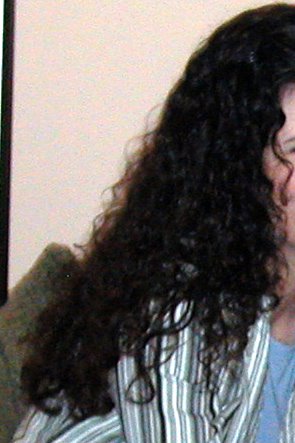
A rug pulls my whole day together
Yesterday was a good day. And it was all because of a rug.
The day started when I walked out my door at 8:30 am to find the new rug I'd ordered from Pier 1 had arrived. When had it done so? Was my doorbell not working again? Good thing it was not stolen from my very open-to-view front stoop, as seen here:
The luck I had in it not getting stolen was a good omen. Then I brought the rug to school, as I'd ordered it for my office, which has very ugly, old, stained, mustard-yellow carpet. I've done all sorts of things to work with the mustard color and also distract from it, first having the walls painted two shades of tealish blue, which also helps make my 7'x7' office look bigger. Here's a picture of the wall colors, with the ugly carpet: In the picture the walls colors look more true-blue than they are. They're really a teal-ish blue. And the carpet looks less mustardy that it is. Trust me -- it looks just like traditional mustard. And you can also see a glimpse of the 'chocolate kiss' door jamb. I couldn't do anything about the black foot guard thingy, unfortunately, though at least it matches the black in the casement windows.
And then I added a wicker chair and a multi-colored pillow that picks up on a lot of the colors I'm throwing together (also Pier 1 budget buys). It's really the pillow that pulls the whole room together, but the post title is a Big Lebowski reference, of course. Anyway, here's a bit of the chair and pillow, along with a throw that I bought on the Isle of Man at the Laxey Woolen Mills (founded by Ruskin and still in operation and, more amazing still, not an overpriced tourist trap!):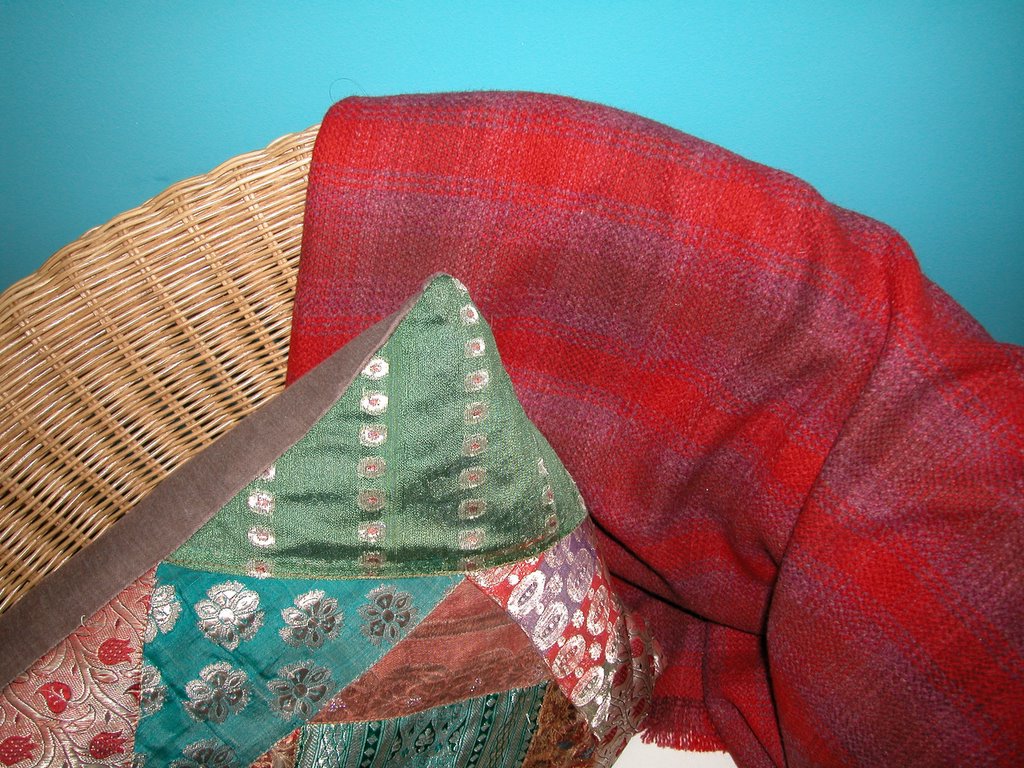
And I also added curtains of a bronzey-sagey color, with which the rug coordinates beautifully. Here are the curtains (again the colors aren't quite true to life): Not pictured anywhere here is the small, white-washed computer desk that I bought to replace the gargantuan oak number that really took up half of my miniscule office. I bought that at Pier 1 as well. I *heart* Pier 1. But it's the rug that really makes the room. It covers the stains, warms the place up, and makes sense of all the other colors. I love it and it made an aesthetically pleasing start to my day. (Now all I have to do is get some pictures on the walls.)
Then everything else fell into place. First, teaching...Finally, at the end of the 5th week of classes, 1/3 through the semester, all three of my classes went well and I felt my old teaching self. There were a couple of technical snafus, but even they couldn't bring me down. For instance, I couldn't figure out how to get the visual part to work with the VCR in the high-tech, multi-media projection system in my first class, so I couldn't show my Schoolhouse Rock: Grammar Rock video, but we did listen to some of it. (Yes, you read that right. I was trying to show Schoolhouse Rock in a college class. It's Old English and in the 5th week some of them still don't understand what the parts of speech are or what "phrases" and "clauses" and "conjunctions" are, and that's essential. I thought a few catchy jingles might make it stick.) And then in the literature class, the department laptop I'd borrowed didn't have the password written on it anywhere (as they usually do) so the chair had to get me another one and I started class a little thrown off and rushed through the presentation of the Bayeux Tapestry, digital edition. But aside from all that, students were in a good mood, they were talkative, I was confident and myself, and I felt like each class had accomplished something.
And so I ended my last class feeling invigorated instead of exhausted, and thus headed to the gym with plenty of energy for a 5-mile run. And that, too, went well. I picked up the pace each mile and did a fast finish. Excellent.
Isn't it amazing how a good teaching day can make other parts of one's life go well? And really, I owe it all to that rug. Never underestimate the power of aesthetic pleasure. :)
The blogfriend meme
If there is someone on your blogroll who makes your world a better place just because that person exists and who you would not have met (in real life or not) without the internet, then post this same sentence on your blog.
As copied from Another Damned Medievalist.
And no, you don't name who that blogger or those bloggers might be (even if it's all of them) so that way no one feels left out.
Thursday, February 9, 2006
Standardized testing for colleges
News that Margaret Spellings' ominous-sounding Commission on the Future of Higher Education has been advocating nationalized, standardized testing for higher education (not to get in, but to assess what a student got out of it) has been reported a bit already, and assessment has been a movement and problem at the accredidation level for some time, but now the NYT is covering it, so now it must be important, you know.
Anyway, there's no way I have the time and energy right now to cover all that is mind-boggling wrong with this push, so I will limit myself to two points which I think are key, and which should be addressed and thought about long before any of the other wrong-headed problems with any of this.
1) If a college student -- an independent adult living away from home with myriad distractions and responsibilities outside of school, and the onus of time management and study completely on his/her shoulders -- fails to learn, is that necessarily a reflection of the quality of the teaching?
2) If the Secretary of Education and her commission members want to test every graduating college student in the nation in the areas of critical thinking, writing, and problem solving, I say: Be my guest. Of course, you'll be grading it all, right Margaret?
Tuesday, February 7, 2006
When gender doesn't mean gender
The small groups in my literature class were discussing Old English 'elegies,' and I asked them to think about the different uses of space and geography in three poems. As I was going around from group to group, the train of conversation in one group inspired me to ask them, "Are the spaces in these poems gendered?" (Two poems have women speakers in fairly circumscribed spaces, seemingly put there by others; the other presents a male speaker exiled, it seems, at sea and by indirect circumstances. I thought it was a no-brainer.) I had the following odd conversation with a student as a result (note, I'm paraphrasing both of us):
Student: Well, it's not gendered, really. Just different things happen to the women characters.
Me: How is that not gendered, then.
Student: It's not because they're women. They just happen to be women. And they're in different spaces. [This, by the way, could be a fair enough argument, but I wanted to push her to defend it. Thus, my next questions....]
Me: So isn't that gendered? Why is that different things happen to the women characters than to the male speaker?
Student: Well, because women just happen to be the people who were raped and pillaged in this poetry.*
Me: Um. And how is that not gendered????
Lucky for me, the student next to her was rolling her eyes and trying to get a word in edgewise, so I said, "Why don't I let someone else take it from here?"
*Note: actually, no one is raped and pillaged in these poems, but I decided that wasn't the salient issue at this point.
To run or not to run
I should go run. I have my running clothes with me here at school, I have a membership to the rec center, and I'm not utterly exhausted from teaching. So what's stopping me? Inertia. Can't. Seem. To. Move. Plus, there's a mess on my desk here at school and I'd rather spend some time sorting that. And I also have way-overdue library books to return, and I need to do that. By the time I do all of that, it will be kind of late, and I don't want to get home really late and end up eating dinner at 9 or something. Ugh. From now on, I must not let myself sit down after class ends at 5:25!!!!
Monday, February 6, 2006
Getting my act together
I think I'm finally getting my work habits and my schedule all straightened out.
OK, it's now close to midnight and I started my day at 9am and only took off time to a) watch Medium and b) go to Pilates class, so this hasn't been the best day ever. I still need to work on not letting the teaching prep expand to the length of the waking time left in the day. However, today I did accomplish the following things:
- First things first, I worked on my research for two hours and wrote a single-spaced draft of a page for a short work-in-progress that I have to get in readable shape by Feb. 24. It's only going to a reading group at that point, so it doesn't have to be perfect or polished, and in fact is best if it's not. So I can get it done by then if I keep up this pace.
- Then I spent the rest of the day prepping for my three classes, answering a few e-mails, and only occassionally goofing off online. Two classes are ready to go tomorrow. One is about 2/3 of the way there, and I have tomorrow morning to finish it off, plus take care of other work-related things.
- I also ate green veggies with my dinner. I'm bad at this -- or at least cooking them for myself -- so I feel like I have to acknowledge to the world that I accomplished it today. :)
- And like I said, I also went to Pilates and watch Medium, with which I'm bizarrely obsessed. (I like the Mulder-Scully relationship of Allison and Joe. And I like the naturalism of the relationship in the midst of paranormal story line.)
- And hey, I'm blogging!
And now to bed.
Friday, February 3, 2006
Oh the services this blog provides!
I am frequently amused by the search strings that bring people here. Some of them make complete sense, such as "Norton Anthology British Literature 8th Edition." I did, indeed, address that very topic in this post. Of course, the person might have wanted to read the table of contents or something, in which case my blog was not so helpful. But for the person searching "teaching Everyman," perhaps the related post on medieval drama in the Norton was helpful, if they read the comments (where Karl freed everyone from ever having to teach that dreadful not-really-a-play).
And there are the unintentional services I provide, such as providing tips on "eyeshadows for pale brunettes" which led someone to this post. I hope they found it helpful. Now perhaps Clinique should send me lots of free stuff in return. :) And then there was the person who landed at this post after searching "chafing help vaseline." Though many runners swear by things like Body Glide, I'm cheap, so I use good old Vaseline to prevent chafing; however, in that particular marathon, I clearly didn't use enough. (If you didn't already read that account of my last marathon experience and don't want to, the long and short of it is that I ended the race with bloody, chafed inner thighs. I still have red marks, by the way.)
And then there are the very large number of people who search the string "I think I'm depressed" and end up at my post of the same title. I should put a caveat on that post, something along the lines of "I'm not a professional, but these are generally the signs of depression in my personal experience, so if you're experiencing them, please see your doctor or a therapist."
But who was searching "crazy sign guy"? Do other people have wacky neighbors with crazy signs? (By the way, Crazy Sign Guy seems to hibernate in the winter.) And you wouldn't believe the numbers of people with "noisy downstairs neighbors." Well, I hope they read the comments in that post -- there are some good suggestions there. However, I have to admit, I've been too disorganized and also afraid of confrontation to talk to my own neighbors yet. I really need to stop suffering in silence over that one.
Meanwhile, back at the ranch, it's been kind of a bad week here. Not in any specific way, but I'm just feeling overwhelmed and exhausted and incapable of doing everything that's expected of me. I apologize for the crappy posts of late; I have some stuff in the back of my head that I want to write about, and I'll try and come up with more interesting facts about Dr. Virago that I can actually share, but if I'm a little quiet for awhile, don't give up on me. I'm just trying to get my shit together.
Thursday, February 2, 2006
Dr Virago Fact #3 of 100
I have ridiculously good stories about famous, semi-famous, and almost-famous people, but I can't blog any of them. Sigh. I might get sued or something. If I ever meet you in real life, and my friends and family (who've heard all these stories) aren't around, ask me to tell you one of them. One involves an orangutan, as well.
************
And equally factual, but not really related to this post: I changed my blogging e-mail address. See the side bar. The old one still works, too, but I'm phasing it out. For those of you who know me in real life, all the other ones are still good.
Wednesday, February 1, 2006
Where have all the crazy students gone?
Sing it with me now, campers: "Lonnnnnggggg time passing."
Oh, wait, I'm not suppose to be mournful and elegaic about my lack of crazy students this semester. I'm supposed to be *glad*. OK, then: woo-hoo! Seriously, it does make it easier to stick to my "I won't complain about my students" policy on this blog. So if you're wondering if I'm just really restrained in not bitching, then the answer to that is no, not really. It's just that I'm actually really freakin' lucky this semester not to have (so far -- KNOCK WOOD) any problem students. Then again, I have less meaty stuff to blog about -- hence the slightly mournful opening.
So in the meantime, my heart goes out to poor Ancrene Wiseass and Bardiac, who've just each had interactions with students that make me think, "NO. They did NOT just say/write that! Really? Seriously? Holy shit."
And also, poor Victorianist Colleague (from now on she shall be called simply Victoria; and Miltonist Colleague will be Milton). It seems the reason why I'm crazy-free is that she's stuck with them all. And all in one class, no less. But her stories are not mine to share, alas.
I am still planning to write about meeting with Rare Books Librarian and how I have become a collector extraordinaire of worthless scraps of vellum, but that's not nearly as colorful as crazy and/or sense-deprived students.
Hello? Anyone out there?
OK, I suck as a blogger this week. I also kind of suck as a 1) professor and scholar, 2) daughter and sister, 3) person who has her shit together. So far as I know I don't yet suck as a girlfriend, but hey, the week's not over yet.* So there's that.
In the meantime, all hail the mighty Giblets! Bow down before Giblets and listen to (or rather, read) the Giblets' State of the Universe Address. (Yeah, the universe pretty much sucks too. It also blows.)
*Er, get your minds out of the gutter -- my family reads this blog!
Tuesday, January 31, 2006
Wendy Wasserstein
Sad news today. Wendy Wasserstein died yesterday, of lymphoma, at the much too young age of 55. The New York Times article is very good in reviewing and assessing both her talent and her impact. A small sample:
Ms. Wasserstein's abundant gift for comedy and her plays' popularity disguised the more serious ambitions underpinning her writing. "My work is often thought of as lightweight commercial comedy," she told The Paris Review in 1997, "and I have always thought, No, you don't understand: this is in fact a political act. 'The Sisters Rosensweig' had the largest advance in Broadway history," for a play (not a musical). Therefore, she continued, "nobody is going to turn down a play on Broadway because a woman wrote it or because it's about women." When Ms. Wasserstein won the best-play Tony for "Heidi Chronicles," it was the first time a woman had won the prize solo.
Sunday, January 29, 2006
Jeffrey Jerome Cohen has a blog
Thanks to a comment left by Karl (aka The Idiot, or sometimes The Grumpy Grouchy Medievalist) , I and a bunch of you now know that Jeffrey Jerome Cohen, medievalist and professor of English at George Washington University, has a blog. I thought it was worth bringing this out of the comments below and noting on the front page, so to speak. There's some heavy-duty commenting going on already (right now mostly by Prof. Cohen and Karl) in addition to Prof. Cohen's wonderful posts (which are mostly excerpts of works in progress), but mostly what I want to point out, in case you miss it by not visiting the comments, is that Prof. Cohen is also very, very funny!
Dr. Virago fact no. 2 of 100
Dr. Virago hates grocery shopping, especially when it means having to drive to the store.
This fact brought to you by another fact -- the fact that at this very moment Dr. Virago should be going to the grocery store to buy necessary staples like milk, OJ, bread, and butter, so that she has things to eat for breakfast and lunch tomorrow, but she really doesn't want to haul her ass out in the windy (though warm) night and drive all the way to the grocery store, which is inconveniently about 4 miles away.
Apparently, though, Dr. Virago loves to write about herself in the third person. (Not really.)
Saturday, January 28, 2006
100 facts about Dr. Virago, one at a time
Because of a recent post by Lisa, it has been brought to my attention that Prof. Bastard is doing the "100 facts" meme one at a time, over 100 days. Now, Prof. Bastard seems like a much more interesting person than I am (and I need to start reading his hilarious cranky blog more often), but since I kind of half promised Ancrene Wiseass that I'd do that meme and know that I'll probably never actually get around to it in complete form, I thought maybe I'd do it Prof. Bastard style. Plus it will give me an easy way to do more frequent posting in between the gargantuan posts. I probably won't do them consecutively, though, as I think Prof. Bastard is doing.
So here's fact number one about Dr. Virago: Like Ancrene Wiseass, as a child I used to climb up in trees with a bunch of books and sit up there reading happily for hours. And sometimes I still have urges to climb trees.
Friday, January 27, 2006
Friday night procrastination
OK, so I finally started updating my blogroll, but I've only managed to get through "H" in my Blogline subscriptions. In other words, if you aren't there yet, don't worry, I'll get to you eventually.
Meanwhile, tonight I also did a very little thinking about my research, but mainly spent the evening finishing off the January budget (rent check!), doing February's budget (ugh -- I can't believe I'm so late renewing my MLA and Medieval Academy memberships!), and making a plan for finally getting all of my credit card debt paid off by the end of the school year (woo hoo!). Of course, there's still the student loan debt, much of which started life as credit card debt before I borrowed from Peter to pay Paul, but at least its interest is tax-deductible. And once the credit cards are paid off, I can double the amount I send to the student loan folks. I offer this information as a ray of hope to the debt-burdened out there, especially for the graduate students. If all goes as planned, I will have paid off quite a lot of consumer debt (low five figures) in three years in a t-t job. Of course, I realize I'm single, childless, and mortgage-less, plus I live in a town where the cost of living is ridiculously low. But still, just know that it's possible.
And I also did the following, which I found at Badger's place, and which you can do here.
For your reading pleasure: Bérubé on academic freedom
Probably everyone who reads my blog already reads Michael Bérubé, but just in case you haven't been there yet today, he has assigned this weekend's "homework" reading: a fantastic, 5000-word post on academic freedom. Since I seem to be unable to manage my time well enough to do a substantive post on anything myself, I'm sending you there.
Btw, you might notice that the first link he has (wherein he claims he does not read "at a 'lightening pace,' as some people claim") I am the "some people." But that's not why I'm sending you there. I mean, if I wanted you to end up back here, why would I send you away? Besides, as Boyfriend points out, he's just mocking me. [Edited to add: perhaps "ribbing" is a better word here than "mocking."] Or rather, since the link he gives (which I've now repeated here) is all about him -- in fact, the post title in question is "Go to Bérubé's blog right now" -- he's not leading anyone to anything I have to say, really, but just to more of him. And since my link to him leads you to a link back to me which leads you to a link all about him maybe it was all about Bérubé anyway.
Let's face it: we are all Bérubé's puppets. Now what are you still doing here -- you have a reading assignment! Bérubé speaks; you listen!
Wednesday, January 25, 2006
Maybe my students actually want to be in my classes -- imagine that!
OK, this is kinda cool. I was talking to my students in class the other day about Beowulf's fight with Grendel's Mother and how it was different from the fight with Grendel and whether that difference was either gendered or sexualized...blah, blah, blah. Anyway, I remarked that I was surprised that they were not skeptical when I raised the issue of it being sexualized and one of them said, "Oh, we've all taken a class with Dr. Libertine, so we're used to seeing sexual imagery in literature." [Note: Libertine is neither his real name nor his personality, but rather, fits his subject matter and period.] I laughed and suggested that maybe it was a lot easier to find sexual imagery in Dr. Libertine's literary period than in Old English texts (unless, of course, you're talking about riddles about keys and dough, but we weren't) and we went on discussing the text.
The reason why I brought this little story up is that later, while doing my evening run, something interesting dawned on me about that conversation. Students don't generally take both Dr. Libertine's class and mine, since they are actually only obligated to take one course about literature before 1800, and our students tend to stick to the requirements, especially when it comes to old stuff. Given that this large group of students had already taken Dr. Libertine's course and were now in mine, could it be actually possible that these students had chosen to take my class voluntarily?!
Wow! Imagine that! :)
Tuesday, January 24, 2006
The post that almost was and possibly will be about an insignificant scrap of a manuscript
So. I was going to write a post about a) how I will soon be joining the ranks of Sir Cotton and Bishop Laud and Mr. Additional* as a manuscript collector, at least according to the fluffy piece about me and my lame $25 scrap of vellum in my university's official newsletter, and b) how the article exhibited the very fetishization of the old that, actually, I was trying to avoid in showing said scrap to my students, and c) how all this connects to teaching old texts and their material contexts....BUT...first my friend with bad news from the job market called, and then I had to call my sister re: the 'rents and their situation, and then I had to catch up with y'all's blogs, and now, I am plum tuckered out. 'Course, it would help if I didn't write such ridiculously long sentences in posts with laughably long titles. If I keep that up I might break Blogger.
*Note: dumb manuscript joke. Ignore it if you don't get it.
Anywho, I will write said post -- perhaps tomorrow? -- but now to bed. But before I say good night, I'd like to add that, for those of you who know who my dissertation advisor was, there's a totally random (OK, not random, but unexpected) picture of him in AAUP's magazine, Academe, at the front of an article that has absolutely nothing to do with him, but which might lead people to think he's a Catholic priest. Weird. Must e-mail him about this. And why have I mentioned him in this post that's not really about a scrap of manuscript? Because in the picture he's reading a medieval manuscript. See, and you thought these two paragraphs were totally unrelated! (And now some of you might figure out who my advisor was, if you've ever met him and have a facility for remembering faces, and you have the magazine. But that's OK.)
Update: I think I have managed to piss off the director of our rare books collection because I bought my own worthless scrap instead of bringing students to see their collection (bought at considerable expense, she noted). Again someone's failing to see the point of my giving students something they can touch in order to demystify old things. Sigh. More details and thoughts later.
Monday, January 23, 2006
Happy happy joy joy! Good news!
The good news I have is not mine, but the Boyfriend's -- he got the first review of his first book and it's absolutely glowing! Woo-hoo! The reviewer liked him so much that by the end of the review he was using Boyfriend's last name as an adjective, as in "Smithian argument" and "Smithian framework." (Boyfriend's last name is not actually Smith, btw.) How cool would it be if people in Boyfriend's field started tossing around "Smithian framework" (albeit with Boyfriend's actual last name!) as common parlance?!
Oh how I wish I weren't anonymous right now because I'd really love to tell you all about Boyfriend's book, especially since it's on such an important issue in American politics and political theory. [Edited to take out original link to article to preserve the Boyfriend's anonymity. Duh.] And also because near the end there's a really funny line comparing Boyfriend to the literary/political thinker/public intellectual whom he takes on. A clue: the intellectual in question has a last name that is also an aquatic creature. Alas, I cannot share that with you in this forum.
****************
And in other Boyfriend-related news, Boyfriend's nephew has a new hairstyle for the new year: a blue arrow-shaped mohawk pointing at his face. Apparently it's based on a cartoon character, but I don't know which one.
[Edited to fix odd typos.]
Saturday, January 21, 2006
Great - now I have a contact high, too
OK, I don't really have a contact high, but I do have a headache from the copious amounts of pot smoke wafting out of my downstairs neighbors' kitchen door, which, like mine, is located on the back stairs that also lead to the basement, which is where I'm doing my post-flood laundry (see post below). The fact that the smoke is coming from the kitchen suggests that they are smoking a lot of pot, because the bedrooms, living room, and den would all be much more comfortable for such an activity, and they're all a few rooms down from the kitchen.
This may explain why there's bad '80s music coming from their apartment as well. Normally they have better and hipper taste.
Early onset absent-minded professorism
I am currently spending a beautiful Saturday afternoon washing all my towels and bathmats -- before I get to go out for a run in our unseasonably warm-ish weather -- because of the very sleep-addled thing I did yesterday morning.
I was getting up extra early to drive out to the suburbs across the river to meet with the junior high teacher with whom I am working on her plans to teach The Hobbit. (Can I just say, btw, how dorkily excited I am about the two guest-lectures I'll be doing -- one on runes and one on Old English riddles. Though I think it's hilarious that I'll be teaching 8th graders how to write in code in the runes lesson! Not sure that's such a good idea!) Anyway, because it was early for me -- or because I am already becoming a stereotype of absent-mindedness -- I did something really dumb. I turned on the sink faucet to do some hand-washing -- plug engaged, of course -- then turned on the shower, and then forgot all about the sink running. Twenty minutes later I stepped out of the shower to a flooded bathroom floor. Every towel I owned went into soaking up the mess. Thank god, at least, it didn't fill up around the toilet and stream into the floorboards or the apartment downstairs.
Sheesh. I'm starting to think what "they" say about intellectuals having no common sense might be true in my case. I blame the last month and half of professional and personal stress, plus my lack of sleep lately.
Thursday, January 19, 2006
How do I switch my brain from "teaching" to "research"?
Help me. Give me advice. Tonight I finished my teaching day (and week) at 5:30 and then headed off to the rec center for a run. During said run, all I could think about was the week of teaching behind me and the week of teaching ahead of me, even though tomorrow is my day o' research and I have a work hardly-in-progress due to folks in a reading group in a month.
How do I make myself stop thinking about teaching and start thinking about research? They're both making me equally anxious right now (yeah, two of my classes aren't going so well -- or at least are frustrating *me* -- and I'm kind of stuck on the research project) so you'd think I'd be equally obsessive about them. But I can't seem to switch my focus to the research project.
How do I do that? Or rather, how do *you* do that? All advice welcome and appreciated, please!
(And by the way, I hope to do a related, and perhaps more developed post in response to the thoughtful post Dr. Crazy did on setting aside time for research and writing. But right now it's not the time that's a problem for me -- or maybe, really, it is -- but the focus.)
Wednesday, January 18, 2006
That gurgling and splashing you hear is the sound of me drowning
I have too much to do. My three classes are kicking my ass and would be doing so even if I hadn't lost all of this weekend to helping out my folks (which I needed to do and I'm glad I did, but still...), and thus are doing so doubly because of that lost time. (I know that's an ugly sentence, though I must admit I like "thus are doing so doubly" if only because it's fun to say out loud. Go ahead, try it and see.) There is too much to do and not enough time to do it. And it's only the second week! Ack!
Of course I realize this describes all of academia. So I'm not really giving you a "poor me, pity me" rant. What I am doing is alerting you to the fact that I haven't had time to blog. Or to comment much (and when I do it's likely incoherent). And I'm behind on everybody's posts from about last Thursday up until now, which includes the marvelous Teaching Carnival V over at Ancarett's Abode (where, I've been told, she has included three of my posts, not just the one I tagged -- thank you, Ancarett!).
By which I mean to say, it's not you, it's me. :) I'll be back soon, I promise.
Friday, January 13, 2006
Light blogging over the three-day weekend
Just like ProfGrrrrl, I'm blogging from an airport. Woo-hoo -- look how high-tech I am!
Anyway, I'm on my way to see the 'rents and help out around the house for the weekend. Mom may be coming home this week from the rehab nursing home, so there may be a lot to do, which means not a lot of time for blogging. Then again, I might need to escape for awhile and what better way to do it than going to a Panera for coffee and free wifi? So who knows.
If I am silent, feel free to keep saying hi in the Lurker open thread below. It's been really cool to hear from everybody there and finally "meet" you.
Also, people are still commenting on the surveys and anthologies post, as well as the related post on the Norton's treatment of medieval drama (all below -- I'm too lazy to link). So talk amongst yourselves. :)
Oops, looks like I'm boarding soon. Have a good weekend everyone.
Wednesday, January 11, 2006
Hey, it's National De-Lurking Week!
 I've gotten a lot more readers recently in a pretty steady stream (many of whom came by way of Inside Higher Ed, but others from my commenting spree of late). Since some of you may not have felt like you could just jump in to the conversation, I thought I'd give you an open thread to say hi and maybe tell me how you got here, if you like. Go ahead -- I won't bite, I promise! But if you prefer to keep to yourself, that's OK, too.
Graphic from Paper Napkin.
Tuesday, January 10, 2006
Dead dog tired already!
Man, it's only the first day of classes for me and I've only taught two classes so far today (another in 15 minutes) and I'm already worn out! And since I haven't been teaching for six months, my vocal chords are out of shape and I'm already losing my voice. On the first day. After two classes. How lame is that?
So anyway, I'm so excited that people are saying interesting stuff in the comments on the two posts below -- and talking to each other! yay! -- but my day o' teaching has kept me from having time to comment thoughtfully myself. Don't worry, I'll get to it!
Monday, January 9, 2006
My tempestuous relationship with literature surveys and anthologies
As I wrote in an earlier post, the recent NY Times piece on M. H. Abrams’ retirement from editing The Norton Anthology of Literature got me thinking, not for the first time, about the perils and pleasures of literature surveys and the anthologies generally used in them. There has also been some discussion in my own department about initiating survey courses, although I am glad to say, for practical reasons as much as pedagogical ones, that that is not going to happen any time soon – we just don’t have the staff to do it. Contrary to Stephen Greenblatt’s odd assertion in the NYT piece, the reluctance of some departments to offer survey courses may not be because there a shortage of generalist faculty with enough breadth to teach surveys, but rather because there is simply a shortage of faculty.* Period. (Really, sometimes I think the grand poobahs should get out more and visit a university like mine once in awhile.)
*This claim that departments and deans don’t want to pay to hire faculty with breadth to teach surveys comes in the last paragraph of the article and isn’t a direct quote. It’s possible that he said something more nuanced and was misunderstood.
So anyway, at my current university I don’t teach a Beowulf to Virginia Woolf (or Thomas Wolfe) survey, but I did TA multiple times for one as a graduate student and saw many different approaches to such surveys, and spent many hours thinking about their positive and negative qualities. Meanwhile, though liberated from the “grand narrative” kind of survey, I have actually used anthologies quite a bit in my medieval literature courses here at Rust Belt University and have found them both vexing and useful, and sometimes both at the same time.
But let’s start with surveys. I think they can be generally useful in giving students a broad historical framework into which they can fit their more particular upper-division courses, or at least apprise them of what some of the larger issues are in periods that they don’t end up studying in more depth. But unfortunately, I think too many students fail to see how sketchy and oversimplified a survey must necessarily be, in its selection of texts, in the issues it addresses, and in the narrative it constructs. It doesn’t matter if their professor tells them on the first day that everything in the class is “a bunch of lies” that their upper-division course professors will have to “unteach” them (which is what one professor I worked for did indeed say) because they will forget that or not quite understand what that means until years later. The sense of literary history as a linear narrative (one damned thing after another) that a survey delivers – even if the students take its components out of order, as many at my grad institution did – is hard to “unteach.” So students may very well end up thinking that The Book of Margery Kempe influenced later women autobiographical or spiritual writers because she came first, so to speak. But while she may have lived in the Middle Ages and first created her Book then, her Book is in many ways a 20th century book, because that was when it was (re)discovered and edited and printed; furthermore, she’s a late 20th century figure, not valued as a specifically literary figure until feminist critics valued her as such. Or take the case of most of Old English literature. We know nothing of who owned and kept the Beowulf manuscript, for instance, until the early modern period; it seems to have been virtually unknown in the late Middle Ages. We know more about Old English literature than Chaucer or Malory did.
Of course you can say that – and say it over and over – in a survey, in the hopes of undoing the problematic illusion of continuity and continuation. (Or worse, the sense of progressive replacement – i.e., the Renaissance replaced the Middle Ages and then the Enlightenment replaced the Renaissance, and so forth. That version of the story is, of course, particularly bad for the medieval period, which will always be historically first, and therefore seemingly “primitive.”) But better still would be to show the seams in that narrative fabric. If I did have to teach a broad survey course, I think I would try to disrupt the timeline somewhat, grouping texts thematically rather than chronologically. This is something that the Longman Anthology of British Literature does to some extent – and which the new edition of the Norton seems to be emulating – and which the Longman further encourages in its hefty instructor’s guide. But of course, they can only do so much of that, and usually the chronological disruptions only occur within larger periods, not across them. And if the instructor does that, how far should one go? After all, one doesn’t want to confuse students completely. We do want them to have some historical sense, don’t we? I might split the difference by putting things roughly in chronological order, but pulling a few things out of order every now and then, and by constantly asking students to think back to texts we’ve left behind (which is helpful pedagogically, too, as they won’t forget them come exam time) – and so to find thematic continuities across periods.
In my early English lit course that starts tomorrow I’ll be doing a little bit of that, but with an emphasis on the materials contexts of the manuscripts for texts we read, both then (in the Middle Ages) and now (that is, their printed editions and how they influence reception). So while my course is entirely medieval in immediate content (including Old English – which I know some people don’t refer to as “medieval”), it will also have an eye to how medieval literature in the context of the 21st century English lit classroom is a construct of that classroom and the texts made for it. Case in point: Seamus Heaney’s Beowulf. To what extent is it an Anglo-Saxon text? To what extent is it a 21st century Irish text? And I’ll also provide excerpts of other translations and ask them how different translations might shape their experience of the Old English poem. Or how does reading Judith with it (in the manuscript and in my class) shape one’s reading of Beowulf? And that’s just the tip of the iceberg of what I’ll do in that class.
Which brings me to anthologies. Anthologies definitely shape reading experiences in lots of odd ways. This is especially true of the longer works which they only excerpt. Talk about taking things out of context (and placing them in new ones)! This troubles me with certain medieval works – such as The Book of Margery Kempe again, where the Norton used to make her seem nuttier by virtue of the passages they excerpted; or with the Morte Darthur, where the excerpts made the Lancelot-Guinevere infidelity seem a large proportion of the text (which is more Tennyson’s Arthurian narrative than Malory’s) – but, BUT, I also kind of like anthologies. For one thing, they’re a bit like medieval manuscripts: lots of different genres, including seemingly ‘non-literary’ ones, all jumbled together, and sometimes excerpted. That’s the ostensible reason why I used to assign them in my early English literature course (i.e., because they were medieval in spirit), but I also used them because they’re gosh-darn handy (if truth be told). The last time I used anthologies I also found that you could use them against themselves. I did that by assigning both the Norton and the Longman medieval break-away volumes and assigning some texts from one and some from another, which made students realize that no one anthology is the final word on what’s important. (I also called this to the students’ attention. Though I have to say that back-fired a wee bit, because certain texts are printed in full in both, which made some students insist on their indispensable importance.) Moreover, with the Norton’s formerly lousy and out of date headnotes on medieval drama, and the Longman’s much better ones (though I still had to correct some things, as I recall), I could point out how relatively recent scholarship had changed our understanding of these old texts. And where the two anthologies used the same text, but different translations, or different excerpts, I had some built-in resources for talking about editions and the effects on their reception and perceptions of the texts. Although I didn’t do the following, one could also pull out older editions of the Norton and show students how malleable the very subject of English literature has become, and discuss some of the reasons why. So, in short, one could turn a survey course – whether a survey of one period or many – into an course equally about the history of the discipline and the history of the anthology as genre.
In the end, I guess what I’m saying is that I don’t so much like survey and anthologies as dominant paradigms, but I do very much enjoy subverting them! What’s your love/hate relationship with either or both?
teaching-carnival
On the new Norton Anthology and medieval drama
This is actually not my post on the pleasures and problems of surveys and anthologies, but a smaller, related but more specific bit that I thought I should separate out of the more general post I’m working on (which I'll finish tonight, I think).
So I finally looked more closely at the medieval drama selections and headnotes in the new 8th edition of the Norton Anthology of English Literature and I have to say I less to complain about where the cycle/mystery plays are concerned (except, perhaps, missing the Chester Noah play, as Lecturess also lamented in the comments to the last post) than I used to. In fact, all in all, I’m actually really pleased with the updates to those selections. Until this new edition, the headnotes for “Mystery Plays” in the Norton were hideously out of date (by about 50 years!) and factually wrong. Finally they’ve been updated by medievalists who know what they’re talking about and, in fact, I think I now prefer them to the ones in the Longman Anthology of British Literature. Best of all, the new Norton headnotes correct the old chestnut – which was overtuned half a century ago but which stubbornly persists – that the vernacular Biblical drama developed out of Latin liturgical drama. (It didn’t.) This medievalist says “Yay! Finally!” Now if only we can get it out of the ‘world drama’ anthologies. There are a few little bits to nitpick – for instance, Simpson and/or David (whoever wrote this particular headnote) seem to think that N-Town and Wakefield were also guild-sponsored like York and Chester, when actually there’s no external evidence for that in either case, and only very questionable manuscript evidence in the case of Wakefield. But that’s a tiny nit. All in all, I think the headnotes for both the York “Crucifixion” (a new edition) and the Wakefield “Second Shepherd’s Play” are very good.
As for the missing Chester “Noah” play and the addition of the York “Crucifixion” (copying Longman, it seems), I think I can guess their reasoning. When the “Second Shepherd’s Play” and “Noah” were the representatives of cycle drama, it made it seem as if it were all slapstick and failed to demonstrate that the vast majority of plays in the cycles are about the trials, passion, and resurrection of Christ, or that there’s a plethora of tones and moods. The replacement of Noah with the Crucifixion not only shows the variety of tones the plays strike – and the weird ways they can combine “gallows humor,” everyday realism, purposeful anachronism, and piety – but shifts the emphasis back onto the central Christian narrative (although I personally would have kept Noah or put in a different Old Testament narrative so one could show how they work in the cycles, too). I like, too, that they put the Crucifixion play right after Margery Kempe, making connections thematic rather than simply generic (again, seemingly copying the Longman).
But why, oh why, must Everyman be the example of a “medieval morality play.” (Never mind the problems with the term “morality play” – or heck, “mystery” play, for that matter. Too big an issue for this blog post.) I remember a Kalamazoo paper title (I should find it online, but I’m rushed now – I’ll find it later) along the lines of “Everyman: Quintessential? English? Medieval? Morality? Play?” and that’s the way I teach it. Everyman is an anomaly and a vexed one at that. Much more representative would be The Castle of Perseverance or Mankind (if they wanted to copy Longman once more). Seriously, no wonder students think medieval drama is stiff and boring if Everyman is all they read (which may be the case in some courses, where there isn’t time for the mystery play selections). And gosh, it sets up the “renaissance” of Elizabethan theater quite nicely, doesn’t it? (I know early modernists who teach it in just that way, as a foil for the greatness of the Elizabethan theater. Of course I know not all would do that, but many Shakespeareans of a certain generation are prone to that sort of reading.) Oh well, stuff to work on for the 9th edition.
OK, so that’s my bit about the medieval drama selections in the Norton. I haven’t had a chance to really plumb the depths of other changes to the medieval selections, but I did notice this: they added “Cheverfoil” to the Marie de France selections. Oh for pete’s sake, why “Chevrefoil” when just about any of the other Lais is more interesting?! I mean, come on – “Bisclavret” is a werewolf tale!
Sunday, January 8, 2006
The Sunday before the semester and what I'm doing with it
The sun is up, the sky is blue,
It's beautiful, and so are you.
Dear Prudence, won't you come out to play?
Here in Rust Belt, the sun is actually shining through the gray coat of winter dullness that usually covers us from December through March, so this particular assistant professor is going to celebrate the last Sunday before the start of the school year by lacing up her Saucony running shoes and heading out for at least an hour's run, more if I feel up to it. (I've been off my game since the marathon, and in the last three weeks I've only gotten in a run or two a week, so no mega-long runs for me for the time being.)
And then I'm going to come back and write something about the problems and pleasures of literature surveys and anthologies -- for the upcoming Teaching Carnival, to be held at Ancarett's Abode on January 15 -- inspired by this NY Times article on M. H. Abrams' retirement from editing the Norton Anthology. (He's handing over the reins to Stephen Greenblatt, which gives this medievalist pause, although no greater pause than the Norton Anthology already does. More on why in the promised post.) So, in other words, I'm spending my last free Sunday thinking about teaching. Will it never end? (She cries in mock despair.)
[ETA: I thought it best not to post my "Why I love/hate surveys and anthologies" post until tomorrow, as my Norton and Longman anthologies are at the office, and as the Norton is a new edition, I should really make sure none of my particular beefs with it have been made obsolete.]
Saturday, January 7, 2006
Eek! I've been tagged!
Not only have I been tagged for the very first time in my young blogging life, I have, in fact, been team-tagged. Both the Bailiff at Night Court and Michael Bérubé have tagged me for the “Meme of Fours.” And darn it all, I had a post all written last night, with Bérubé lined up as my final taggee, but Blogger went all wonky on me and kept adding hundreds of extra “span” and “font” codes and the darn post wouldn’t publish. I was even going to “double dog dare” Michael to sully his blog with a silly meme, but he beat me to it and tagged me first. Alas, I guess that’s how tagging works. So here goes…the Meme of Fours.
Btw, in Bérubé’s answers, under “Four Jobs,” he wrote “1. Foot messenger” and at first I thought he wrote “1. Foot massager.” See my list of “Four Movies You Could Watch Over and Over” (#2) for an explanation why I would make that particular misreading.
Four Jobs You’ve Had
- Taco slinger
- Punk-ass record store clerk
- Telemarketer (with a 96% success rate! No, really!)
- Paralegal
- A Christmas Story (all year long, even)
- Pulp Fiction
- Small Change (L’argent de poche) – Truffaut (seriously, the best movie about children ever)
- His Girl Friday
- In my parents’ 1950s suburban ranch-style home
- In the Big City high-rise co-op my sister and I shared
- In a 1929 Spanish-style courtyard apartment building, like Melrose Place without the pool
- In a second story Arts and Crafts duplex in a historic district
- Lost
- Battlestar Gallactica
- The Gilmore Girls (gotta support my doppelganger – plus it’s a good show)
- Deadwood (gotta support my old neighbor in the courtyard – plus it’s an excellent show)
- The Isle of Man
- Beijing
- Bergen, Norway
- A small island on the Menominee River, Wisconsin
(Here I’m going to give the four still-extant blogs I’ve been reading the longest – although some of them are current incarnations of earlier forms)
- Thanks for Not Being a Zombie
- Danah Boyd at Apophenia (who, btw, turns out to be a friend of a friend in the “actual real world,” not on Friendster, which she studies -- seems strangely appropriate)
- Ancrene Wiseass
- Michael Bérubé Online
- Duck, any style (Peking, à la orange, paté, you name it)
- The Boyfriend’s pasta with tomato-anchovy sauce
- The mussels at Jar in LA or Monk’s in Philadelphia
- Pulled pork (any BBQ sauce, though I prefer KC style, Arthur Bryant to Gates)
- New York
- Cambridge, England
- Anywhere in Yorkshire, England, preferably in the country, but near to a train into Leeds
- Vancouver
- Wilco, Yankee Hotel Foxtrot
- The Essential Johnny Cash
- Flaming Lips, Yoshimi Battles the Pink Robots
- The Jayhawks, Tomorrow the Green Grass
- 1975 Ford Grenada, 1985-1989 (Strangely, this same make, model, and model year is on Bérubé’s list. Mine was actually owned by my mother, but I totally pwned it once I could drive.)
- 1993 Honda Civic in cherry red, with bitchin’ low rider rims and low profile tires -- suh-weet!
- 1996 Saturn sedan – so boring I can never even remember the damn model number and it's the car I currently own!
- Saucony running shoes (like The Bailiff, I haven’t owned enough vehicles to fill this category, so like her also, I will add my brand of running shoes, which also happens to be the same as hers)
(Forgive me if you’ve been tagged before.)
- Heo Cwaeth
- The Green Knight (who's too mysterious to do this sort of thing often)
- Ancrene Wiseass (if she isn’t worn out from the “100 Things” meme)
- Another Damn Medievalist (when she gets back from AHA and needs a break)
Public Service Announcement: Publication CFP (Medieval and Renaissance Studies)
As a public service announcement and a favor to friends, I am posting the following CFP for the journal Comitatus. It really is an excellent journal – I’ve sited sources from it, I’ve given articles to my students as models to imitate, and I have friends who have published in it – and I urge those of you out there in the blogosphere who are graduate students and recent Ph.D.s in medieval and renaissance fields (all disciplines) to submit something for consideration. Here’s the official CFP:
COMITATUS: A JOURNAL OF MEDIEVAL AND RENAISSANCE STUDIES, published
annually under the auspices of the UCLA Center for Medieval and
Renaissance Studies, invites the submission of articles by graduate
students and recent PhDs in any field of medieval and renaissance
studies. Double-spaced manuscripts should not exceed thirty-five pages
in length, and all references should be in footnotes. We prefer
submissions in the form of e-mail attachments in Windows format; paper
submissions are also accepted. Please include an e-mail address.
SUBMISSION DEADLINE FOR VOLUME 37 (2006): 1 FEBRUARY 2006.
The editorial board will make its final selections by early May. Please
send submissions to sullivan[at]humnet[dot]ucla[dot]edu, or to Blair Sullivan,
CMRS, 302 Royce Hall, Box 951485, Los Angeles, CA 90095-1485.
Wednesday, January 4, 2006
What a fuss about a syllabus
Hee. I'm a poet.
Seriously, since I've decided the raison d'etre of this blog is to describe what this particular professor does all day, here's a sketch of what I did yesterday:
- Worked on the syllabus for my early English literature class
- And also:
- quickly mailed some overdue holiday presents
- quickly deposited Christmas money
- turned in two completed syllabuses* for photocopying
- e-mailed the junior high teacher with whom I'm working on teaching The Hobbit
- did a 45-minute run
- But mostly: worked on the syllabus for my early English literature class
And btw, is there a program or a plug-in for making syllabuses* that makes the dates automatic, a bit like using the "repeat" function on Palm software? Because I swear, typing in the dates takes up about half the work.
*From now on this blog will use "syllabuses" as the plural of "syllabus." I'm making a stand. The word is fully Anglicized and therefore open to forming its plural through analogy to the most common English morphology for plurals of words ending in -s. And anyway, my American Heritage Dictionary says I'm not the only one -- it lists "syllabuses" before "syllabi."
Sunday, January 1, 2006
On the inflexibility of academic life
[Welcome Inside Higher Ed readers. Now I know why I'm getting new commenters, which is terrific! Please forgive the typos!]
For those of you who'd like to know, my mom is now in the nursing home for her rehabilitation. It's so close to the old homestead that she and Dad could probably communicate by semiphore flags if they were so inclined. But alas, I am far away -- back in Rust Belt City -- and that has prompted the subject of this post.
When I went into academia -- a little more consciously than I allowed in the last post -- one of the reasons why I thought the life would suit me is because I'm generally self-directed (I have trained myself for four marathons, after all) and much happier organizing my own time than being on a set schedule. Indeed, I pretty much hate being on someone else's clock. And yes, the academic lifestyle is often about organizing your own time, especially on days or in periods when you're not teaching. You decide which hours you'll devote to sleeping, working, eating, running errands, watching tv, socializing, blogging, exercising, etc., and sometimes departments can be amenable to setting your teaching schedule in ways that are most convenient for you. (I had an interview at MLA one year in which the interviewer cheerfully told me their department scheduled courses according to faculty members' biorhythms!) That can be a real *problem* for some people, though, and even I struggle with procrastination almost daily. [Edited to add: As The Bailiff and I were discussing in the comments, the day-to-day flexibility of academic life is indeed one of its great perks. It makes the little stresses and responsibilities of life so much easier to schedule. But there's a flip side to this, and that's what the rest of the post is about.]
But what I wanted to talk about now, just generally, is the ways in which the the academic life can be surprisingly inflexible. Or, at least, it was a little surprising to me. Anyone with kids knows that the school year patterns a family's life, but the majority of people entering grad school do not have kids and, if they are like me, haven't thought about how fixed that calendar is. Take, for example, my family's current situation. I'm really lucky it all happened over Christmas, when I could be there for most of the hospital stay. I'm not there now to be Mom's support through the rehabilitation, however, because classes start in a week and most of everything I needed to get things going is here in Rust Belt City. (Not to mention the research and grant deadlines I have coming up.) The semester starts when it starts, and it ends when it ends, and in between the work is non-stop. If it had been absolutely necessary, I might have been able to arrange sick or family leave for a week and delayed the first meeting of my classes, and I would've done it if it had been necessary. But my classes would have had to be trimmed of some of their material (epsecially hard in the linguistic classes, where each week builds on the former), because there's no one really in my department to cover for me. I'm the only medievalist. And I don't know what would have happened if I'd needed the whole semester -- as one of my colleagues recently did when her teenage niece was tragically orphaned. In my colleague's case, there were others in the department who could take over her courses, and she had a sabbatical coming, as well. In my case, I'm sure something would've been worked out, but a lot of students might have been seriously inconvenienced, since many in my current classes need those classes to graduate and to complete requirements. And as I just had a semester off from teaching, it might not have looked great, either.
That's not to say that in other professions you can drop things willy-nilly. But there's a little more flexibility. People work in teams or pairs in many other professions and there's someone to pick up the slack when shit happens. A person can rearrange vacation time, meetings can be postponed, and work can be shared or delegated. [Edited to clarify: I'm thinking of other professionals here, the kind with a month or more of vacation plus personal days. Not the lower rungs of 9-to-5ers, of which I have been one, or retail workers (also been there, done that) or factory shift workers, etc., etc. I was trying to compare apples to apples or professionals to professionals.] That's often not the case in academia, especially in the humanities in small colleges and univerisities, where we work alone, often the only one in our field, both in the classroom and in our research.
And it's not just in times of distress that the inflexibility is felt. One of my best friends and I keep talking about traveling together, but generally my most flexible time is summer, which happens to be her busiest time in her current job, not to mention peak travel time above the equator and therefore the most expensive time to travel. We did manage to fit in a hiking trip on the Isle of Man over my spring break one year, and we picked the destination not only out of interest but because Man is pocket-sized enough to cover in a week!
And then there are the plans that the Boyfriend and I have for cohabitation. We're both ready to plan and make the move, but there just won't be time for such chaos until the school year is over. On the one hand, that gives us time to have all those necessary discussions about who's job it is to mow the lawn and all that, but on the other hand, wouldn't it be nice to already be sharing a home!
And everything is planned so far ahead and moves so slowly in academia. It takes a full year for the job market cycle and a full year for the tenure process. Classes are scheduled and assigned a year ahead. Fellowships and grants must be applied for six to eighteen months before they're needed. And if you want to get pregnant and take maternity leave, you better start scheduling it while you're still trying to get pregnant or, at the latest, soon after you become pregnant.
And even summers aren't the flexible times that non-academics think they are. If you teach summer school, you're still on the term-time clock. And if not, that's when everything else happens, when research time must be scheduled, when trips to specialty libraries and archives and field work sites are made, when preofessional development institutes and seminars and meetings are held. Solid blocks of time are precious commodities and other plans must be balanced with those needs.
In short, the academic year is an inexorable and unmovable mass and our extracurricular lives must simply be made to fit in the gaps and breaks and crevices. It is, in fact, much like the daily grind of an office job, but on a much bigger scale. Sigh. Despite having obviously been a student myself before thinking about an academic career, being the callow youth that I was, I didn't quite realize all of this until I started to live it.
And I have to say that inexorability, especially its cyclical nature, makes me feel the passage of time and my own mortality more than I ever have before, and that's even before my mom's recent brush with death. I think in graduate school, there was still a sense of "getting finished" and "getting out" to give it a sense of suspended time. (Well, that and the lack of seasons in Sprawling Big City.) But now it marches on, year in and out, and the rigid rhythms of the school year combined with the natural year feel a little bit like doom. Or maybe I've just been reading too much Old English poetry. Still, if you yourself -- you out there in cyberspace -- are thinking about academia or just beginning in it, and haven't realized all of this about the academic calendar, consider yourself warned.


