Friday, October 13, 2006

Friday Poetry Blogging: Old English Edition

The following is one of my favorites from the Old English riddles in the Exeter Book. You can read more – including the naughty ones (one of which HeoCwaeth once posted) – at this site, which presents them in Old English and in translation (based on Craig Williamson’s 1977 edition, so with a numbering system different from Krapp-Dobbie, for those of you who care about those things). For those new to Old English, the ð character is equivalent to the modern th. And now I present it, in Old English and in translation (by John Porter, Anglo-Saxon Riddles, Norfolk, England: Anglo-Saxon Books, 1995, rpt. 2003), without further comment.


Riddle 69

Wundor wearð on wege; wæter wearð to bane.

Wonder formed in wave; water turned to bone.

Wednesday, October 11, 2006

The end of the world as I know it? (Updated: Maybe not!)

Update: Thanks to all for the good wishes and words of advice. I put the following in a comment below (among other things said there) but I thought it was worth posting here.

I think I'm going to go with Dr. Crazy's advice. The situation lends itself well to more general, theoretical pieces about things like the value and use of the humanities in the "real world;" the importance of the liberal arts as including the sciences, the humanities, and the social sciences under one umbrella; the utlity of consensus-building in running a large and public organization; the importance of faculty governance; the idea and value of having a "vocation" in the deepest sense of the word; the place of the study of the past in our supposedly rapidly changing, technology-infused world; and all sorts of other good stuff. And writing on such topics appeals to me. Such topics also have application to other universities, because what's going on here isn't completely unique in its general character, only in its specific *characters.* I can couch a lot of it in terms of general trends. Of course, writing on such topics also takes a lot out of me, so expect maybe one of these topics a week!

Also, last night I actually briefly toyed with the idea of getting out job applications to two universities that are in 3-4 hour driving distance from here and would each be a small step up from here in prestige (and whose deadlines were in November and would give me time to pull an application and letters together). Bullock and I talked about how we could buy our vacation home and land in between here and those places and spend weekends at it. (In this plan, Bullock would stay here for the time being.) But then we realized that would seriously disrupt our lives, that there weren't all that many universities around those two where Bullock could then get a job comparable or better than the one he's got, so we decided together to go back to the wait-and-see-and-maybe-go-on-the-market-next-year-if-things-get-worse plan. It didn't seem worth it to let one administration's bad ideas -- which may not even be implemented -- ruin our lives.

And if you saw the premiere of 30 Rock last night (I *heart* Tina Fey), I have to say I identified very deeply with that entire episode. Translate it into academia and you've got an idea of what's going on here. If you didn't see it, you missed something pretty funny (and, as our students would say, "relatable"). My new motto now, every time I feel like fleeing, is "Don't buy all the hot dogs."

Original post:

Sorry for the unexplained silences lately, but Bullock and I traveled over the weekend, and you know how it is when you go away – everything else gets backed up. But the other reason I’ve been a little light on the content here is because I’ve been weighing the decision to blog about something that would really compromise my anonymity, and in doing so, could potentially jeopardize my chances of tenure at Rust Belt U (not on the department level, or even the college level, but at those levels over which faculty have less control) – but only if the parties concerned happen to find my blog. If I make sure what I write isn’t readily found by a Google search, then I doubt very much the parties concerned will find it, since I doubt they read blogs, but students might. And so it might come to other people’s attention. But those are big maybes and mights, so I think the chances are slim. More important, I really need to write publicly about the disturbing changes my university is undergoing – at the hands of a deeply misguided new administration – because these changes make me angry and frustrated and depressed. And if my university is headed in the direction that the administration wants it to go, then I’m not sure I want tenure here. I didn’t go on the job market this year because Bullock and I are incredibly lucky to already be in the same institution, and Bullock is up for tenure this year. I was thinking of possibly going up for tenure early next year (instead of the following year), and throwing my energies into what I could contribute here now and in the future, but now I may be going on the market next year instead. (It's too late to pull it together for this year, and even more so for Bullock's field.) It remains to be seen. The administration might meet resistance from the students and community as well as the faculty (it deserves to) and might be stymied, so some wait-and-see might be worth it. And of course, Bullock and I have to define what we want for ourselves.

I know I’m being incredibly vague and it’s not clear what’s at stake. I’m going to post about this and with more concrete detail – I just have to figure out how. Perhaps in the meantime I can post other things, but I’m finding all of this to be consuming a lot of my mental energy at the moment.

Monday, October 9, 2006

Sign of the times

According to SiteMeter, the largest group of hits I've had lately were from many different people searching the phrase "in nomine patris, et filii, et spiritus sancti" or some shortened version of it (such as "in nomine" or "in nomine patris") or the phrase plus the word "meaning" or "translation." Except in the latter cases, I'm not sure if they're searching to find out what the phrase means, or if they're looking for a blog called "Catholic Convert" which has the entire Latin phrase as its URL, or if they're seeking another site with the entire phrase as its name (but a different URL), whose owner happened to advertise in a comment on my blog (which I've left up because as spam goes, at least it's related to the post), or if they want this goth-y bracelet. In all of these various searches my post on the Latin mass comes up on the first page.

At any rate, I find it kind of surprising that people don't know what the phrase means. Or that they can't figure out it means "in the name of the father, the son, and the holy spirit." Certainly those kids from Spellbound would be able to rattle off English words related to all of those Latin words (nomination! patriotic! affiliation! spiritual! sanctity!), and in my high school they told all of us that learning Latin would help us on the SATs, but I guess most people don't even make the connections between such foreign words and the English words they've spawned.

But I'm especially intrigued that it's the most common set of hits for my blog right now. Are the Googlers themselves Christian? Are they conservative Christians -- and if so, what must they think when they land on my blog (the horror! the horror! -- or perhaps, more relevant, it burns! it burns!)? Or are they people curious about Christianity and its history, or more specifically Catholicism? What are their motives? And what are they looking for? But most of all, why do they think my blog, of all places, has the answers they're looking for????

Thursday, October 5, 2006

How much Middle English spelling can students take? Or: on choosing an edition of Malory

OK, folks, once again I’m asking for your input in designing my classes for next term.  No, I’m not lazy – I just think I’ve reached the limits of my own bright ideas and need fresh thinking.

Last time I taught my upper division medieval survey class, I taught Malory’s Morte Darthur from the Norton Critical Edition, edited by Stephen H.A. Shepherd.  (That link takes you to the Amazon page, and it’s worth a whole ‘nuther post to discuss the baffling ways in which Amazon thinks one edition of a text is the same as the next.  The “search inside this book” function takes you to the Penguin edition and the customer reviews discuss other editions as well.)  While you can’t see it on the Amazon page, Shepherd’s edition for Norton is really, really cool.  Not only is it in Middle English, but it tries to reproduce the visual experience of the Winchester manuscript by reproducing the marginal decorations and the rubrications of proper names, albeit in black and white (he uses bold and a slightly larger font).  There’s something really stunning about the pages where battles and feast take place and lists of names are invoked, because when one looks at it without actually reading it, one is confronted by a sea of ink that turns the epic catalog into a visual effect instead of a rhetorical one.  I’m not sure what the theoretical import of that is, but I think my students get it more immediately than they would by simply reading the lists.  And the marginalia is interesting as a way of finding one’s place in the text and also perhaps seeing what Malory or his scribe thought was significant.  In addition to the marginalia and the tricks with bold, Shepherd has used something along the lines of the so-called Old English font for the entire text.  Of course, that doesn’t really reproduce the hand of the manuscript, and a modern typeface/font is thoroughly anachronistic, but then the Morte Darthur is itself an anachronistic feast of nostalgia, so on some meta-commentary level, I think it works.

But here’s the deal.  It’s certainly a lot harder work for the students to read.  Malory’s Middle English is much easier than Chaucer’s, but when you add that funky typeface, even familiar letters get hard to discern.  In some ways, that’s good.  I like students to be a little defamiliarized from a story that’s been replicated so much they think they know it and they think they know what it’s “about.”  But, practically and realistically speaking, it’s rough going for them.  That was especially true last year when I assigned Malory in chronological order – thus, at the end of the semester – and assigned a lot of the work, just when they were overwhelmed with papers and projects in other classes.  So next time, I may start with Malory.  There are theoretical reasons as well as practical ones to do this.  Malory’s text is the only one on my syllabus that had an immediate print life and was circulated and read continuously from its own day to ours  – whereas all the other texts we discuss disappeared for centuries at a time.  So Malory is a direct link between our reading world and the medieval one.  (Chaucer, let me remind you, is a separate course at my institution.) And I can use it to emphasize what print did, how it affected what we read and how we read, and contrast it with the Norton’s simulacrum of a manuscript (not to mention the ways Caxton shaped the text, and the way modern editors, including Shepherd, shape it as well).

But – and here, finally, are my questions to you – should I assign an easier-to-grasp edition?  One that doesn’t make the very letters and words difficult to perceive?  When we assign Middle English texts with original spelling, are we mystifying rather than illuminating the Middle Ages?  And more practically speaking, are we turning off legions of students who can’t get past the intimidating surface of Middle English?  Will I turn students off of Malory and thus risk turning them off of my course in general if I start with the Norton edition?

Monday, October 2, 2006

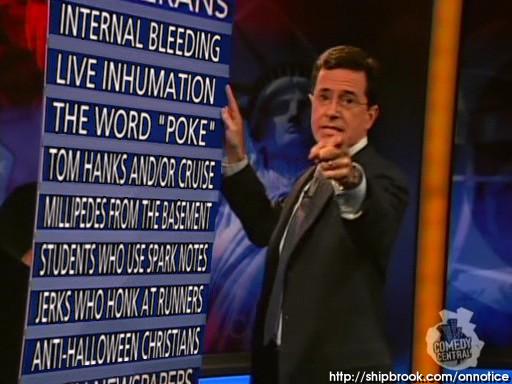
That honking jerk from yesterday's post is ON NOTICE!

(And he's got a lot of other company there!)


Make your own "On Notice!" board here.

Sunday, October 1, 2006

Sometimes I wish I were teaching composition...

...because I often find inspiration for assignments from my daily experiences.

For example, today on my long run I came up with two ideas, one for a paper topic and one for an in-class discussion (small groups or full class - your choice). For preparation for the paper topic, students would look at map of my working-to-middle-class neighborhood in Rust Belt, with its easy-to-navigate N-S and E-W grid, and compare it with a map of Rust Belt's version of Beverly Hills, where the streets wind and curve, double in on themselves, and have confusingly similar names. (I mean, really, *must* Riverview and Riverside cross each other?!) And then, after that part of the excercise, they would go to each of these neighborhoods and catalog the physical properties of the streets (wide or narrow? sidewalks or not? where are the street signs? How easy are they to read?), the landscaping and lots (size and character), the houses, the proximity of the houses to the road and each other, the number of cars parked on the streets, and the visibility of the garages. Then they'd come back with all of that and do a semiotic reading of the two neighborhoods' geography, planning, and architecture in light of class and power.

Yes, this is really what I do with my time when I run. Can you tell, btw, that I got a little lost?

The other idea came more suddenly, less leisurely. In this assignment, students are first given a "case":

A woman runner is waiting at a corner for her crosswalk light to say "walk." The cross-traffic has an increasingly stale yellow light and she's getting ready for her turn to go. Just as that stale yellow light is about to turn red and her light turn to "walk," a guy in a beat-up muscle car hits the accelerator to "make" the yellow, honking at the woman and whistling at her through his open window at the same time. She mutters "Asshole!" and continues on her run after the guy has cleared the crosswalk and gone through the now-red light.
First, students must discuss how many signs are involved in this "case" and how they signify to each of the parties concerned. Then they are to debate whether the two parties' interpretations of those signs are "correct." Who or what determines what's correct in each case (law, social mores, ethics, common sense, etc.)? How might some of these signs have multiple meaning from different points of view? If the driver had good intentions (warning, not catcalling) might the runner still have the right to think he's an asshole?

Te-hee. Yes, I *do* see my life in terms of a series of "teaching moments," why do you ask?

Saturday, September 30, 2006

Belated Friday Poetry Blogging: Naughty Medieval Edition

I haven't done Friday poetry blogging in awhile, in part because my Fridays this semester have been incredibly and annoyingly busy. We've had department meetings every freaking Friday and faculty research group seminars every other Friday. Yesterday was the first Friday I got to stay home and spent all of it putting together proposals to "mediate" two department classrooms. (To "mediate" is RBU's awful jargon for adding multimedia technology to the classroom. It cracks me up.) Argh.

So, as a result, I'm only getting to Friday Poetry Blogging now. On Saturday. To make up for it, I give you my favorite naughty-but-fascinatingly-complex "macaronic" (i.e., mixed language) poem from the medieval period, complete with explanatory footnotes. But for those of you who aren't medievalists or have never been to a Latin mass, don't let the footnotes intimidate you -- all you really need to know is that the Latin and Greek comes from the Mass, that it appears in the order it comes in the mass, and that much of it is chanted or sung. The rest you can probably figure out yourselves. In fact, I'm not even going to say how I read it, only that I often use it as an introduction to the Middle Ages for its mix of sacred and profane and its multilingual, multi-voiced qualities, and for its evocation of the sounds of the Middle Ages. It's also just a damn good and richly layered poem.

Read and discuss.


“Kyrie,” so “Kyrie,”

Jankin singeth merie,

With “aleison.”[1]


As I went on Yol Day in our procession,

Knew I joly Jankin be his mery ton.

Kyrieleison.


Jankin began the offis on the Yol Day,

And yet me thinketh[2] it dos me good, so merie gan he say

Kyrieleison.


Jankin red the pistil ful fair and full well,

And yet me thinketh it dos me good, as evere have I sell.

Kyrieleison.


Jankin at the Sanctus[3] craked a merie note,

And yet me thinketh it does me good – I payed for his cote.

Kyrieleison.


Jankin craked notes an hundered on a knot[4],

And yet he hakked hem smaller than wortes to the pot.

Kyrieleison.


Jankin at the Angnus[5] bered the pax-brede[6];

He twinkeled, but said nout, and on min fot he trede.

Kyrieleison.


Benedicamus Domino[7], Crist fro schame me schilde.

Deo gracias[8], therto – alas, I go with childe!

Kyrieleison.

-- Anon., 15th century


[1]Kyrie aleison” : also spelled “kyrie eleison,” Greek for “God have mercy” – sung during church service. [This stanza is the “burden” of the poem – a refrain repeated after each non-repeating verse.]

[2] “me thinketh”: it seems to me.

[3] “Sanctus”: Latin for ‘Holy’ – like “kyrie aleison,” part of a liturgical chant, sung during church service.

[4] “on a knot”: at a time

[5] “Angnus”: Agnus Dei, Latin for “Lamb of God” – the Eucharist, Communion

[6] “pax-brede”: tablet kissed during the medieval church service, first by the celebrant and his assistants, then by members of the congregation

[7] “Benedicamus Domino”: Latin for “Let us bless the Lord,” sung at the closing of church service.

[8] “Deo gracias”: also “Deo gratias,” Latin for “Thanks be to God,” said by the medieval congregation at the end of church service

Wednesday, September 27, 2006

Thank you! Thank you! Thank you!

See, this is why every academic should blog. I tell a round-about story about my frustrations with a class, ask for advice -- in this case, whether I can work a research paper into my upper-division medieval literature survey, even though students already seem to find it "too hard!" -- and I get 26 comments chock full of helpful advice, much of it detailed or with links to the commenters' own guidelines and other handouts. (Rob Barrett and Dr. Crazy, I am definitely going to steal stuff from your handouts and ideas.)

I suppose I could have asked my colleagues, and some of the assistant profs. might have had equally helpful stuff, although I know Victoria doesn't have them do research papers because she worries about taking class time away from the course content (she does have to teach 600-page novels, after all) and Milton prefers to work on their close-reading and poetry-reading skills. And as for my senior colleagues, many have long since given up, I think. In fact, one of my students told me that one of the grumpier old men assigned a research paper and then, when my student asked for some parameters (length, number of citations, etc.), my colleague reportedly said, "You're a senior; you should know that already." So in the days before these here tubes on the internets, I wouldn't have had anyone to turn to. But now I have you!

Three cheers for the mostly anonymous masses of bloggy academics who I feel I know better than my own neighbors and can rely on more than my colleagues!

Boo grumpy, burnt-out senior colleagues! Hooray energetic academic bloggers!

Monday, September 25, 2006

Teaching bleg: can I teach the reseach paper in a lit. class?

technorati tag:

So I've been thinking about what to do in next semester's senior-level medieval literature (excluding Chaucer) class. It's been on my mind a lot this week because book orders are due soon, but also because I finally got around to reading my teaching evaluations from last Spring and I'm not sure what I did then went over well. I'm thinking about getting students to do a research paper next time around, but I'm not sure that will work, either, and I'd love to hear what you all think.

First of all, some background on what I did last year. I did a lot more lecturing last time and emphasized the book as material object and idea -- as well as the distance between the modern, edited text and the medieval manuscript -- and so what happened is that we didn't spend a lot of time getting really close to the texts, but instead spent a lot of time thinking about what books and texts and authors are (or are not) then and now, what books do in cultural terms, who gets to produce them, who consumes them, and so forth. Or we'd talk about how texts in a collection read each other. So, for example, I had them read a lot of stuff from the OE Exeter Book (in translation -- another reason why I don't do a lot of close reading in class) and talked about the appropriation of potentially pre-Christian traditional literature for Christian readers, or the juxtaposition of the sacred and profane (especially in the Riddles), and so forth. Or, at the other end of the temporal spectrum, we read a lot more of The Book of Margery Kempe than I usually assign (I made them buy the whole book) and talked about (female) authority, the author, the scribe, and all that good stuff, including whether the ways in which my students thought she lost authority (by behaving in what they saw as crazy ways) actually gave her authority in the context of saints lives (we read some of those, too) -- which I blogged about here.

Anyway, I think my whole tactic over the semester is what resulted in my most mix-bag bunch of evals ever. I got many of the usual 'her enthusiasm makes you realize this stuff is really interesting, and she's always concerned with student learning' good comments. But I also got two or three students saying I graded too hard and treated them "like graduate students." So maybe thinking about the book as idea and material object, and talking about manuscripts, and reading a lot of texts in Middle English (including The Morte Darthur, at the end of the semester! OK, big mistake!) was too much for my students. At the same, time, frustratingly, I got one comment that said the class was "too high school," that I told them what the text meant when "we should have been analyzing it." OK, so I'm pretty sure that's a reaction to my lecturing and to my frequent contextualizing and historicizing. I just can't help it. I've gotten really tired of facile readings of medieval texts from a 21st century 20-year-old's point of view and I'd like to show them that there are other ways to read texts other than the New Critical way! Close reading is important, but when most of your texts are in translation, what's the point? And actually, for the record, we were analyzing -- we just weren't doing close reading, but I think that's what that student meant by "analyzing." I mean, I certainly didn't summarize or ever, ever say "This text means X." I did sometimes say things like, "A medieval reader, experienced with this genre, might not find surprising what you just found surprising." But of course, medieval readers don't all read alike, do they now?

So, suffice it to say, I'm still experimenting a lot with my methods, and some work with my students (they really, really like my pop culture references and visual aids) and some don't (Middle English is too much unless we're in Chaucer, where I have time to teach it to them and they read it all semester). So next time, no Norton edition of the Morte Darthur, even though it's really, really cool. I'll bring in photocopies to show them. And now that there's a modernized spelling edition of Mankind -- still, it's Middle English, just no y's where you expect i's and so forth -- maybe that won't make them freak too much and we can actully do some close reading of it (which really pays given its complex use of diction and register for all sorts of symbolic ends).

But here's the real point of this post. I wonder, is a research paper too much to ask of my students? A lot of them still haven't learned how to write a paper that's an argument, so I fear a research paper would be a string of quotes. But I thought maybe I'd assign a very, very short paper or two in the beginning of the semester, emphasizing argument and analysis, then break the research paper into small parts over the rest of the semester, including having them read some sample scholarly articles before they do their own research -- and get rid of all tests. And if they're not doing research papers as undergrads, then the ones who want to go on to graduate school are at a real disadvantage. Plus, many of my students are English-Education students (sadly, they're the ones most likely to say that my course is too hard, or that it has no use for an adolescent ed. major -- which means they'll produce students like them who've never read any old literature in high school and freak out when they get it in college) and I'd like my future students to have had teachers who knew how to do a research paper. Hell, I wrote my first research paper sophomore year in high school, at age 15, when I still had to have my mom drive me to the library! (I can still recall the thesis, actually, so I know it had one.)

But if my students think asking them to think conceptually and read Middle English is treating them like grad students, will they balk at a research paper? Or will they find it a useful skill? Part of me just wants to get them reading how scholars write about medieval literature. But then, a lot of scholarship is too difficult for my students. What do I do about that? And how do I teach them how to do a research paper -- from picking a topic to find the criticism to writing the thing itself -- and also teach them how to read and think about medieval literature?

Any ideas (including from those of you not medievalists but who teach difficult literature of other eras)?

Wednesday, September 20, 2006

From the professional to the personal...

Perhaps I am thus far moderately successful, or at least competent, on the professional side of things, but boy do I suck on the personal side.

Today marks my third anniversary with Bullock.

And I forgot...until he brought it up.

I suck. There's a special circle of hell for bad girlfriends, partners, and 'helpmeets' like me.

So what did I spend today doing while forgetting that it was our 3rd anniversary? I spent today putting together my renewal dossier.

What have I become?!

Monday, September 18, 2006

To professionalize or not to professionalize - Is there really any question?


technorati tag:

Update: The conversation continues here and also over at JJC's place, in this thread, where In the Middle contributor Eileen Joy, in her usual awesome way, has given it a whole new "professionalization be damned" spin.

Last week Jeffrey Jerome Cohen, whose work and blog I love, said something that I disagreed with (the horror!). As chair of his department, he told the brand new crop of graduate students to stress less about “professionalization” and to get the most out the here and now of graduate school that they could. Actually, here are his own words:

Mostly, I urged them to take what they could from the experience of being in graduate school without obsessing to an extreme over what comes next (I believe too many graduate programs overemphasize professionalization, so that students become neurotic about conference papers and publication -- as if there were some magic checklist that when completed yields a first job).
I’m sure that Prof. Cohen, in the first overwhelming months of being his department’s new Chair, is especially nostalgic for an era when the only work he had to do – whether teaching or researching – was his own, and he didn’t have to try to herd cats on top of everything else. And being a brand new Director of Graduate Studies, whose office hours are suddenly jam-packed whereas I used to be able to hear the crickets chirp in them, I can appreciate to some extent the administrator’s nostalgia. And Prof. Cohen certainly isn’t the type to wave away the idea that graduate students are already part of an intellectual community and the scholarly conversation, and that their contribution to it matters – in fact, he said something along the lines of that in the rest of his post. He seems to me an exemplary mentor of graduate students, at least judging from how he treats the graduate student commenters on his blog. And he’ll be the first to tell those who start comments with “I’m just a grad student…” not to do so.

But I have two problems with what Prof. Cohen said. First, enjoyment of the experience and professionalization are not mutually exclusive terms. Second, graduate students have very good reasons to be worried about “professionalization” – largely a euphemism for publishing, but which also includes under its umbrella going to conferences, thinking ahead to the job market (even in the early stages), keeping up with the field, becoming active in professional associations, and largely being aware of how the profession works beyond the potentially narrow world of graduate student life – and their advisors and mentors should be thinking about these things with them as well.

Graduate school can be intensely and destructively infantilizing, depressing, and soul-crushing. Part of the responsibility for that environment comes from professors and from the world at large who, with good intentions or bad, think of grad students as merely students, of people who don’t yet have real jobs, who exist in some kind of preliminary, temporary stage of quasi-adult life without all the real pressures of being a prof, of being on the tenure track, of publishing or perishing, of herding cats in the department, the administration, the classroom, and the community. This is what allows universities to call TAs and instructors “apprentices” and what allows clueless family members to think a grad student’s time is endlessly flexible and not fully booked. (Of course, that little problem doesn’t end when you get the tenure-track job, let me tell you.) It also allows well meaning mentors, who would like to see graduate students less stressed-out, to suggest to them that they worry too much about professionalization.

That’s a bit like telling a farmer not to worry about his newly planted crops. Sure, they’ve just been planted, but they don’t get to be fully grown, ripe-for-the-picking, healthy crops on their own. And sure, there are forces beyond the farmer’s control that might wipe out his crop or make the market for it terrible, but if he wants any chance of selling those crops when they’re ready, he has to tend them from beginning to end. And that means he’s a farmer – an actual, real life, fully-blown, honest-to-god farmer – from day one. He’s not practicing to be a farmer while tending those crops and then only a real farmer once he sells them. He’s a farmer through and through.

Graduate students in Ph.D. programs are like that, too. Fine, they may be junior members of the profession – I’ll allow you that – but they are still members of the profession. (See Ancrene Wiseass’s much more deliciously rantful post here. I admit I can’t do beautiful and righteous anger the way she does.) In that sense “professionalization” isn’t something they must or mustn’t learn so they can use it down the road or because it could take away from the enjoyment of their salad days; rather, it’s an identity one should assume the minute one enters a graduate program. And what’s more, it's an identity and a way of thinking about oneself that could go a long ways toward relieving the feelings of infantilization, insecurity, and inadequacy that from which most graduate students suffer. If you think of yourself as a professional, you’re also more likely to be treated like one. (I know, not always. But more often.) If you think of a publishable article or two as a goal while in graduate school, you’ll make every seminar paper into part of that process, rather than mere hoops to jump through. If you think of your dissertation as the first draft of a book, you’ll use books as your models and have an easier time making that transition from dissertation to book. (Though there’s still a transition to be made and that’s a post for another time.) And if you start thinking that way in the beginning of graduate program, with you eyes on the goal not only of the degree but the reason for the degree – the tenure track job – my bet is you’ll be more likely to finish on time than take extra time. The students I’ve known who wallowed or who dropped out were the most abject cases of “only-students,” the ones who frequently started sentences with “If I ever get out of here…” or “When I have a real job…” Granted, there’s no “magic checklist,” as Prof. Cohen says, but being professional, contributing to the profession now, while one is a graduate student, and not later, as if one only enters into the profession with the conferral of the doctorate, is a way to combat the potential waywardness of graduate study.

And the reality is, the job market is asking for more from job candidates. We all bemoan this, but the only people who can change it are the people with tenure. I can do a bit. I can tell my full professor colleague who thinks our just-recently-hooded job candidate’s two article publication record is “light” that I disagree (and I can mumble under my breath, “I bet you weren’t even done with the diss when you were hired”) and I will do my best to combat these things after I’m tenured. (For one thing, our older colleagues generally won’t consider a candidate who’s ABD; they prefer candidates who’ve lectured or been visiting asst. profs because they feel they can hit the ground running with our 3/2 load and research expectations. While this may be true, it also contributes to the system of instructor/adjunct/visitor exploitation. This is something I hope to change once I have a little more authority and if we ever get to hire again!) Certainly a grad student is in no position to change the state of things.

But here’s the silver lining. In his book Graduate Study for the 21st Century, Gregory Colón Semenza argues that increased pressures to “professionalize” actually pushes the job market towards some semblance of meritocracy. (I know, and he knows, that there’s no such thing really, but let’s just go with the idea for a moment.) There was a time – and there are still old fogies around who reflect this time* – when a Ph.D. from Wisconsin or UCLA didn’t stand a chance against a Ph.D. from Yale or Columbia. Now they do. If the hiring committees are judging a candidate on their ability to meet tenure requirements in research, teaching, and service, and the Wisconsin candidate has two articles, a half dozen conference presentations, a competitively selected undergraduate honors seminar teaching experience alongside a slate of other teaching experiences, and a stint as the assistant organizer of a conference or as a graduate student representative, while the Yale candidate has fancy fellowships, light teaching, a brand-name degree, and a famous advisor, chances are, all other things like the quality of their work being equal, the Wisconsin candidate will get the job. At least at my university they’ll get the job. And jobs at my kind of university are much, much more plentiful than the R1 prestige jobs.

I came out of a program that started emphasizing professionalization at about the time I arrived there, and much of the impetus came from some very saavy graduate students. I saw their advice and the professionalization they were modeling as a kind of “add-on” option to my graduate career. Had I seen it as the sine qua non of graduate study, had I thought of myself as a professional and not as a student learning to professionalize so that when I was a professional I could do it, I might have shaved off a year of dithering and been much more able to claim my work as the work of a professional. And I would’ve been a lot less depressed in those final years, which means, ultimately, I would have enjoyed myself and my life more then. As it is, I am so glad to be out of graduate school. Although I’m busier now, I’m happier and more fulfilled, and I don’t want my friends and acquaintances and students in graduate school now to have to wait for that feeling. So my advice to them – aside from buying Semenza’s book, which I think is absolutely fantastic – is to assume that you are a professional right now, not just in the classes you teach, but in the classes you take, and in the work you produce. Banish the words “student” and “school” and “study” from your vocabulary; you are now an MA or Ph.D. candidate and a university instructor, and you work on research or produce scholarship in whatever field you’re in.

Welcome to the profession. It’s good to have you here.


*I heard through the grapevine that when I was a candidate for my job, one of my older colleagues went through the applications and sorted them only by the prestige of their degree-granting institution. I have a public university Ph.D., but an Ivy BA, and I got accidentally put in the Ivy pile. Of course, the less snobby members of the committee also deemed my application worthy. And as you know, all turned out well. I even get along with and frequently find myself agreeing with that old snob from time to time. Shocking!

Friday, September 15, 2006

A haiku for the academic masses

This is supposedly a haiku especially for Quod She, but I think just about all of my readers can take this as their own zen motto.

Haiku2 for quodshe
it's exhausting
on the up side however
my thursday classes are
@
Created by Grahame


As seen at In the Middle.

Graduate students says the darndest, most self-destructive things


technorati tag:

Welcome Inside Higher Ed readers. I know we all love a good bitchy post -- and this is one of those -- but if you want to read my positive advice and take on graduate student "professionalization," see my current post here. This blog isn't bitchy all the time.

Before I present the following conversation, I want to say first off that a) I really, really dig being Graduate Director and I'm finding that I'm not only good at the administrative thing, but that I also actually like it, and b) as a group I dig our graduate students and want to help each of them get what they want out of the graduate studies (which is a variety of things in our program). Sometimes they have very rigid -- and often misguided -- ideas of what they want and need, but I'm pretty good at convincing them otherwise, or of teaching them how to use the requirements that seem unrelated to their interests and make them useful.

BUT, when I have a conversation like the following, it makes me think, "Why bother?" Without further comment, a more or less accurate transcript of a conversation I had with a first-year graduate student who came to me seeking advice.

Student: I wanted to talk to you about strategies for preparing for the MA Exam.

Me: Oh, good! You're thinking ahead. Great! What do you want to know?

Student (pulling out the suggested ways of studying and thinking about it, as posted on the web site): Question 2 here talks about themes....

Me (interrupting to clarify): Just to be clear, that's not going to be Part II of the exam. The four parts of the exam are below that. The list you're looking at is just some suggested ways of making connections between the works on the list.

[Note: we have a rather old-fashioned comprehensive exam, although we keep it pretty short. We don't pretend that the works on it are "must know" works in some Bloomsian Closing of the American Mind way, but are at least representative of major periods, genres, and movements. This might seem rather a rehash of a typical English major, but many of our students are coming to us because they weren't English majors, so the exam is one way we give some of the background English majors have. To give you an idea of its short-comings and also it shortness: the entire Middle Ages is represented by The Canterbury Tales. At least it's a collection of many genres, and of course, sometimes that's all an undergrad English major has, but I'm a little annoyed that English literature seems to start in the 14th century. Sheesh, let's at least get Beowulf on there! Right, item for the agenda of the next grad committee meeting! Now back to the dialogue...]

Student: Oh, OK...well, here's what I'm really wondering: do I have to read all these works?

Me: (Stunned. Blinking. Searching for non-sarcastic tone. Trying to sound cheery.) Yes. All thirty-three. Which, when you think about it, is less than two books a month if you start now and then take the exam your last semester!

Student: But I'm not interested in most of these texts. Doesn't the exam allow you to talk about what you're most interested in?

Me: No, not exactly. You can play to your strengths, but it expects breadth. It expects you to make connections. [I then proceeded to show him a sample exam and to show him how even with a choice of questions, there's no way one can get by with just the texts or period one is interested in.]

Student: Fine, fine. I guess what I want to know is whether I can just read the Spark Notes and some critical articles and get by with that for the texts I'm not interested in.

Me (giving him the look of death): No, Mr. Student, you can't. You will fail. (Pausing) And a graduate student shouldn't even being saying that out loud.

[End dialogue]

That wasn't really the end of our conversation. There was more about what he was interested in, which he claimed we didn't offer (making me wonder why he came to our department) but which turned out to be something that one of faculty members actually does active research in (which then made me wonder if he'd bother to look at our web page at all). That's just naivite, though, and I can understand and forgive that. But to openly say to your Director of Graduate Studies, in hardly veiled language, that you would prefer to find an easy way to a degree and not have to do the work, seems so self-destructive as to be utterly incomprehensible to me. He's lucky that I'm not the vindictive type who would then tell the rest of the graduate faculty to look out for him (no, I only blog it on my anonymous blog - te-hee!), or who would judge his work in my course according to his attitude. I will judge his work on his work's merits. But he just lost my benefit of the doubt. And all of this is especially vexing after we just spent the first two weeks in my "How to do Grad School Right" course (aka my methods and professionalization course) reading Gregory Colon Semenza's Graduate Study for the 21st Century, in which he says, twice, something along the lines of 'any English graduate student not willing to read a Victorian novel on his own shouldn't be in graduate school in English,' and also has repeated advice about how not to shoot yourself in the foot.

Well, I guess I can lead graduate students to good advice, but I can't make them take it. And that's what I learned in school today.

Tuesday, September 12, 2006

The day after

I didn't post yesterday in remembrance of 9/11. I couldn't think of anything to say that wouldn't sound trite or oddly self-absorbed. So I left my blog blank in a kind of moment of silence. But then I realized maybe I should have *said* it was a purposeful moment of silence. Sigh. Well, it was.

Today will probably be a little silent as well, since it's my 14-hour day. I'm usually up and working at my desk by 8am every morning, and Tuesdays are no exception. The problem is, my last class doesn't end until 10pm tonight. And I'm generally pretty actively busy for all of those hours, too. It's exhausting. On the up side, however, my Thursday classes are over by 5:30 since my late Tuesday night is a once-a-week seminar. So the rest of the week I can usually get by on 10-hour days, and on Wednesdays, I admit, I sleep in a little.

OK, back to work.

Sunday, September 10, 2006

In nomine Patris, et Filii, et Spiritus Sancti

Well I had an interesting morning today: I went to a Latin mass (Tridentine rite). There's a church here in Rust Belt that offers them twice a month and this morning's service was even a high mass, so it was extra, extra special.

First of all, I should say that I went for scholarly and intellectual enlightenment, not in a spiritual quest or for devotional puporses. I realized while teaching the Jeu d'Adam last week -- a 12th century Anglo-Norman play that draws on the liturgy and includes a great amount of song and non-dialogue material in Latin -- that everything I said about the Latin mass came from what I knew, but not what I'd experienced, given that I was born after Vatican II and raised in a large, suburban, and relatively young Catholic parish. So I thought it might be instructive for me to go hear a Latin mass and see what mass is like when the priest doesn't face the congregation and the choir and servers say most of the responses and prayers on behalf of the congregation. Now, I realize that a modern Tridentine Latin mass in Rust Belt, USA, isn't going to be exactly like a medieval mass, but I figured it was the closest thing going. And since I'm a baptised Catholic, I participated as fully as one does in a Latin mass, including receiving communion (at the rail! on my tongue! -- more on that below) because what I really wanted to do was compare my own post-Vatican II experiences with this one and their effects on me as fully as possible. As I frequently tell me students, even if you're Catholic, your modern experiences and practices in the church and in your religous life are very different from medieval Christian ones. (I do this in part to get all students -- including non-Catholics and non-Christians -- on as much of the same page as possible: we're all reading texts at some remove from us.) Now, I don't think I needed to have heard a Latin mass for anything of these things I say to have been "authentic," but I thought it would still be instructive. Plus, I thought if students wanted to check it out themselves, I could report on what to expect of this particular church and congregation.

And wow. It was completely different from anything I've experienced or seen. First of all, as you might expect, a traditional Latin mass attracts people with attachments to the "traditional," however one might parse that word. Although I've heard my baby-boomer siblings describe life before Vatican II, there's much that I had never seen. For example, I'd never seen women wearing lace veils over their heads, but there were about ten such women in this church (which, by the way, was not a huge church -- about the size of a standard 19th century church of just about any high church denomination). Some of those women were also dressed in what Bullock calls "Little House on the Prairie style" or what I sometimes call the "Amish jumper" -- shapeless jumpers over long-sleeved blouses, or floral print dresses, all with arms and necks covered, i.e., "modest dress," as interpreted by American religious ultra-conservatives (wherein, apparently, the biblical writers were clearly thinking of 19th century fashions when they wrote the passages ultra-conservatives use to justify their brand of modest dress). Aside from the veils, the style of dress really surprised me, since I associate that style and the assumptions that go with it with certain strains of American fundamentalist Protestantism, and not with Catholics at all. Actually, though, now that I think about it, I think I've seen a few of these styles in the church I grew up in, but without the veils and head-coverings, so I just interpreted it as plain old, non-ideological bad taste! Who knew their bad taste has meaning to them! Te-hee! Anyway, some of the younger girls had a bit of lace attached to barrettes in the back of their hair, but not exactly what you'd call a head covering. I found that kind of curious -- does it signify something (perhaps they were pre-confirmation but post-First Communion)? And there were other women and girls all wearing nice, fashionable skirts, often in a group together (some families, but also teenage girls in groups). But there were also plenty of women in pants -- and among the ladies of a certain age, pant suits -- so really, in terms of manifesting conservativism through dress (harder to tell among the men -- there were no ties that I saw) the congregation ran the gamut up to but excluding jeans (though denim jumpers and skirts were OK). So I didn't stick out in my trousers, thank god. (And if my bountiful curls distracted some man from his godly thoughts, well then he's got issues a lace doily on my head isn't going to solve!)

But I didn't do all that much people watching once the mass started because I was too busy trying to keep up. Seriously, I felt like non-Catholics at a Catholic wedding, trying to figure out when to stand, sit, or kneel, because, of course, the cues I know by heart are in English. I should have just watched and listened, since plenty of people knew what they were doing and I could have followed them, but I kept trying to read both the Latin and the English in my missal (it had a facing-page translation) and all the instructive marginal notes about what the priest was doing and why (with helpful illustrations, too, including little bell icons for every time the altar servers rang the bells!). My friend the Big Teutonic Queer had advised me to get the missal ahead of time to read through it and he was right. I was very distracted at times and so not focused on what was going on at the altar (which is where I should have been focused, both in devotional terms and for my own interests). But about halfway through I realized that the missal was more distracting than helpful during mass, and just watched and "heard" mass (as they say). And then I realized that, since I wasn't saying any of the prayers or responses, I noticed much more what the priest was doing -- how he held his body, the gestures he made, whether he was speaking aloud or not, when the incense was used, what he was doing when the servers rang the bells (which they still do in vernacular masses, but become all the more meaningful in a mass you can't understand) -- much more so than in an English mass. And in a way that was kind of cool and interesting. I can imagine that if I saw this every week it could potentially become too habitual, easy to take for granted, and with the mass not in my own language, it would be easy to become passive. I understand that the very point of all the changes that came with the Vatican II Council was about involving the lay person more actively in the sacramental life of the Church. But one can become passive and do things by rote in one's own language, too, -- witness my father, who I'm sure could not tell you accurately the words he slurs and mumbles before meals and in mass, even though they're in English. But in the Latin mass, I was much more focused on the rite itself -- at least as impartial observer, if not believer -- than on what I had to do or say. Again, I'm sure the novelty had something to do with this, but I got the theory of it, anyway.

And the same goes for the fact that the priest mostly has his back to the congregation. Suddenly it didn't matter so much who the priest was as an individual, and though his body blocks much of what he does (and the rood screen would have blocked even more in a medieval church), the mental focus is on the rite itself, not the person performing it. I was talking to Bullock about this afterwards, and he said it made it clearer to him how then priests could be moved from parish to parish and a congregation thus expected to accept the priest who they're sent. Of course, the individual comes out in the homily -- when he faces the congregation and speaks in their language -- so it's not all about the role over and above the individual. But still, the idea of corpus Christi as composed of all believers who share in the eucharist makes much more sense to me when the priest's individual identity is erased under the vestments that cover his body, which you can only see from behind, and with his face turned away in the same direction which all the congregation also faces: the altar, the tabernacle, and the eucharist. And the fact that the priest's vestments matched the altar cloth suddenly also became more meaningful or functional than I'd before noticed, since this priest, when he was before the altar with his back turned to us, really did seem to melt into to the altar itself and become a vessel of the sacrament, rather than an individual authority figure, although clearly he had a connection to and authority of the altar that we did not. Still, one of the key times the priest does face the congretation -- thus calling attention to this moment in a way that a modern mass doesn't -- is when he asks the congregation's blessing ("Orate, fratres..." or "Pray, brethren, that my sacrifice and yours, may be acceptable to God the Father Almighty") as he is about to begin the consecration.

And the other thing that I saw with fresh eyes was the symbolic use of space in relation to the gesture and text, but which in my experience is underplayed in modern churches. In the church I grew up in, built while I was in grade school, the altar dais is a bit like a Globe Theatre style "thrust" stage, and the congregants sit around it in a 180 degree arrangement. The altar is in the center of this dais, there are two lecterns on either side, and the tabernacle is the only thing that is flush against a back wall. (Ugh, and I just realized it's at the western point of the compass, not the East -- what were they thinking?) There are steps up to the altar, but the priest can conduct an entire mass without ever having to ascend or descend them since the altar is mostly in front of him, between him and the congregation, which he faces except when he's in front of the tabernacle. And in front of the dais, there's open space which the current pastor likes to use for giving his sermons (I go to church with Dad when I'm home) -- you know, so he's "down with the people" and all that, so he does make *some* self-consciously symbolic use of his space. But in that church, there's a missal or Bible on each lectern, so the lay reader who reads the Old Testament or Epistle reading and the priest who reads the Gospel simply have to step up to the lecturn to read. In the Latin mass I heard, though, where both readings are done by the priest, in Latin, with his back turned, and at the rather small altar/tabernacle that is flush against the wall (on the East side of this church), the missal had to be picked up and moved to and from the "Epistle side" (the right as you face it) and the "Gospel side" (the left as you face it), and each time this was done there were accompanying gestures and movements. I think the way this mass called my attention to the symbolic creation and use of space could be very useful for thinking about medieval dramaturgy, which, while not simply aping or even necessarily drawing on the mass (depending on the play), still made use of space and the gestures in it in similarly rich and symbolic ways. Again, I realize the 'foreigness' of the Latin mass to me drew my attention to these things in a way that I wouldn't necessarily always think consciously about if I were to hear this mass every week, but I still thought it was interesting and theoretically effective that the sacred text itself is made to exist fully in space during the mass -- it's a concrete way of thinking about text (sacred or not) that isn't really something we do regularly, and which is something I've been thinking about more generally while teaching medieval literature and book culture. (I commented once over at New Kid's place that lately I've made my students in the medieval survey make their own miscellanies -- on paper, not vellum, alas -- in which they handwrite texts they think are worth saving for posterity or knowing or reading, just so they can get some sense of the physical reality of handwritten books. But that's a post for another day.)

But one of the best parts of the mass for me -- being the medievalist geek that I am -- was the sermon. The priest talked about how we are led astray from God's will by the World, the Flesh, and the Devil! Holy cow! Talk about getting medieval! I swear I've never heard any other Catholic priest give a sermon in those terms, at least not since I've been studying medieval literature, so I wonder if the priest has altered his sermon topics to fit the "traditional" nature of the Latin mass. (But then, I've pretty much forgotten most of my Catholic school youth, so I can't be sure.) Anyway, too bad my students who are reading The Castle of Perseverance next week weren't there. I'm hoping to get together some of the graduate students in my seminar to go to the next Latin service or one next month, so we'll see if the sermons continue to have medieval inspiration. (A side note: Big Teutonic Queer once went to a mass, in English, in which the priest ripped off Wulfstan's "Sermo Lupi," adapting it a little bit for the present day -- changing the Vikings to terrorists I believe, and getting rid of references to slaves -- so medieval-style sermons are not limited to Latin masses, I guess.)

Although I was pretty caught up in and fascinated by the whole mass, there was one part where I goofed -- and where I should have been reading the marginal notes in the missal! That was at communion, of course. I say of course, because I remember before my First Communion and for some time after I was all anxious about screwing up in some way, and when you're a little kid dealing with the Body of Christ, that's some serious anxiety! So here I was, having to do communion in a way I hadn't done since those first anxious years -- kneeling at a communion rail, receiving it on the tongue -- and feeling like perhaps I really shouldn't be receiving communion anyway, given that I don't believe in it any more, and being in a strange church with strange practices and strange people with strange headwear, and, of course, I screw it up. It wasn't really a big deal, but I felt like a dolt for not being more observant. See, when the priest offered the communion wafer and said, "Corpus Domini," etc. (it's a lot longer in Latin, by the way, than the mere "Body of Christ" I'm used to), not only was I thinking, "This isn't really a very ergonomic height for the priest, is it? And this poor old man seems a little arthritic, to boot" but I also didn't realize I was not supposed to say "Amen" as in the modern practice. I was just supposed to open my mouth. There was a split second there when some real awkwardness was barely avoided -- visions of me nipping the priest's fingers between the "A-" and the "-men" or of a communion wafer on the floor flashed through my head -- but the priest was clearly used to idiots like me (after all, the Latin mass hasn't been regularly said since before I was born) and the altar server had the paten very well poised to catch any mishaps, just in case. Embarrassment was averted.

Oh, and speaking of altar servers, there were *six* of them, plus a deacon. That's many more people doing stuff than at the giant suburban church of my youth. Of course, there were all those bells to ring and missals to help move and pages to turn, and censers to swing, and so forth. And the servers were older than the young boys (and now girls) who do it in modern churches. Since a server really has to learn all that Latin, at least phonetically, my guess is that they were from the local boys' Catholic high school (where Latin is still required -- and yet, our university doesn't offer it any more; but that's another post) and doing it as part of their community service requirements.

All in all, it was a really educational experience, and if you ever teach anything having to do with the Middle Ages, or Catholicism or Catholic writers before Vatican II, and you've never heard or seen a Latin mass, I recommend seeing if your community has one and attending at least once. It really is quite a different experience from modern Christian services, even Catholic ones. It's worth knowing the difference first-hand if it directly relates to what you do. Plus it's also just really pretty. For someone who grew up with the congregation singing all those cheesy modern religious songs, it was really lovely to hear a talented choir do Latin chant and sing Latin hymns!

Saturday, September 9, 2006

Whatcha been up ta?

So, today I have spent many hours (really!) catching up with youse all and your posts over the last month or so. But only those of you whose blog names begin with A-Pan, because mysteriously, Bloglines wouldn't show me anything beyond that, and I know it's not because those of you in the last part of the alphabet have been silent. WTF? Bloglines is getting to be awfully unstable. Anyway, all this means that I'll have to actually visit y'alls blogs themselves to see whatcha been up ta in the last month. I may not comment, but I'm reading. Just wanted you to know that.

Meanwhile, I'm finding that reading other blogs actually gives me ideas of things to post about! Whaddya know! Reading produces ideas! Maybe I should share that insight with my grad students. :)

OK, I've had too many of Bullock's cherry and chocolate-chunk cookies and I've got a sugar high, so a substantive post will have to wait a bit. But I was thinking of writing something about the grad advising I've been doing and tagging it for the next Teaching Carnival. Advising is teaching, right?

Wednesday, September 6, 2006

Wow, clearly I really miss you guys

OK, I am *waaaaayyyyy* behind on my blog reading, and as you may have noticed, I haven't been posting much. It's not that I don't want to, but I've just been running out of time to fit it in lately. Things have loosened up a bit now, so I maybe I can both post more regularly and catch up with reading what y'all have had to say in the last three weeks or so. And maybe I can also actually update that creaky old blogroll of mine!

Anyway, the post title is prompted by the very *weird* dream I had last night, which involved Flavia asking me over for sidecars, Dr. Crazy giving me a stray cat she found but couldn't keep (because her gorgeous Man Kitty just wouldn't share her with another), and an important department meeting I needed to get to -- all of which was impeded by my having set a neighbor's pig sty on fire. (Huh?!?! WTF?!) Perhaps that last bit was a rural, midwestern, dream-world version of a Hurcelean task or something -- otherwise I don't know where the frak that came from. Oh, and btw, since I've never met Flavia or Dr. Crazy, I cast TV actors in their stead. Get this...Flavia was played by the English actess Liz White, from Life on Mars:


(I told you I'm obsessed with that show!) And clearly I was in a Martian kind of mood, because Dr. Crazy was played by Veronica Mars aka Kristen Bell:


Well, at least I think I got their hair colors right, or at least close. Hmmm...and you know what else this dream might mean? It might be a sign that I don't have enough girlfriends in real life here in Rust Belt. OK, maybe I should work on that. Maybe I should join the Saturday morning running group near here or something.

Anyway, you know when you're dreaming about blogs and bloggers, it's time to catch up, drop in, and say hello to a few folks! So I aim to do just that. It might take me awhile before you see me commenting again (I have a *lot* of reading to do to catch up) but at least you know I'm thinking of ya. (And if you weren't in my dream, don't worry -- my dreams are like The Love Boat: each episode has a different guest star!)

Saturday, September 2, 2006

Shameless self-congratulations; or: woo-hoo!

My university's research committee, in their great wisdom, decided I was worth taking a second chance on, and nominated me for the NEH Summer Stipend, even though, as I mentioned here, I tried once before with the same project in an early, inchoate stage and didn't get the stipend. Since a university can only nominated two people, I feel like my colleagues have faith in me to trust me when I say that this time the project is likely to be much more competitive. (For one thing, it's an article-length project already in progress, something for which the major research and theoretical framing could realistically be completed in the two-month period the Summer Stipend seeks to fund.)

Woo-hoo! Yay me! Now, wish me luck and keep your fingers crossed for me in the NEH round. I know some of you out there have won this very funding, so if you have any advice, please feel to give it. My application is due October 2.

And in other news...I totally missed the chance yesterday to wish myself a Happy Blogiversary. Yes, that's right, I have now been blogging for over a year. I'm not sure I've said very much of use, intelligence, or value, but what the hey -- it's just a blog, right? And I *still* don't really have a consistent mission for this darn thing. Well, here's to another year of randomness!

Thursday, August 31, 2006

Students (and boyfriends) say the darndest things

Once again I've gone unintentionally silent for longer than I meant to. Chalk it up to the following: Bullock's going up for tenure and the file's due tomorrow; the university is doing "prioritization" and every department has extra weekly meetings; I'm still not done with those fraking encyclopedia articles and they're due tomorrow; and, dammit, graduate students are freakin' needy and being graduate advisor seems to take up more time than the one course I traded for the job.

Anyway...while helping Bullock go through his file one more time, I came upon the Best Student Evaluation Comment Ever, at least from this medievalist's point of view. Keep in mind that Bullock teaches in a social science and the reading material for the course is primarily 20th century. OK, you ready? Here it is:

The cases are written in Old English prose, so hearing the lecture in today's English language definitely helps me understand.
Well...at least s/he got "prose" right. And Bullock's response (to me, that is, while I was laughing)? He said this: "I think what the student means is prose steeped in stinky cologne."

Te-hee!

Saturday, August 26, 2006

Affecting, flattering, and frightening items of the week

Item 1: Affecting

Yesterday I got the mail at home and found a small, elegant envelope addressed to "Prof. FirstName Virago" (what would Dr. Virago's first name be, btw?) in my dissertation director's unmistakable handwriting and blue ink. (Maybe he uses black, too, but all I can ever recall is blue.) Inside was an architecture review from his Big City newspaper about The Rust Belt Museum's latest expansion. (Think the Milwaukee Museum of Art's expansion and you'll get the sense of what a Big Deal this has been for Rust Belt.) At the top of the review -- which was glowingly positive -- was a note that said "Dear FirstName -- Sounds/looks good in Rust Belt! From today's Big City Paper. Best, HisFirstName."

I found this so utterly touching and sweet. First of all, he's Mr. Sophisticated, so he's probably been thinking all this time, since I got this job, that I'd been exiled to some hideous existence on the fringes of civilization, and was delighted to see that the savages do have some culture after all. I say this warmly -- he does have a snobby streak, but I think he works hard not to act on the first impulses of that snobbishness. But the main reason I was so affected by it is that it was something my mother would have done. Actually, she would have *loved* the Director. They both had/have penchants for the color green, fine art, all things European, and fine cuisine, and they both were/are decent, kind people with snobby streaks they tried not to express, for that just wouldn't be polite. But more to the point, my Mom used to cut out and send me articles about things of interest to me in just the same way -- in an envelope by itself with a note written on the top on the article. Honestly, it almost made me cry.

Item 2: Flattering, but also freakin' frightening

So I have a friend visiting this weekend, who used to be a grad student in our program -- he's currently galavanting about with another friend in town, so I'm not ignoring him, I swear. Let's call him Big Teutonic Queer, an epithet I came up with last night while imitating someone in the department who was clearly uneasy in BTQ's presence, and which BTQ loved so much that he's been referring to himself by it all day today. Anyway, last night Big Teutonic Queer went out drinking with our department chair and while BTQ didn't come back with the best gossip ever -- dammit! -- he did come back with a little nugget that set my heart pounding with a strange combination of pride and abject fear. Apparently, Chair said that she has to take a sabbatical soon or she's be thrown off the whole sabbatical rotation, but she has to wait until I get tenure so that there's someone she trusts to run the department in her stead.

Uh....Squeeze me? Baking powder? Gosh and golly, I'm flattered, but um, no. There will be no chairing of departments right after I'm tenured, interim or not. And I think the department might have some say in this anyway. (Yeah, ya think?) But still, it's nice that she thinks I could take that on.

All in all, I feel so "grown up"!