It seems that over the weekend our BMOC (in the official sense) here at RBU had a relatively minor, though no doubt painful mishap that has put him under a doctor's care. So he released a press announcement to the entire campus. It's not so much the press release that I think is a little melodramatic (hence my subject line) or unnecessary -- after all, he's a busy man and an important man and lots of people probably were counting on meeting with him this week. However, there was a bit in the press release that assured us all that the business of the university would continue without him.
Really? Are you sure? Because I just don't know how I can go on teaching my classes without our fearless leader!
All sarcasm aside, this otherwise innocuous announcement is one of the less disturbing ways he has shown his failure to understand that the fundamental "business" of our university is teaching, and that the faculty and students are the primary consituents in that business. Earlier this semester he sent out an announcement to everyone including the faculty reminding us (read: himself) that students are our reason for being here and that we should say hello to them and greet them by name. Perhaps I should invite him to my classes and demonstrate that I have all 70 of my students' names memorized already? I mean, seriously, maybe he's never been in anything except a giant lecture or something, and doesn't realize how we teach on this campus. And if that's the case, that's our failure.
[PS - The post title could also refer to the fact that I haven't blogged in over a week! Ack! Sorry about that!]
Tuesday, January 30, 2007
Just go on without me - really - I insist!


Tuesday, January 23, 2007
The book inches ever closer
Whew.
I just e-mailed the electronic "typescript" files of my manuscript back to the copy-editors, having spent most of January going through it line by line and either excepting or rejecting their changes, or just rewriting the damn sentence from scratch (the latter happened a couple of times). Generally I think I'm a fine writer, but apparently I don't know my "thats" from my "whiches" and I abuse commas and scare quotes. Oh, and I use "like" when I should use "such as," though sometimes I really meant "like" -- I think my editor got used to correcting most of them and automatically over-corrected ones that didn't need it. But man, medieval subjects throw the copy-editors off. My subject includes texts with generic names as character names -- similar to referring to the Wife of Bath as simply the Wife, for instance, only this wasn't about her specifically -- and my editor made them all lowercase! Ack! About halfway through she realized that these were indeed character names and stopped. And one time, I wrote something along the lines of "this story was also popular in France, Germany, Italy, Spain, and Persian romance" (I'm making up the "Persian romance" part for the purposes of this illustration) and she changed it to "French, German, Italian, Spanish, and Persian romance." Now why would she do that? Those sentences say two different things! And her version makes it sound like the whole list of languages modifies "romance," which it shouldn't. Moreover, how does she know the texts I'm talking about aren't in Latin?
But, whatever. Those kinds of mistakes, though tedious, were easy to fix with a "stet" or, if there were some changes that were OK, going back in and changing it myself. That's the beauty of the electronic file -- "Track Changes" kept track of who changed what without having to sqeeze things in between lines. And more often than not, even if she changed a sentence in a way that changed the meaning, it was a sentence that needed rewriting anyway.
My experience definitely wasn't as stressful as Anne of Fernham's experience, and both of our books were edited by the same Indian company hired by the same publisher. Perhaps I got lucky, or maybe my series gets the sharper editors simply because the medieval stuff is tricky. I don't know, but keep your fingers crossed that they know what to do with the special characters, and that my "yoghs" actually look like yoghs and not the 3's I put in as placeholders!
The academic circle of life continues
ETA: Thanks for all your helpful suggestions in the comments, everybody! I'm going to take Dr. Crazy's advice first of all, and tell the *director* to send my contact info on to the student, and let him take it from there.
I've been asked to be an outside reader on a dissertation committee (at my university, but a different departement -- the only humanities departement with a Ph.D. program). The dissertation is on a medieval English subject, though way out of my part of the period*, but I thought I might as well say yes for the following reasons:
- I'm the outside reader, so really, my opinion comes last in the hierarchies of opinion, which means I have the easiest job. And anyway, he's not going to have something written until 2008, so there's plenty of time to plan ahead.
- I'll learn something.**
- Such requests will come up rarely enough that it's not like this one will open up the flood gates.
- Dude! I was finishing my own dissertation a mere 4 1/2 years ago and now I'm advising/reading one! How cool is that?! That also means I probably the only one on the committee with a clear memory of what it's like to be a dissertator. I think my best role in this case is to be the sympathetic junior faculty member who can offer concrete advice on the *process*, rather than the content. In fact, I think that's how I can be of the most value to this student, since his topic is fairly far out of my expertise.
*Let's just say that the student's topic is as distant in time from the subject of my forthcoming book as we are from my book's topic. In case y'all haven't noticed, the Middle Ages is huge!
**Yes, I know, I ranked managing my workload over learning something. So sue me -- I have a job to do and managing my time means I do it better.
Sunday, January 21, 2007
No wonder my students think I'm a Christian...
Wow! You are awesome! You are a true Biblical scholar, not just a hearer but a personal reader! The books, the characters, the events, the verses - you know it all! You are fantastic!
Ultimate Bible Quiz
Create MySpace Quizzes
As seen at Bardiac. And as she says: not bad for an atheist!
And yes, I will return to substantive posting. Blogger and old man Time both got in my way this week. But I will prevail! Besides, I have stuff to say that's actually obliquely related to this quiz!
Sunday, January 14, 2007
Hey, why are people starting to leave?
First Michael Bérubé.
Then Ancrene Wiseass.
And now New Kid.
More and more of the bloggers who got me into this thing -- indirectly or directly -- seem to be taking blogging sabbaticals. And Eileen Joy at In the Middle asked if we all had blog ennui, or what?
I have to say, I'm a little bit with all of these folks in some way or another. Bérubé talks about how much mental time blogging takes up -- even when you're not doing it; Wiseass* says she worries that blogging has become "something rather more official, high-profile, and authoritative than it used to be," and therefore not what she needs it for (and Eileen takes this up in her post); and New Kid suggests that she feels guilt when she doesn't blog.
I get it. I totally get it. At one time or another I have felt all those things. And now I feel a bit like I'm being a hanger-on at a party that's winding down, especially since Wiseass is most directly the reason I got into blogging, first by reading a now defunct blog she had some time ago when I was in my first year on the tenure-track and just trying to keep in touch with all my far-flung friends. And it's her blog that led me to Bérubé and New Kid.
But, of course, there are still a lot of you lovely people out there and new blogs popping up all the time -- just look at my blogroll! -- and my RSS feed is constantly updating. So this party certainly is not over yet.
Besides, I have lots of stuff to talk about, including topics that may actually interest other people. For one thing, I had a *great* teaching week this past week and I felt great energy in the classroom, and I wondered if undergraduate teaching, which is all I'm doing this semester, just does that more than graduate teaching (which is all I did last semester). Maybe I'll post more on that tomorrow, because there are other factors involved and of interest (like class size and setting).
And in other news, next week I'm meeting with my chair to talk about planning for possibly going up for tenure a year early next year, and planning all that out. I may also still go on the market again -- at the same time -- next year, depending on just how unwelcome our new administration continues to make folks feel who aren't in applied sciences or professional programs, and how Bullock and I would be able to swing it. There's a lot to talk about there, both personal and professional.
And I'm still trying to figure out how to talk about what makes me cranky about stuff around here -- and how it's really not just local, either -- without shooting myself in the foot. My "speaking for the dead" post was just a start.
So I've got things to say and I'm sticking around. But sometimes it takes me a little while to formulate it or to find the time to say it. My blog has always been a once-every-few-days blog, but I thought I should re-iterate that, given all these other leaves of absence.
*I know most people address her as Ancrene, but I'm a pedant here. The title she puns on, Ancrene Wisse, means roughly "A Guide for Anchoresses," with "Wisse" being the guide. So therefore, "Ancrene Wiseass" should mean "A Wiseass for Anchoresses," thus making the blogger Wiseass. Besides, she *is* a wiseass. :)
Friday, January 12, 2007
Friday Dog (and Squirrel) Blogging
Wiley, where's the squirrel?! Find the squirrel!
Is it over there...? Nooooo...
Around there? Noooo....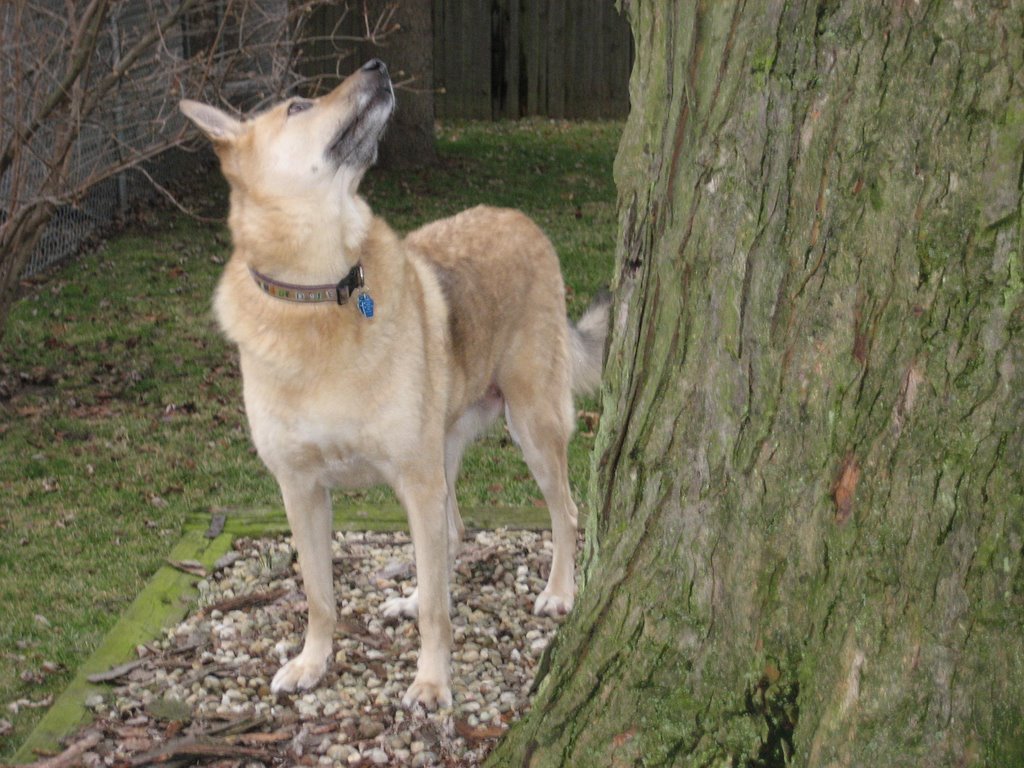
Ooh, maybe up there? Not quite....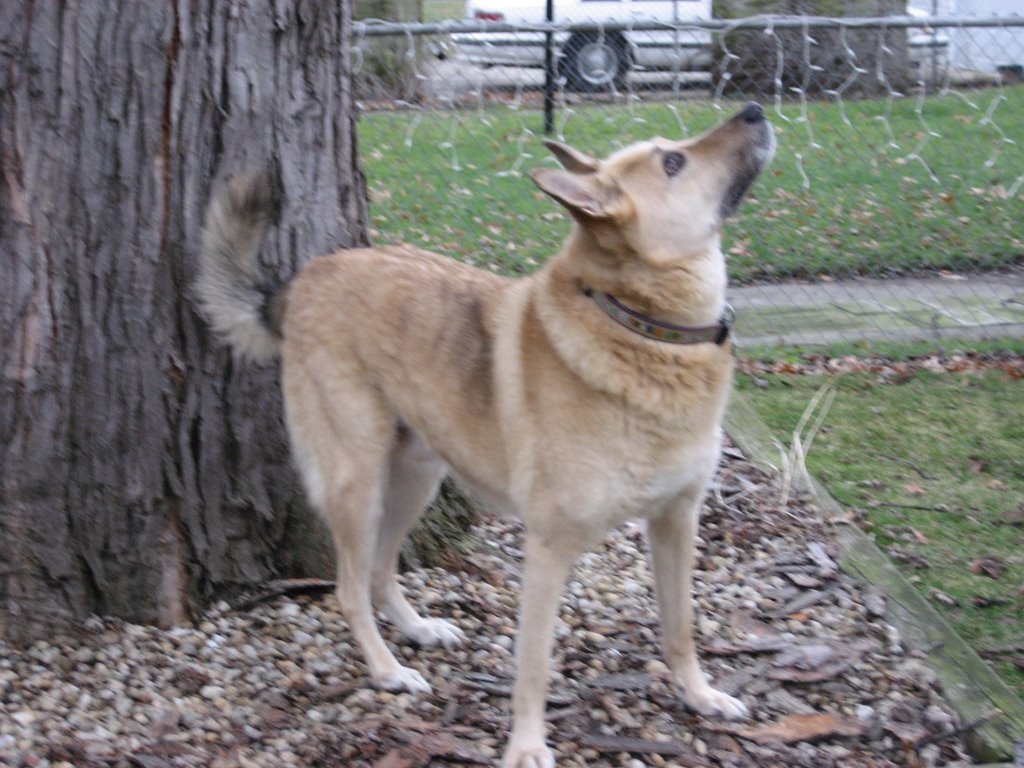
Or how about up here? Getting warmer.....
HERE it is...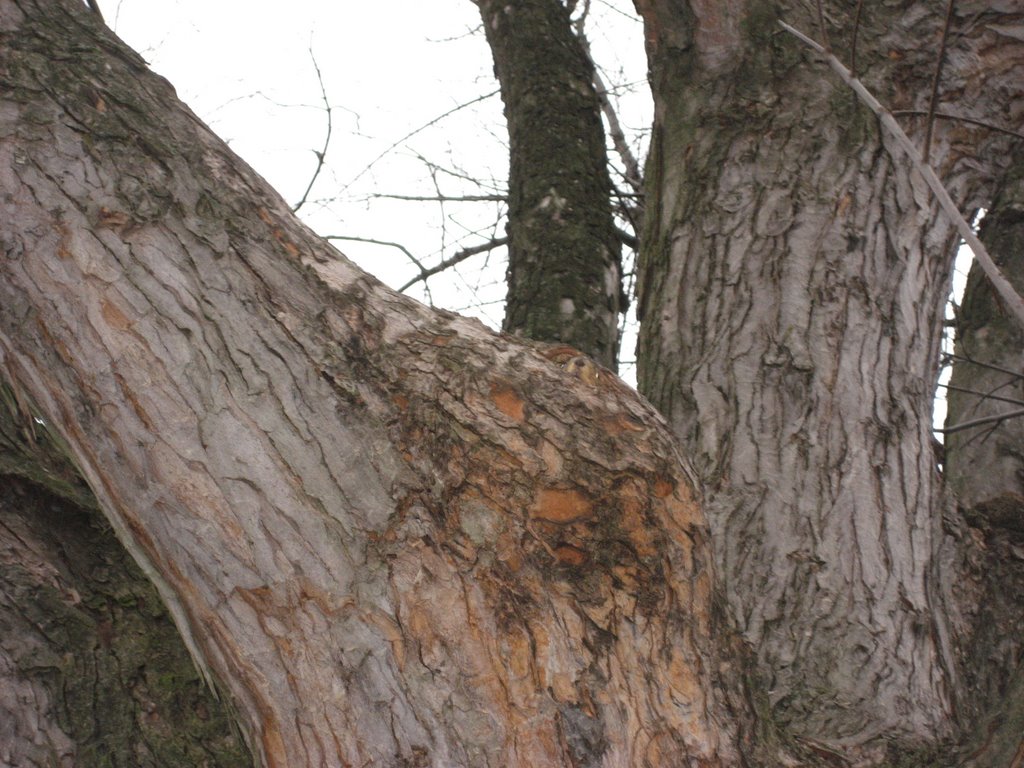
(Look at the center of the knot in the tree, and you'll see its little head peeking out. Click on the picture and magnify if necessary.)
Monday, January 8, 2007
Look what I'm in for!
(Edited for clarity)
Yesterday I packed up the Christmas ornaments and disassembled the Christmas tree. That must mean today is the beginning of the new semester for Rust Belt U!
As I write, Bullock has started his first class of the day. My first class starts tomorrow -- both of mine are in the exact same time slots as his but on opposite days, weirdly. It's a good thing they don't start until tomorrow, since I'm currently in pj bottoms and a minor league baseball t-shirt over long underwear. Nice!
Anywho, I spent the morning finishing up my review of the editor's comments on chapter 2 of my book. 3 more chapters and the works cited to go before January 25. I was kind of hoping to power through it before the semester began, but clearly that didn't happen. And now I have to plan for the first day of classes tomorrow. The syllabuses are written and copied, but I still have to make some short poetry handouts -- because, yes, I *do* use the whole class on the first day of school! -- and figure out just how much time to spend on various tasks on the first day. Every year I change what I do. In the medieval lit survey, for example, sometimes I ask students what they think of when they hear the word "medieval." Or I put a timeline on the board. Or I just jump right into some lyric poems. In Shakespeare tomorrow, I might talk about Will's life and times, or I might just jump right into a sonnet. In the classroom I'm often as New Historicist as I am in my work, but I'm starting to realize that sometimes students need a little bit of New Criticism first, and I'm trying to build in more close textual work, even when they're reading stuff in translation. So it might be good for me to start there in each of my classes tomorrow and get them to start participating and doing it themselves right away.
But so far, we're just talking about tomorrow. My subject line actually refers to what I'm "in for" for the whole semester. Last semester I had two graduate classes with a total of 25 students (though, keep in mind that that meant about 400 pages of grading at the end of the semester and a greater level of reading and other scholarly preparation on my part). This semester, I have two undergraduate courses with a total of 70 students (35 each). In one class they'll be writing 3 medium-length papers. In another, they'll be writing 6 2-page responses, a short paper, and a research paper with an additional proposal-and-bibliography aspect.
What have I done to myself?!!!!
Oh, and did I mention that I took on an independent study student? Or that I'm training for the Boston Marathon (on a more intense, but less time-consuming-than-usual 3 day/week schedule)? Or that it's admissions season and I'm the Grad Director? Or that Bullock and I will have Wiley with us until April? And then there's the little matter of my book, which I'll be indexing myself as I review the proofs in March (thank the FSM that that's supposed to arrive over Spring Break!).
Woo boy. By K'zoo time in May, those of you who are medievalists should expect to see a very exhausted Dr. V. But at least I won't be giving a paper there this year and can just use it as a well-deserved fun-but-still-professional reward at the end of the term. I'm going to need it!
Wednesday, January 3, 2007
"Student centered" does not mean "At the student's whim"
Just as I was feeling all warm and fuzzy about the impending start of the semester, one bozo does something to put me in a sour mood.
I went to campus today and while checking my mailbox there, the pre-semester stillness of the usually buzzing mailroom offered me the chance to notice a tidy little computer-printed sign that one of my colleagues had affixed to her mailbox, effectively blocking access to the box itself. The sign said something along these lines:
Don't even think about turning in your paper now.
- Dr. So-and-So
Heh heh. Not something I would have done myself, but I appreciated the tired if sarcastic sentiment of it (especially knowing that the colleague was a composition instructor with a heavy load). But that's not what put me in a sour mood. I then noticed another, smaller sign stapled to the first one, with the following neatly handwritten message in block letters:
STUDENT CENTERED
PROFESSOR
Oh for crying out loud. Since when does imposing a strict deadline signify that the professor is somehow not "student centered" (and by implication, supposedly only concerned with him/herself)??
Here's what I want to say to that student: I'm sorry, but when the university talks about being "student centered" they don't mean just you. I know, I know, it's in the singular, but it has a kind of allegorical ring to it -- like "Everyman." Just as he is every man, the "student" in "student centered" is every student. There are actually other students here at Rust Belt, and they turn things in on time, finishing their work in the time allotted to them. Should we be less centered on them and more centered on you? Should we, perhaps, forget our own deadline for turning in grades and let you turn in your work at your whim? Yes, that's right, we have deadlines to meet too. In fact, that's often why people create deadlines -- so that the work that has to be done subsequent to your part can get done on time. And when it comes to grading, most of us like to grade work from a single class all in one bunch; that way, if there's a problem or essay question or whatever that's flawed in some way, we see the patterns and cut students some slack. It's also a kind of norming, giving us a sense of what students in a class are capable of. So see, our silly, whimsical, self-centered deadlines really *are* about students. And exactly how do you think this flexible attitude towards deadlines will fly in, say, the world of law, or at the IRS, or commerce, or wherever? Do you think you'll suddenly and magically develop good habits when you leave school? Are we really doing you a service if we let you do work when you feel like it?
Sigh.
You know, what gets me is that so many of our students are totally instrumentalist in choosing majors -- they want something "practical," that will give them "real world" skills -- and yet so many (often the same ones) miss some of the most fundamental "practical" lessons that college is supposed to teach you or at least give you time to perfect: time management, responsibility, independence, and self-motivation. I could be teaching you the most bizarre, esoteric, obscure subject (and some might argue that I do!) and my class would still be giving you a pretty low-stakes way to hone those skills. And I'm sure my colleague's class is the same.
I don't often rant on this blog, but that little added note rubbed me the wrong way. I mean, if it had said, "The sarcarsm isn't necessary," I might have even agreed with it! But the writer had to go and act like the unthinkable imposition of a freakin' deadline was somehow a blow against all studentdom.
Please.
Tuesday, January 2, 2007
Happy New Year!
The Virago is back. (And so are Bullock and Wiley, of course.)
Classes start next week, I'm in the midst of reviewing the editorial changes on my book manuscript (it's actually fun! yes, I am a geek!), and I was even on campus today. Break? What break? And I didn't even have to squeeze in MLA (though I can't wait to read everyone else's tales -- I feel like I missed out). I'll get back to substative blogging shortly, but in the meantime, I leave you with a couple of pictures of how Youngest Niece spent her entire Christmas break: playing her new Wii. The back of her head is pretty much all the rest of us saw, too.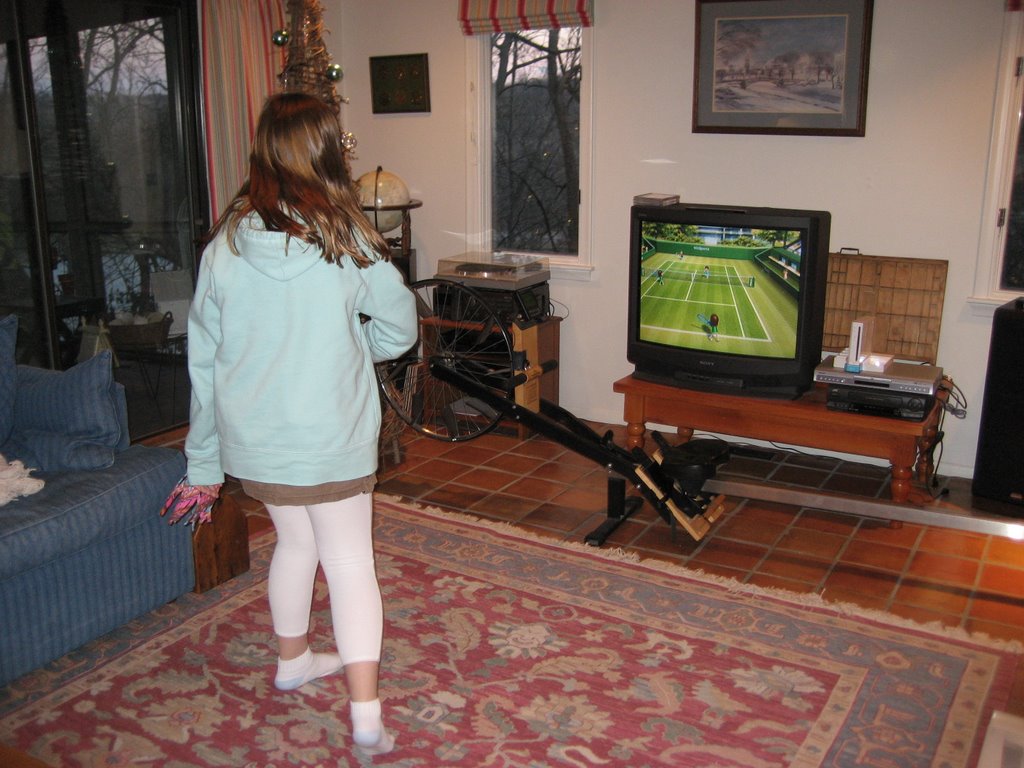

Friday, December 22, 2006
Happy Holidays from our home to yours
[Edited for typos. Nothing new to read here.]
Bullock and I are leaving for various home towns tomorrow and won't be back until the new year. I may be able to do some blogging from Cowtown, but I may not, so I wanted to wish you all a very happy holiday season with this virtual Christmas card. That's our brand new authentic fake tree -- plenty of room to start collecting beautiful ornaments (gift hint to relatives for future reference)! Note the candy canes used as filler and the rather bare bottom branches. Alas, all the pictures came out blurry -- I think the battery's low or the light was just too low -- but this is the least fuzzy of them. (Oh, and by the way, the fabulously perfect paint job on the walls, windows, and ceiling was all done by Bullock himself. He is truly multi-talented.)
And below, for Friday Poetry Blogging, I give you the Coventry Carol (with modern spelling).
May you have a very happy holiday season -- MLA and AHA included! -- and a splendid new year!
All our best,
Dr. Virago and Bullock
Lullay, Thou little tiny Child,
By, by, lully, lullay.
Lullay, Thou little tiny Child.
By, by, lully, lullay.
O sisters, too, how may we do,
For to preserve this day;
This poor Youngling for whom we sing,
By, by, lully, lullay.
Herod the King, in his raging,
Charged he hath this day;
His men of might, in his own sight,
All children young, to slay.
Then woe is me, poor Child, for Thee,
And ever mourn and say;
For Thy parting, nor say nor sing,
By, by, lully, lullay.
Thursday, December 21, 2006
MA thesis or exam? Or both? Or none of the above?
OK, here's a follow-up post to the previous one on our MA exam reading list. We don't do a formal thesis; instead, we have the exam and a "master's paper." While currently the official language doesn't compare it to a journal article, we're currently discussing making it more rigorous in some way or another, and I think a "potentially publishable" work of about 30 pages is a way we should go.
But I don't think we should go back to the old MA thesis. First, I think the 60-100 page document has no connection to what we do as scholars -- it's too long for an article and too short for a book. Second, our students (meaning the university's -- I'm drawing on what I know of the other MA programs) tend either not to finish or to drag out their time to degree when there's a thesis, and I don't want to contribute to the ever-lengthening time to the Ph.D. for students in the humanities. A stand-alone MA should be no longer than two years so the students can move on to whatever comes next. Besides, we can't fund them longer than that, anyway, and I'm also looking to reduce the number of unfunded semesters students tack on.
That said, the discussion list for directors of grad programs has lately gotten into this discussion, and I've seen some passionate arguments for the thesis. They fall roughly into two groups: 1) those who report that their students who go on to PhDs find that having already worked on a sustained piece of research and writing helps them with the dissertation; and 2) those who argue that a student will remember his or her thesis years later, but not what s/he wrote or said in an exam. The first argument moves me more than the second, but I wonder if the same can be said of a "potentially publishable work," since something like that takes sustained research and writing, even though shorter.
I also think something like that combined with some kind of exam that demonstrates more breadth -- though I'm still not sure what that would look like -- gets at the heart of the MA experience, which I think should give you the sense of the discipline and allow you the opportunity to show your "mastery" of its discourse and knowledge. (And I'm really starting to think that George Justice's description of a portfolio exam/capstone in the comments in the post below might be the best possible combination of all of the above. Thanks, George! And welcome to the blogosphere.)
What do y'all think?
Tuesday, December 19, 2006
Reading with my students
So I'm in grading jail, and what I'm grading at the moment are essays on the state of scholarship in the last 15 years on selected texts from our MA exam. And while I can assess the effectiveness of these essays pretty well without myself knowing the criticism of, say, Louise Erdrich's Tracks (it's all about the student convincing me s/he knows it), I realized that there are a number of texts on our MA exam that I either haven't read at all, or have only read excerpts of, or that I haven't read since I was an undergraduate. And yet, when it's my turn to write an exam, I'm supposed to write questions with these texts in mind. Hm. Maybe I should read them! Ya think?
So, I'm going to make a resolution -- not exactly a New Year's resolution -- to have read all the works on the MA exam list by the time the current 1st year class is graduated in 2008. Below is our rather odd list (seriously, isn't it bizarre?!), dominated by the 19th century and doing poor service to everything from the Middle Ages to the 18th century. (We're currently in discussions about that, but I've got a very stubborn colleague on the grad committee who thinks the list should be *shorter* and should just be a kind of exercise in "practical criticism" to show they can read a few things deeply. In that case, why not just give them random passages on the exam -- like the actual Practical Criticism Tripos exam at Cambridge -- and forget the list? Honestly, I have no idea what this list is suppose to be or do.)
Anyway, I've crossed off the texts I've read recently and know well. What's left is what I think I need to read or reread (so this isn't exactly a game of humiliation -- I have read Paradise Lost, for instance, but not since I was an undergrad).Chaucer, Canterbury Tales
Shakespeare, King Lear
Shakespeare, Hamlet
John Donne, Poems
Milton, Paradise LostSwift, Gulliver's Travels
Pope, Poems
Austen, Pride and Prejudice
Shelley, Frankenstein
Wordsworth, Poems
Keats, PoemsBrontë, Jane Eyre
Dickens, Great Expectations
Tennyson, PoemsConrad, Heart of Darkness
Yeats, Poems
Joyce, DublinersWoolf, Mrs. Dalloway
Franklin, Autobiography
Douglass, Narrative of the Life of Frederick Douglass, An American Slave: Written by Himself
Melville, Moby-Dick
Thoreau, Walden
Dickinson, Poems
Whitman, Poems
James, Portrait of a LadyEliot, Poems
Williams, Poems
Faulkner, The Sound and the FuryEllison, Invisible Man
O'Neill, Long Day's Journey Into Night
Rich, Poems
Morrison, Beloved
Erdrich, Tracks
And for discussion purposes: what do you think of this list? How would you change it if you could and why?
Sunday, December 17, 2006
Who taught you your moves?
Next time I teach the "how to do graduate school course," I'm thinking about assigning Graff and Birkenstein's They Say / I Say: The Moves That Matter in Academic Writing. It's a book written with undergraduates in mind -- and I'm also going to assign in my undergrad classes where I'm going to start requiring a research paper -- but my graduate students need it. Many of them probably came through undergrad programs where they didn't learn to write a research paper, and it seems a number of them haven't figured out yet that they can use the scholarly articles they cite as 'how-to' models.
I say this because I'm reading the papers from my other graduate course -- my seminar -- and realizing that many of the students don't know how to use secondary sources, how to integrate them into their own writing, or how to contend with them in their own papers. Some of them know how to integrate the sources grammatically and with some polish, but then the content of their papers is largely a review of the criticism and doesn't have much of their own argument. Others seem to think secondary sources can be used as evidence. One students keeps stringing together quotes from scholarly works following assertions about the primary text and with introductory phrases such as "For example." In other words, he'll say something like "Fart jokes are common in medieval literature" and then follow that with, "For example, This Dude says X, That Chick says Y, and Some Other Dude agrees with them both and says X and Y." And then he never cites any actual medieval literature! (Note: none of my students are actually writing on fart jokes in medieval literature. That's just my silly and totally fictious example.) And often they quote huge blocks when really all they had to do was simply say something along the lines of "So-and-so also notes this."
So next year, in addition to assigning this book, I'm going to spend some time giving them scholarly articles to read and we're going to do rhetorical analyses of them to see how those critics made "the moves that matter." Or something like that. I have until fall to figure it out. Any other suggestions? How did you learn to write a scholarly research paper?
Friday, December 15, 2006
What's an MA for anyway?
The subject line refers to a question a prospective MA student asked me yesterday, completely sincerely.
My response? "That's a very good question!"
I did have some answers for him, including:
- public high school teachers in our state are required to get one within 5 years of being hired full-time
- it's possible, though these days not as likely as it used to be, to get a stable job teaching in a community college with an MA (for more information see this thread on my blog, and this one over at Dean Dad's place)
- it might increase your marketability for jobs in publishing (though it's certainly not necessary)
- it might increase your marketability for in-house editing and writing jobs
- it's a way to test the academic waters before committing yourself to a PhD program (and without the hassle of the intense application process)
- those students who come from teeny, tiny schools and don't quite have the breadth or depth of study to make them competitive in PhD admissions, might do better with an MA
- those students who are changing careers or disciplines and weren't English majors might have a chance of getting into PhD programs with an MA
So I turn the question over to you, oh wise peoples of the InterTubes. What *is* an MA for anyway? -- that is, if you're not a high school teacher, which seems to be about the only category where it's the terminal and required degreee.
Wednesday, December 13, 2006
Show trials are fun! Confusing and full of inside jokes, but fun!
OK, I have to admit that even as a regular reader of Le Blogue Bérubé, I'm still a bit lost by the whole We Are All Giant Nuclear Fireball Now! Party and Chris Clarke Show Trial escapades. I think you have to have read every damn comment on every post for the last three months or so to really get everything. And who has time for that when there's a new 1000+ page Pynchon novel to read! (Not that I'll ever get to that since, to paraphrase Bardiac, I'm 600 years behind on my reading.)
BUT...I wanna play, too! So, to add to the list of charges against Chris I give you this:
He says he's not a feminist even though he is! He says instead that he's a "fellow traveler" and that sounds mighty suspicious. Who needs to travel when all you need is right here in the good ol' U. S. of A? And what does travelin' have to do with feminism? Hm? Clearly he's confusing a populace about what it means to be a feminist when they're already confused enough as it is! Heck, even I'm confused and I'm a feminist. At least, I think I am. See! Dammit! Confused! Makes head hurt!
Guilty, I say! Guilty! Guilty! Guilty!
Monday, December 11, 2006
Message from the Pastry Pirate
Since I (Dr. V.) have been craptacular at posting lately, and since it's the end-of-the-semester crunch time, I thought I'd let the Pastry Pirate pilot the ship today. She sent me an e-mail detailing her cross-country trip to Vegas and said I could post it as a shout-out to her blog friends. I've edited a few things to protect my pseudonymity, but other than that, the rest of this post comes straight from the Pirate's mouth!
Greetings all...I just wanted to let you know I arrived in Las Vegas to start my
externship at MGM Grand in one piece, though the same cannot be said
of my car, which is being held together by a wire hanger (no, really).
In the immortal words of Inigo Montoya: I ess-plain. No. There is too
much. I sum up.
Last Friday (Dec 1), a freak storm caused my apartment to lose power
while I was doing laundry and packing, so instead of leaving Saturday
as planned, I had to push things back and hit the road Sunday morning.
Wiley and I arrived in Rust Belt, home of Dr. V., Bullock, and the world's
most famous Lebanese actor, on Sunday night. Wiley seemed to settle quite
well into his foster parents' pad (that would be the lovely home of
Dr. V. and Bullock, not the Lebanese actor), perhaps because he overheard
Bullock say that he sees no reason not to feed dogs table scraps.
After a relaxing morning (it was nice to talk to grown-ups again!), I
set out from Rust Belt sans Wiley Monday afternoon and got as far as
Boonville, Missouri. The next day, I made it all the way to
Georgetown, in the heart of the Rocky Mountains, but not without some
peril. Outside Colby, Kansas, my Ford Focus tussled with a tumbleweed.
I thought nothing of it, but when I got stuck in Denver rush hour
traffic and had to slow from 90 mph to a crawl, I heard a horrible
scraping noise. I pulled over to the shoulder, got on my hands and
knees and discovered that the bottom of my car seemed to be scraping
the ground.
Not good.
I also discovered that Denver, or at least the area I was in, has no
gas stations. I got off the Interstate and drove around fruitlessly
with my car dragging and my fuel gauge empty light on until I found a
truck stop that was open. It was funny because all the tools, etc.,
they had were for trucks and dwarfed my poor Focus, but finally David
(born and raised in Brooklyn, in the process of moving to Las Vegas as
soon as he has enough for the Greyhound ticket... so far he's only
gotten as far as Denver, and no, I'm not kidding) managed to jack the
car up enough to crawl under it and inform me that half the screws of
my catalytic converter shield had been torn off, leaving gaping holes
behind, but that he did not have the right screw driver to either pull
the shield off entirely or repair the screws that had come off.
Damn tumbleweed.
David, who was very cute in a James Hetfield circa Garage, Inc. days
way and very sweet but, uhm, slow in a Joe the produce carny way (many
of you will remember my long lost produce carny...), said it would
take days to order the new part anyway because the shield itself was
unsalvageable. He then got excited with "an idea" that would get me
"over the mountains safe and to Las Vegas ok"... he ran into the
locker room and came out with a wire hanger, which he threaded through
the gaping holes, twisted and pronounced a successful repair.
I decided to trust him that my car would not become a fireball
somewhere near the Continental Divide because he said he planned to
look me up when he got to Vegas and seemed quite sincere.
David's jerry-rigging did indeed hold, not only over the mountains but
the following day, over the San Rafael Swell where the road seemed
much steeper. The San Rafael was also gorgeous in a bleak, hostile
sort of way, and I wound up stopping at all the geologic view points,
because you know how much I love that stuff. Much of the exposed rock
is from around the Permian extinction timeframe, which was the most
devastating with more than 95% of all species on earth utterly wiped
out. I dunno about you, but that gets my blood racin'.
I also love being able to see rock layers all twisted and bunched up
like taffy, and some of them were as tortured as anything I've seen in
Iceland. Every time I stopped to read the roadside plaque, however, my
car literally groaned. It made these awful noises when I turned the
motor off that, translated into human, were probably "ohh, my back...
my achin' back."
I spent Wednesday night in southern Utah, in the dumpy town of Cedar
City, because I wanted to arrive fresh and awake in Vegas. Good thing
I made that decision, because Vegas traffic is a bit insane.
Actually, the epiphany I had earlier today about Vegas is that it's
like a desert Moscow.
No, it's not that bad... but there are disturbing similarities. The
traffic, for example, is all six or eight lanes, and with a lot of
liberal interpretation of traffic laws and frequent U-turns. Every
time I do a U-turn, I think in my head "Vwot! Razresheniye!" and
remember with some fondness the insane dip-razes I used to pull in
Moscow ("razresheniye" meaning u-turn, and dip-raz being short for,
essentially, a diplomatic u-turn, as in a reckless manuever that only
someone with diplomatic immunity would try, such as a u-turn across
five lanes of traffic and in front of a cop with sirens blaring).
More Moscow similarities: you'll be driving along one block after
another of anonymous buildings (in Moscow, it's grimy gray blocks...
here it's strip malls) and then suddenly come upon an enormous,
ostentatious building that looks ridiculously out of place (the
Stalinist behemoths in Moscow, the hotels here, which exist off the
strip, too, and stick out even worse).
Also: regardless of the weather in Moscow, even in the heat of summer,
people would be bundled up. And here in Vegas, where it's 70 degrees
and sunny and I am melting in a t-shirt and jeans, I keep seeing
people in winter coats and boots and hats and scarves. Yes, there are
a lot of people in tiny clothes, too, but the number of people dressed
for an Arctic expedition is unsettling.
For those of you who know how I feel about Moscow, Don't Worry. I am
fascinated by Vegas, by its weirdness and foreigness. Quite frankly, I
think this is the most foreign place I've ever lived... it's just
so... *odd*... like the lady who waited on me at World Market
yesterday. She was about 50, my height and maybe 120 pounds, with a
very ill-fitting long blond wig and a lot of really, really bad
plastic surgery and strange, badly-drawn eyebrows. She was very nice
and I felt bad because I was trying not to stare, but wow, she looked
like one of the freakish Frankenstein nurses in "Escape from L.A."...
and don't tell me I'm the only one who's seen that movie! Also, in my
29 hours here in Vegas, I've already encountered at least half a dozen
people shouting that Jesus is coming and Hallelujah and so on. It's
already got me wondering if Vegas acts as a freak magnet, drawing the
troubled, or if people go nuts after living here too long. It's
probably both, so while I'm excited to be here, I'm also glad it's
only for a few months.
My apartment is nicer than I had thought it would be, though the
complex looks very dumpy from the outside. My unit is clean and quiet,
however, with big shade trees that let me keep the vertical blinds
open and still have privacy. It's about two miles from MGM Grand, and
I plan on walking to and from work as often as possible since it's a
safe, straight shot along Tropicana.
This morning I got my health card and now I'm running errands, picking
up some things I couldn't fit in my car. I don't start work until
early Tuesday morning, and between now and then I plan on visiting the
Liberace Museum (in a strip mall just two blocks from my apartment!)
and doing some hiking at the Valley of Fire, which sounds like my kind
of place.
This morning as I was walking out of the scary community health center
with my health card, I took in the brilliant sunshine (the sun really
is noticeably stronger here than in NY or Wisconsin) and cloudless sky
and had that gut reaction of "Wait! I have to go hiking today! I have
to go hiking RIGHT NOW because who knows when I'll see the sun
again!!"
Then I realized I'll be seeing the sun again tomorrow. And the next
day... and the next day... and the next day...
Thursday, December 7, 2006
Funny mix-up
I just received part of the birthday present I ordered for Bullock's upcoming birthday of a certain number, but instead of the very appropriate present I ordered for him, I got sent someone else's present: the book 29 and Counting: A Chick's Guide to Turning 30.
Too funny!
Wednesday, December 6, 2006
Welcome Wiley
[Edited to fix a link.]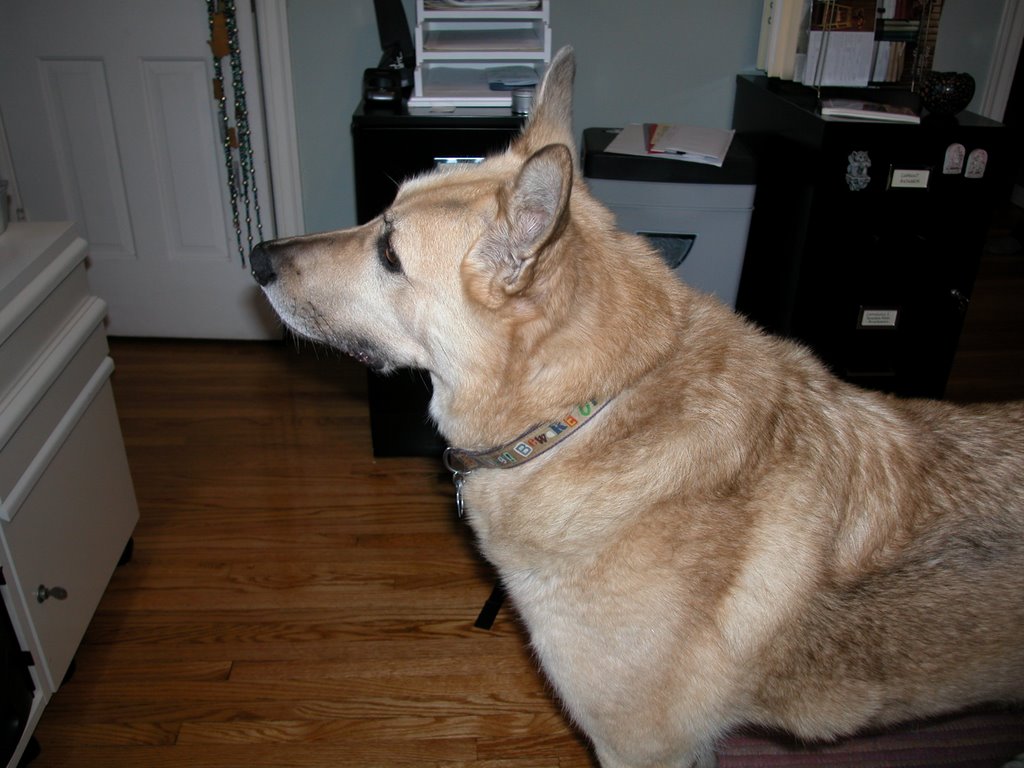
This handsome fellow staring at a squirrel outside my study window is Wiley. He usually belongs to the Pastry Pirate pack, but his "alpha bitch" (as she sometimes refers to herself) is on her way to Las Vegas for a 16-week stint in the bakery of one of the Strip hotels and couldn't find a place to live that would accept dogs bigger than pocket-sized, so he'll be running with our pack here in Rust Belt until late April.
Wiley is a type of laika -- a generic name for a set of closely-related Russian hunting dog breeds. Laika was also the name (not just the breed) of the dog sent into space in Sputnik 2. And, last but not least, Laika Dog is also a rock band from Yorkshire.
This is what Wiley has to say for himself (in first person!) in the introduction to "The Book of Wiley" (the hilarious and informative guide the Pastry Pirate left with us):
I am a very good boy, overall...I am very smart, but I also worry more than most dogs, sometimes about things that may make no sense to you, such as the bad Feng Shui of how you place my water bowl.Indeed, he has already moved his food bowl to the center of the room, away from the wall where we originally placed it. Fine -- we can walk around it. And so far he has been very good and very easy. He howled for a little bit after the Pirate left, and was kind of sad that first day, but now he's got his routine down and he's playing with us, eating healthily, and barking joyfully when either of us comes home from being at school or out. If you followed the laika links, you learned that the word "laika" means "barker." As "The Book of Wiley" states, "I bark a lot. It's my idiom. It's how I roll." He barks pretty predictably so far: at squirrels and other dogs, and when we come home. Oh, and when the old man who lives behind us makes doggy noises in an attempt to *get* Wiley to bark! (Well, at least the neighbors are understanding -- it's a doggy neighborhood.)
So everyone say hello to Wiley and give him a virtual butt scratch -- he really likes those!
Friday, December 1, 2006
Odds and ends
Edited to add a query to the internets: If you had to choose between MA programs in Medieval (or Medieval and Renaissance) Studies at the Universities of Leeds, York, and Durham, which would *you* choose? (Obviously this a question for the medievalists -- all disciplines.)
Woah. I really didn't mean to go silent for a week and a half there. (Random note: I typed "hlaf" for "half" at first, which amused me, as that would me "a week and a *loaf*" in Old English.)
Since we've been back from our Turkey Day weekend road trip, I've been running around like an acephalous farm fowl, but without any real reason for feeling so busy, at least not that I can think of at the moment. Hm. How does that happen?
The trip, by the way, gave me lots of food for thought about the zombification of the past, which, if I can find the time and space, I hope to write about. It also presented me with yet another Jesus, Son of Godzilla -- or maybe it's the same one and I just forgot which interstate highway it was on -- and I have things to say about that, too. I don't which is weirder, it or Jesusland Jerusalem in Orlando.
But now, a quick little story of academic happy happy joy joy. One of my favorite former students in the whole wide world just got word that she got into all three UK medieval studies MA programs for which she applied, and she forwarded the comments of one of the program directors to me. They're *very* impressed with her. She thinks it's all because of me, but really, she was fabulous all on her own. Anyway, I'm so very excited for her! I love it when good and exciting things happen for my students.
Tuesday, November 21, 2006
On a lighter, happier, livelier note...
I've got a production schedule for my book, at last! Woo-hoo! And it has a June 2007 publication date, so even if it's not completely ready for K'zoo, it will at least be there in proofs and ready for pre-order.
And I just got proofs back for one of the articles that are currently "forthcoming." So that's moving forward, too.
Just didn't want to leave for the holidays with the somewhat dark "speaking for the dead" post on top.
On that note, Bullock and I are leaving tomorrow for a trip to visit Virgo Sis in her natural habitat. Fast Fizzy and the Fizzy family will be there, too. (Dad will be staying in Cowtown, but Eldest Niece will be spending Turkey Day with him, so he won't be alone.)
And when we get back, Bullock and I have to get the house ready for a visit from the Pastry Pirate and her dog, Wiley, whom we will be fostering for 16 weeks while the Pirate is doing piratical things to pastry in Vegas, baby.
So you won't see any new posts for a few days. And in the future there may be dog stories every now and then. Consider yourselves warned.
Saturday, November 18, 2006
Speaking for the dead
Yesterday I gave a talk on my work in progress to our humanities research seminar, and since it was a pretty technical, specialist talk, I wanted to give an introduction that put it in a broader context, especially because I was speaking to a generalist audience, but also because the value of my work – why it should matter – has been much on my mind. Lately I’ve been feeling a little down about the worth of my work – my research in particular, but sometimes my teaching, too – and that has everything to do with the ways the current administration at my university has been treating those of us who work in the humanities and social sciences (or, for that matter, the pure sciences). I won’t get into specifics, but it’s gone way beyond the usual nonsense that humanities people have to put up with, to the extent that it’s been seriously affecting morale in these parts. So I’ve been thinking a lot about what the value of my work is, but not in some instrumentalist, utilitarian way. I think when you start to talk that way about education, it plays right into the hands of the technocrats who think the point of education is to give them a well-trained workforce and to meet their needs and their needs only.
This kind of talk is especially nerve-wracking for me, since it’s hard for a medievalist to justify her work on the basis of use-value and practical needs. Every now and then current events make the general public see the value of, say, a Crusades historian, but when one’s work is about a miscellaneous manuscript of anonymous saints’ lives and romances and allegorical poems, which was once owned by a London merchant who might have been “somebody” in the 15th century but is pretty much a “nobody” to the ages after, well then, you’ve got the kind of obscure-seeming project that’s just asking to be mocked by the utilitarian and instrumental thinkers. I mean, it’s not even about
So here’s what I said.
Lately, honestly, I’ve been feeling kind of down about my work and its value; after all, it doesn’t save lives and it doesn’t make the world a better place. So what use is it? [note: spoken with some sarcasm – there’s a context here for my original audience]. If we ask students what the value of studying the past is, they say we can learn from the past or from those who study the past. And as I often tell my students, we can point to medieval origins of much of our contemporary world including the university and the liberal arts. But that’s using the past as means, and I’d rather study it as an end in itself, to give it its own integrity and dignity, rather than make all about what it says about me, us, now – that’s “presentism.” Moreover, that use of the past as means can be abused. The medieval origin or association of something can be used to denigrate it: “how medieval” versus the privilege and supposed progress of modernity. Or, it can be used as a fetishization of “tradition” to oppress and to maintain the status quo – as in the conservative cry to preserve “traditional marriage.”
So, of what “use” is the past? In my teaching narrative in my dossier, I wrote the following, and I deeply believe it: “I believe in the humanist, liberal arts ideal that deep, critical encounters with lives, literatures, cultures, discourses, and ways of thinking other than one’s own makes one a fuller, better human being. In that sense, I hope students will ‘use’ their experiences in English courses for the rest of their lives.” That certainly includes lives, etc. of the past. But that’s about the classroom – what about my research? Why does it matter?
Having thought much about this in recent months, I realized just last night that while my work may not save lives in any literal sense, neither does any other work except temporarily, because ultimately we all die. Thus, those of us who work on the past speak for the dead, either as individuals or as cultures. We are all mortal, and we share this mortality with all life on earth; but what makes humans distinct is that we can memorialize, represent, study, and remember the long dead – their culture, their art, their literature, their governments, their disasters and triumphs, their religions, their social practices, their lives – and we, like them, can leave our traces to be so remembered when we are dead. We all die. And so to speak for the dead is to speak for humanity, for the human condition itself, and it is also to be human.
The dead I’m speaking for today wouldn’t have needed me to speak for them when they were alive. I’m talking about wealthy, powerful aldermen of late medieval London – the kind of men who were sheriffs and mayors, or the sons of them and who loaned money to the crown. Indeed, they’d be a little baffled and bewildered to have a woman scholar speak for them. In their world I couldn’t have existed! But “Dead White European Men” need us to speak for them, too, because the dead can’t speak for themselves. And these particular “DWEMs” really haven’t had much said about them at all (only the briefest mentions in books dedicated to their social milieu) And the manuscript they’ve inscribed their names on, as they knew it, has also been overlooked – though certain of the earlier texts within it have gotten plenty of scholarly attention, just not together. Plus, the texts are anonymous – there’s no Chaucer or other named author here – and even rich merchants aren’t kings or other world historical figures, so their reading and cultural practices have only begun to be studied in recent decades.
As for why I’m interested in them, I’ve always been interested in the readers and audiences for texts as much as or more than I’ve been interested in their authors. After all, I’m a reader not an author (at least not in a literary sense) and I fell into literary study because of that. More and more, questions of how and what and why we read (or don’t read) interest me more than how X author wrote. I never really needed Roland Barthes to tell me that the author was dead or that a text’s meaning lies in its audience, its destination – though when I first read that essay in college, I thought “Yes! I’m not the only one! Maybe I’m not a freak!” So that’s what this project is about: about a particular manuscript’s “destination” in the 15th century and its audience with 15th century merchants whose names are on its final folio. But it’s also about those larger questions of how and what and why we read, and how reading produces meaning, how it produces culture, questions that I’m not the first to ask certainly, but which still have not been fully answered, for the dead or the living.
Thursday, November 16, 2006
I got bupkis
I know I promised to get back to substantial posting and I really want to live up to that promise, but I've got blogger's block. In lieu of real substance, I offer you a moment in the life of Dr. Virago and Bullock (who is also a Dr., btw, in case you didn't know that).
[Setting: a really comfy, tomato red couch facing a ridiculously large TV. A man and a woman sit on the couch, mesmerized by a local television commercial with embarrassingly poor production quality and an annoying, repetitive catch-phrase. (Seriously, I don't remember local TV commercials this bad since about the 1970s.)]
Dr. Virago: Wow. That was incredibly annoying.
Bullock: Yeah, that was so annoying it made me want to vote Republican.
Dr. V: Huh?
Bullock: You know, like the annoying robocalls.
Dr. V: Huh? But I thought those were by Republicans.
Bullock: They were. And they may have made a difference in about 7 races.
Dr. V: But wait. Why would the commercial make you vote Republican? Why did the robocalls work? I don't get it.
Bullock (sighing patiently at Virago's wonk-less-ness): The annoying robocalls seemed to be from Democrats. They posed as pro-Democrat calls and called Democratic households.
Dr. V: I know, but why would they make you want to vote for the Republicans who made them?
Bullock (continuing with utmost patience): Because, people would hang up on them, as usual, but they were programmed to keep calling back. And they were programmed to call at dinner time, during local sporting events, and even in the middle of the night.
Dr. V: Go on.
Bullock: And if you didn't listen all the way through -- and most people didn't -- you thought they were from Democrats...
Dr. V: Oh, I get it. So people got so annoyed at all the calls from "Democrats," they voted for Republicans out of spite.
Bullock: Exactly.
Dr. V: So this commercial is so annoying, like the robocalls, it's making even you, a Democrat, want to vote for Republicans.
Bullock: Yes -- now you get it!
Dr. V: Wow, honey, that's a really obscure joke.
Bullock: But see how brilliantly it comes together once you get all the pieces?
Dr. V: But honey, it took me an 8-step process and I have a Ph.D.!
Bullock: Do you think this is why my students don't laugh at my jokes?
Tuesday, November 14, 2006
Postcard from Profgrrrrl

Yay! Bullock and I finally got our postcard from Profgrrrrl, mailed nearly two months ago, I think. Perhaps the batch ours was in took the scenic route? Speaking of scenic -- wow! Gorgeous! Just gorgeous!
Sunday, November 12, 2006
Who knew?
ETA: OK, I conflated the Welsh and the Cornish in my babbling about pasties and miners below. D'oh! Pasties are Cornish. And the miners who brought them to the UP were Cornish as well. But the miners in southern Ohio were indeed Welsh. But wait, there's more! -- see below.
So I've spent at least half of each of the last three days compiling a mailing list of every high school English department in our metro area and every college and university English department in the upper Midwest that doesn't have an MA program -- all for recruitment purposes for our own MA program. And since I'm doing this on the web and not in phone books, it gives me opportunities to learn all sorts of interesting things about education in my metro-area and region of the U.S. because it's hard to keep myself focused on getting the basic information I'm there to get. Clicking around is almost second nature!
For one thing, I've learned that you can do three electives in gourmet cooking at one of our area's best public high schools, and that graduates have gone on to the CIA (the culinary one, not the government one). I wonder if they'd take an "adult learner"? Te-hee!
I've also learned that there are an un-frakin'-believable amount of tiny colleges in this part of the country. Seriously, how do these places survive?! Now, some of them are Christian colleges with very active religious missions, so I suspect they have a very directed marketing campaign. But how do the rest survive? These are the kind of places that are so tiny that they have departments of "language and literature" where there are five English profs, a Spanish prof, and maybe a French prof. Our area high schools have bigger faculties -- and their own, separate departments of English and Foreign Languages! (Clearly my life-long association with research universities is beginning to show here. But dang, even the SLACs I know something about are about 10x the size of these places. Maybe we should call them TLACs for "Tiny Liberal Arts Colleges.") Anyway, I'm especially targeting these places because their students really need our MA program if only to get a decent generalist program of study in English for whatever their goals are. They probably wouldn't be able to get into most Ph.D. programs with their majors in "English/Humanities."
But I've also found out all sorts of little cultural and historical tidbits. I remember last summer finally learning how the "pasty" (pronounced "past + y" and not "paste + y"), which I think of as belonging to certain parts of Great Britain, became the regional treat of the Upper Peninsula of Michigan and parts of Northern Wisconsin -- the Welsh Cornish miners who worked there brought it with them. But does Northern Michigan University, situated on the Upper Peninsula, have a center for Welsh Cornish studies? No, it does not. Meanwhile, it turns out that southern Ohio is a region with a Welsh heritage, also related to mining, and so much so that teeny weeny University of Rio Grande (and no, it's not in Texas) has a Madog Center of Welsh Studies. There's even a Welsh Scenic Byway in that part of the country. Who knew? Now I totally want to take a scenic drive there someday.
ETA: OK, so while the Welsh were in southern Ohio, the Finns were waaaay up yonder in Michigan's UP, founding Finlandia University on the tip of a smaller peninsula jutting into Lake Superior (pretty much as far north in Michigan as you can get). And get this: you can major in Finnish studies! Again, who knew?! I'm learning so much about the upper midwest.
And now I swear I'll stop updating this post.
Ah the internets -- making a boring task fascinating and much, much longer that it really should be! Sigh.
Wednesday, November 8, 2006
Well *that's* interesting
The powers that be at my university think that our future lies in science and technology education, and that such should be our focus. They say they think this because it will best serve our region and will provide our constituents with the best chances at jobs.
Perhaps they should have a look at this study by the National Science Foundation. According to the summary on InsideHigherEd:
More than half of those who graduated with science bachelor’s degrees in 2001 or 2002 were employed outside of science and engineering or unemployed, non-students by October 2003, according to a report released by the National Science Foundation. The report features numerous tables on the post-graduation work and education histories of science graduates.I still need to look at all the tables, and those of you out there trained in statistics and survey methodology (that means you, Bullock) will probably have more substantive things to say about its methods it than I (though I just want to note that it weirldy includes the social sciences). Right now I'm just posting this without much comment as a way to get me back on track with substantive posts, including those posts about just what it is that I think a liberal arts education is supposed to do.
Things to celebrate
Yesterday was an auspicious day in America.
Finally, the long national nightmare of the Britney Spears - Kevin Federline marriage is over.
Tuesday, November 7, 2006
Election Day academic humor
On today, election day, I thought everyone could use a little election-inspired academic humor (funnier than the silly card in the post below). If you haven't seen this before, you need to check it out: it's a parody of a negative political ad, created in good humor by Jeremy D. Mayer, Associate Professor and Director of the Masters of Public Policy Program, School of Public Policy, George Mason University. The subject of the ad is John G. Geer, whose book, In Defense of Negativity: Attack Ads in Presidential Campaigns, makes the argument that negative campaign ads benefit the democratic process. Here's Mayer's parody negative ad about Geer:
I loved the bit about the "8 jobs in 14 years." I never thought how weird that might sound to someone outside of academia! Too funny! And the best part of it all is that Geer apparently thinks it's funny, and the U Chicago Press even posted about it on their blog (yes, they have a blog).
Sunday, November 5, 2006
And now for something completely different
The former blogger known as the Pastry Pirate sent me this card not long ago:
...and now you are, too.
(That's what is said on the inside.)*
I'm not sure if she sent it to me because a) she knows the word "monkey" makes me laugh, b) she knows the fact that the chimps on the card are *apes,* not monkeys, would drive me nuts, c) the thought that I wouldn't know whether to laugh or get frustrated ("Apes! Dammit! Apes!") gave her sadistic pleasure, or d) all of the above. All I know is that I'm sharing it with you all for a little levity and easy reading after my last 3000-word post! And also, I'm practicing using my scanner! :)
*Image and text provided for demonstration purposes only and will be removed upon request. Copyright AGC, Inc., Cleveland, OH.
Thursday, November 2, 2006
Liberalpalooza: Inside the Humanities Classroom
The mysterious Bitch, Ph.D.
The mysterious
Ooh, such august company! And to be as mysterious as Dr. B! Cool! (And for those still beating the dead horse of the pros and cons of blogging under a pseudonym, this is the main reason why I remain pseudonymous: because my pseudonym is cooler than my real name.)
But enough about me – on to the book event. First of all, for my non-academic readers, especially those who read no blogs other than mine, What’s Liberal About the Liberal Arts?: Classroom Politics and “Bias” in Higher Education is by Michael Bérubé, the Paterno Family Professor in Literature in the Department of English at Pennsylvania State University, blogger extraordinaire at the currently titled Le Blogue Bérubé, public intellectual, postmodern literature and cultural studies scholar, father of an exceptional child, co-director of Disability Studies at Penn State, and also a really fast talker. (He has also been said by some to be a “whiz-bang manic trendy,” and he only half denies this.) One of the recurring topics of his blog (along with Theory Tuesdays and Arbitrary-But-Fun Fridays) and of his public (i.e., general, non-academic audience) writing is the attack on the academy by figures such as David Horowitz (“author” of The Professors: The 101 Most Dangerous Academics in America) who claim that the preponderance of liberals on American campuses is both the result of active discrimination against conservatives in the academy and also a danger to American youth. Part of What’s Liberal directly addresses the claims of Horowitz and others, while part of the book takes the reader into Bérubé’s classroom with examples of just what happens when students disagree with him and with each other – with an emphasis on Bérubé’s areas of expertise, American literature and culture, and the (often poorly defined) bogey man of many a conservative commenter and blog troll: postmodernism. If you go to Bérubé’s blog, you’ll find reviews of the book listed in the sidebar; I don’t feel the need to add yet another one since a whole bunch of reviews ad infinitum would make a very boring book event for the Valvesters. So if you want a review, go check out those links.
Instead, I’ll do what I think this blog does best, which is, in part, to shamelessly use someone else’s writing as inspiration and general theme and provide my thoughts on the subject. Oh, and also, to talk about concrete examples of what goes on in my classroom and my work in order to give the world out there a sense of what it is assistant professors at regional, public, non-flagship universities do all day.
When I first read What’s Liberal, I thought: man, I *wish* my students were this combative, or at least questioning and argumentative, or even, at the very least, talkative! I spend so much of my energy and time in the classroom and in the preparation of my classes and assignments teaching my students how to be students in a liberal arts tradition, how to analyze, argue, discuss, think, use evidence, and write persuasively, that I don’t have much time or energy left to care whether their assumptions are coming from the left, right, center, or some bizarro-world point off the political map. So many of them would rather please their professors than argue with them, and so they often give tentative and brief answers that stop short of arguments, use “hedge phrases” like “Well, I don’t know if this is right,” or else keep quiet and save their energy for the graded stuff. And some of them are so exhausted from trying to take on full-time school on top of full-time work, that they have little energy left come class time. I find myself saying “Say more” a lot. And I’ll do it until the cows come home, and I’m also perfectly content with awkward silence, which is good, because I get it a lot. I’m trying to work on my assignments and course structure to get them to process more before class. Like I said: I spend a lot of time teaching them how to be students in a liberal arts tradition.
Likewise, when it comes to papers and other assignments, I think Bérubé has slightly higher expectations than I. He writes of his own grading practices:
All I ask is that their interpretations be plausible, and my criteria are lawyerly and austere. One, I read their essays to see how well they handle textual evidence, that is, how well they support whatever claims they make by reference to the material in front of them; and two, I want to know how well they anticipate and head off possible counterarguments. That’s it. Meet those two criteria in my classroom, and the field of interpretation is open.
If I had written that, it would look like this: All I ask is that they have an interpretation (instead of a summary), that they use textual evidence, that they make claims, that they realize that to be an argument their ideas must plausibly have counterarguments. That’s it. Meet those criteria in my classroom and I’ll be so happy I’ll cry tears of joy. Go beyond those criteria and make a persuasive argument with nuanced handling of the evidence in support of those claims and I’ll do my happy dance for you. And I don’t say that to be mean to my students; clearly they’re not getting this instruction before they get to my classes, and if I don’t insist on it, the problem will replicate itself, because many of these students are Education majors and will be the teachers of my future students. Scary.
Anyway, in my specialty field – medieval literature – my biggest problem is trying to get students not to be so “presentist,” not to read the texts only through the lens of their own worldview, or at least to recognize when they are doing so. Such presentism can come from any explicitly or implicitly political direction or it can be largely apolitical, as well. What such comments have in common is that they are usually so wildly off topic that I have to reign the students back in and get them to focus on the text again. They very well may perceive this as “bias,” and they’d be right: I’m biased towards discussing the literature in terms relevant to it, which may or may not be how we perceive it now, depending on the text and the terms of discussion. Let me give a few examples, from one of my medieval lit courses and also from the introductory course for the English major, in which the texts we explored ranged across British and American literature.
In one of my
That kind of moment can stand in for the bulk of my classroom experience. Getting students away from free-association, impressionistic readings and getting them closer to the text is, I’d say, about 50% of what I do in the classroom. In the example above, the comment wasn’t expressly political on a Democrat-Republican scale, but it was implicitly about gender, and it was ultimately about the different subject positions of male and female readers, an idea developed by modern feminist critical practices but certainly not foreign to the Middle Ages. But then students don’t seem to balk when I talk about those things in
And sometimes, that means steering conservative students away from their free-association responses, too. In another classroom, we were discussing the opening scene of The Tempest – the storm scene in which the ship’s crew and the royal passengers are at odds over issues and sources of authority. The shipmen know how to sail, and therein lies their authority; the various kings and dukes think they have the authority of royalty and that the shipmen should follow their orders. And of course, they’re all equally subject to the power of nature. The problem is less about who has greater rank than about which kind and source of authority matters here, and that’s an interesting issue for the rest of the play. But one of my students was having none of it. He brought discussion to a halt with an awkward analogy to
And at this point I have to say that’s the only example I’ve had of students being openly political in my classes, and I’ve been in the classroom for a dozen years now. And I’ve only ever gotten a single student evaluation in all those years that suggested that I graded based on a political bias. The vast majority of complaints about my grading are that I’m too hard. That’s it. One guy once, in twelve years and hundreds of students, said that if you weren’t a feminist you got a bad grade in my class. This was in a lower-division, general education literature course, and the texts we discussed ranged in time from the Anlgo-Saxon era to the 1980s, and included all sorts of texts from different historical, cultural, and political contexts. Of course, like many quirky comments, I knew exactly who it must have been, and why he wrote it. I had given him a B- (ooh! really bad grade!) on a paper in which he argued that Charlotte Perkins Gilman’s The Yellow Wallpaper is pro-patriarchy, that it shows that John, the husband in it, is just trying to do his duty as a man and a husband. Now, for those of you who don’t know, The Yellow Wallpaper is a about as unsubtle a hit-them-over-the-head-with-your-message feminist text as they come. (OK, there are those who would argue with me on that point. It’s a complicated text, but I really wouldn’t call it subtle.) But the student had some good points. Certainly the character
So what’s the point of this post of Bérubian length? In part, it’s the same point as the ‘classroom chapters’ of What’s Liberal About the Liberal Arts: that what goes on in the classroom is complex, both on the observable levels and in the unobservable motivations of students and professors. I also think that the more stories of what the classroom is like, the better, since popular culture is full of strange and silly images and narratives of the classroom (especially literature classrooms!), even without the stories of “liberal indoctrination.” That’s one of the values of those central chapters of What’s Liberal – they let you in on an extraordinary classroom experience with a master teacher (for the mere price of a book! Even for non-Pennsylvania residents!). As for me, I’m at best a journeyman, still perfecting my craft. But the more stories the better, for what really allows the myths and rumors and misunderstandings to flourish is the distance that most people have from their own college experiences, if they even had them. Anecdotal evidence, I know, doesn’t make good policy argument, but narrative is still a powerful tool for understanding the lives and minds of others. It’s why I do what I do – as a scholar and teacher, and also as a blogger.
Wednesday, November 1, 2006
Should I call bullshit?
So one of my grad students is spreading bullshit. S/he's telling other students -- who are then telling me -- that s/he got into a very prestiguous Ph.D. program, with a fabulous fellowship, all within a few weeks of submitting the application this semester and then having a phone interview.
Um. Where do you start with "that's not how it works"?
And that's the problem I have. I really couldn't care less that this particular student is parading around like a peacock based on total fantasy. Heck, it might even have the benefit of giving hope to our often self-defeating students. But the thing is, this story is not how it works (especially given the school s/he's bullshitting about). And my students already have enough crazy misinformation and bad advice running around in their heads as it is. Knowing some of my students, if they submit applications and don't get accepted until March, they might spend the rest of their graduate careers thinking they weren't as nifty as the bullshitting student. Or, if they submit applications and have to wait until March or April, they might have neurotic fits of insecurity in the meantime. Seriously, the more neurotic fits I can head off at the pass, the better.
With the two students who told me this "news" about the bullshitting student, I had different reactions. To one of them, who's a pretty reasonable person, I said, "Really?? Because that's not usually how it works." I'm pretty sure that planted enough doubt in her head that she checked things out for herself. And then the other student was so wowed by the very idea of fellowships that I decided to steer the conversation to that.
And maybe I just answered my question, which was what the hell to do about this, if anything. Thoughts?
Uh-oh, now what? (On feeling relief and a lack of motivation)
On Friday I turned in a revised article as a response to a revise-and-resubmit peer review. Since it was all being done electronically, one of the editors (it's a book collection) got back to me on Monday and said she was satisfied with the revision and hoped the co-editor would be, too. Wow, that must be the shortest turn-around in the history of academic publishing! And it's a good thing that she said yes (and, I hope, the other editor will, too) because originally I thought the response was accepted-with-revisions and not revise-and-resubmit, and my merit and renewal documents and dossier all say that the article has been accepted. Oops. (The letter was vague, I tell you! You would have been confused, too!)
But that's not what the "uh-oh" in my post title is about. Instead, I'm feeling this immense sense of relief and a dangerous sense of liberty because for the first time this semester I don't have a grant or article or abstract deadline looming. I do owe some friends and acquaintances feedback and other things I promised I'd help with, and I've been putting all of those things off for months now. And, of course, there are things to be done for my current classes and as graduate director, such as reading (no grading at the moment, however -- ah, the bliss of all graduate courses this semester -- no major grading until the very end!) and putting together recruitment packages to send to all the tiny SLACs and the RCUs in the area to tempt people to our MA program. And I need to call a meeting of the grad committee -- we really need to see if we can find a way to lighten the teaching load of our students, and we need to discuss the MA exam format. And the chair asked for flow charts of course selection processes (this is coming from the higher-ups --- it seems our new president is a "visual learner," and also, clearly, a micromanager) so I have to do one for graduate courses. And I really need to work on a clearer, more detailed, and physical (not just web-based) grad student handbook, because our students aren't as comfortable with hypertext links and web organization as we think they are. They like linear narratives.
But I don't want to do any of that. For the first time this semester I feel unburdened. And for the first time since, oh, I don't know, 2005, I feel on top of things. And I just want to take a little mid-week break and do nothing but go for a run, read for tomorrow's class, and meet students in office hours. Nothing but the immediate and necessary tasks, in other words. (Hey, running is immediate and necessary!) And did I mention it's a crisp and beautiful autumn day? But the blood of my Puritan ancestors is crying "Idler! Wastrel!" And the voices of hundreds of millions of other working people are yelling in my head, "Hey *we* don't get to take Wednesday off just because we feel like it...even if we do 'zone out' for half of the day." (Heh. I loved Office Space.) And there's also an Irish Catholic voice in there somewhere mumbling something about a holy day of obligation. Oh the guilt! (And now *you* are saying I should see someone about these voices in my head.)
Right. Ahem. Anyway....I'll probably at least tidy up my pigsty of an office and work on syllabuses for next semester, all of which is untaxing, soothing, and full of hope for the future. And then that will quiet the voice of the Protestant work ethic in my head. And this is why I got into this profession (well, one of the reasons, well below "because my work fascinates me" and "it suits my talents") -- so that I can decide *which* 60 hours of the week I'll work!


