And here's where I've moved to!
OK, I thought a post with that title might be more obvious on the blogrolls of those of you who use those updating blogrolls that show the most recent post.
That is all.
Friday, August 5, 2011
I've moved!


Sunday, July 10, 2011
Time for a change!
You know what this blog needs to get re-started? A NEW LOCATION! Yup, I've just moved into my new digs at a fancy Wordpress blog. You can now find me here -- just replace the blogspot in this old URL with wordpress to get you there (and to update your blogrolls and RSS readers).
I thought now was a good time to move since I'm entering a new phase of my career, the amorphous "mid-career" stage. I'm not only post-tenure, but post-sabbatical (I'm not hopeful that we'll have them any more in another seven years), so it seemed like a good time to upgrade the blog a bit.
I've got a introductory post up at the new place now, and I've also moved all the archives over from here. And shortly, I really will re-commence substantive blogging. I've got a post brewing about an infuriating e-text issue and tons of pictures to show you and stuff to tell you about my research trip to London (where I was too crazily busy to find time to blog). So go check out the new place and give me some feedback there.
I've been doing all sorts of house-cleaning and moving in the electronic realm, actually. I've moved the blog from Blogger to Wordpress, started up a Google+ profile (which I really hope will ultimately take the place of Facebook), and switched up the way I do e-mail. Basically, I'm trying to move Dr. Virago's world away from Google products (although I still have a Gmail account under that name) so that I won't find myself accidentally commenting under my real name on blogs or sending an e-mail to a friend as Dr. Virago. Plus things are just prettier and sleeker over at the Wordpress blog -- go see!
Saturday, April 30, 2011
Sabbatical makes for boring blogging
Sorry for the radio silence lately, but there just hasn't been much to talk about, really. *However*, I'm leaving today for six weeks in England, so maybe I'll have more to tell you about from there. The flat I'm renting is in a celebrity-rich part of Belsize Park, so I'll be sure to tell you if I have any star sightings. :)
Friday, February 11, 2011
Who the heck is the audience for a "companion to" piece??
I have been tasked with writing a chapter for one of those "companion to" books, one with a *huge* charge: all of medieval British literature. So I'm writing a single chapter on a single very large genre (rather than, say, writing a more focused chapter for a guide to said genre). And worse, its word limit is 7500 words. (OK, that's 30 double-spaced typescript pages, but still, it's a big topic!) I'm feeling a little overwhelmed by the task before me.
But what most has me puzzled is just who I'm writing *for*. The style guide gives me some help, as it clearly privileges a synthesis of scholarly debates over an encyclopedia-like summary of the primary texts. But then it hilariously says it should be aimed at "undergraduates, graduate students, and scholars." Um, OK, then who the heck *isn't* it aimed at? (Well, a "general audience," I suppose -- but I kind of assumed that already.) And though it emphasizes scholarly debates over the primary texts, it also says I shouldn't assume too much detailed prior knowledge.
*headdesk*
Can my wise and witty readers help me out here? I've got some ideas, but I thought maybe I could spark some discussion about what is and isn't helpful in these guides and companions. In the case of my subject, I see non-specialists in it get all sorts of things wrong because they rely on out of date scholarship (i.e., what they learned in grad school or college years ago), and imho, no subfield of medieval literary studies has changed its mind so much about the basic facts as this particular subfield has. So beginning researchers are entering a minefield of bad sources. I think I should perhaps keep that in mind in my writing, perhaps even make that one of the shaping ideas of it. That would be helpful to anyone turning to it for a crash course in the subject. But I don't want it to sound like my "how to do research" class for first-year grad students; I don't want to talk down to people.
And on the other hand, one of the problems I have with many of these "companion to" essays is that they don't start at the beginning, that they do, in fact, assume too much knowledge, especially for undergrads and beginning grad students, so that reading one is no different than diving into any random point in the scholarship. And I don't want my chapter to be one of those, either.
Oy, what to do? Any thoughts? And if there are models of what you think makes the perfect "companion to" essay, lead me to it. Of course, different series do it differently, but even without those series, there's a lot of variety, so any model is useful. And if you were trying to bone up on a field, what would you find most helpful?
(Yeah, I'm being vague, I know. But hey, now this post applies to ALL the fields of literary studies!)
Tuesday, February 1, 2011
My super-awesome, brand-new early medieval lit course for the fall; or, something to be excited about!
OK, I should be doing research work now—I still haven't been as productive as I'd like to have been this sabbatical—but I'm excited about one of my fall classes and I wanted to tell you all about it, both in terms of its content (which the medievalists should be interested in and can give me feedback on) and in terms of its methods, objectives, and assessments, which just about anyone in literature or the humanities more generally might have something to say about. And can I just say that I'm glad I'm finally looking forward to teaching again? Some of you may remember a post from last semester in which I admitted I was burnt out as burnt out can be. It's amazing what time away plus a revamped course can do to get you excited again!
First of all, let me give you some background on the revamping. Here in the RBU English department, we have one undergraduate course on the books for the broad medieval period (which, btw, is "slashed," or combined with the lower-level MA course). We also have a Chaucer course. I can come up with other courses and offer them as special topics, but our students seem to be allergic to special topics, thinking they won't count for anything, even when they will—even when we say so in the course description. (Problem number one is that they don't always read the course description—the one written for that semester's particular version of the course—and if they read anything, they read the brief, vague catalog description.) Anyway, in previous years I treated the everything-but-Chaucer course as a kind of smorgasbord introduction to the entire medieval period, from the Anglo-Saxon period through the 15th century and even a little into the 16th (if we count the performance history of medieval drama). I used to put up a timeline on the first day to show them that we'd be speeding through more centuries of literature than all of their other English literature courses combined! It was enough to make my head spin, and I'm used to thinking across large swaths of time. In the very beginning, I tried to get some Irish and Welsh literature in there as well as Old English, Middle English, Anglo-Norman, and Latin literature, but the one time I did that, the class was an amorphous mess of "If it's Tuesday, this must be The Táin " kind of sampling. Bleh. So after awhile I started whittling down to the texts I most loved to teach or knew best. And for awhile that worked, but I knew that my students and I were both missing out on so much other good stuff, and I was starting to feel my brain atrophy. So, two years ago, with the encouragement of the undergraduate studies chair and the vote of the faculty, I changed the course description in the catalog to say that subsequent semesters would alternate between the earlier and later parts of the 8+ centuries of the medieval period, with some semesters offering thematically arranged topics across the whole period; it also directs students to consult the course description on the department website to find out the current topic. We also made it possible for students to repeat the course for credit if the specific topics are different (this is especially important for any MA students who are interested in the Middle Ages, but may also be true of some undergraduates).
So. Here we are approaching book-ordering and course description-writing time for next fall and I have to make good on my promise! This fall I'll be devoting the class to Anglo-Saxon, Norse, and Celtic (ASNaC) literatures, roughly those written or thought to have their origins before the full conquest of the Normans (for the Anglo-Saxon, Irish, and Welsh literatures) or from roughly the same period for the Old Norse literature—basically up to the 11th century for the Anglo-Saxon literature and up to the 12th and 13th centuries for the rest. There will, of course, be a little fudging, but the next time, I'll start with the Norman invasion in England and stick to the British Isles. And then after that, having taught a bigger range of texts, I'll know better what works for the students and what works together, and I'll come up with a thematically arranged class.
Of course, my more historically arranged courses aren't going to be without their themes, and one of the driving themes of this ASNaC course is the interlocking contact of these cultures. The Irish sent monks to England; the Vikings invaded England and Ireland; Wayland the smithy shows up in the both Old English and Old Norse contexts; shape-shifters appear in Norse and Celtic texts; the warrior-poet (or at least the articulate warrior) is a recurring figure across the cultures, and text after text brings the poet and/or the scribe into the narrative; the surviving texts are all written or written down by Christians but often draw on the pagan past even for explicitly Christian subjects; and so on. I know that it's really difficult to show or prove direct influence between the vernacular literatures in these cultures, but I want to create a general impression of a multi-cultural, multi-lingual, vibrant—even violent—state of flux for the insular and peninsular cultures of the North Sea in and around the British Isles. And so my syllabus isn't going to be arranged in any neat geographic or chronological way (which would be really hard to do, anyway, given how many questions there are about dates and places of origin for so many of these texts). I don't have it all sorted out yet, but on the first day I'll show images of three material objects—The Book of Kells, the Lindisfarne Gospels, and the Franks Casket (especially the Wayland/Magi side)—to stage the shared cultures and influences, and also to begin pointing out the blend or juxtaposition of pagan and Christian narratives and themes (well, in the Franks Casket, anyway). The next day I'm thinking of either doing "Widsith," "Deor," and the Eddic "Lay of Volund" (to continue the "Wayland is everywhere!" theme, and also to set up the poet-as-hero idea with the first two), or else jumping into The Táin (after all, the Celts were in Britain first!), and doing "Widsith," "Deor," and "The Lay of Volund" after Beowulf, which I'd do after The Táin (to contrast "epic" heroic tales from two cultures). At any rate, I'm definitely going to intersperse appropriately analogous Eddic poems throughout the reading of Old English and Old Norse texts, and I may assign Hrolf Kraki's Saga right after the Beowulf -"Widsith" sequence, to get all those references to Hrothgar together. Usually I teach Judith after Beowulf, since they are manuscript neighbors, after all, and because I like to teach Judith as a response to Beowulf—especially as a rather critical response to the heroic drinking culture—which complicates the whole "yeah, we're Christians, but we admire our pagan ancestors" idea. But Judith could be fruitfully put off until after Hrolf Kraki. And skipping to the end of my syllabus, I'm going to put the Welsh last just to honor the fact that they were the last to fall to the Normans among the Anglo-Saxons and Celts. Well, they'll be sort of last, because on the very last day of reading, I'm going to assign "Pangur Ban," which is an Irish poem (and one of the oldest poetic texts on the syllabus), but which uses a Welsh word ("pangur") in the name of the poem's eponymous cat. And I'll be assigning it in Seamus Heaney's translation in order to reinforce the continued and very present-day vibrancy of this very old body of literature. (I also think it's a great poem to end with right before final exams since it depicts the scholar at work.) But The Mabinogi and Taliesin will get pride of place just before "Pangur Ban," even though the Book of Taliesin and "The Tale of Taliesin" are later in their manuscript forms than the dates I've imposed above. Like I said, there will be fudging.
So that's roughly the content of the course. I've got the list of texts I want to do and some rough idea where they'll go in the syllabus, but I haven't worked out the finer details yet, and in order to do that, first I have to, ahem, *read* some of these texts. I've never read most of the Old Norse material (or only in excerpt or summary form), but thanks to my friends on Facebook, I got a lot of good suggestions for stuff to assign and I'm going to sort through it this summer as I prep the class. And I'm excited to read it, too, because, hey, new stuff! (Well, new to me.) But I'm just as excited about the shape of the rest of the class—its assignments and their conception—as I am about the content. So lemme tell you about that, too, K?
For the undergraduates, there are going to be five graded components: participation, which counts a variety of ways of "participating" (10%); 8 one-page response papers (40% - 5% each); 10 submitted discussion questions (10% - 1% each); a 6-8 page essay in which they analyze at least three different translations of a text (20%); and a final essay-exam (20%). In the past I've taken exams out of my course assignments and replaced them with more writing assignments, but I've decided to put an exam back into the equation in this class for a few reasons. First of all, since one of the overarching themes of the class is the connections between the bodies of literature we're reading (even if those connections are nothing more than thematic), I want assessment that emphasizes seeing and articulating those connections, analogies, and parallels. A final, cumulative exam does that better than discrete papers on individual texts. I'm also going to emphasize making connections in the ongoing short assignments—the response papers and the discussion questions—both of which will also serve to keep students engaged in the material. Between the response papers and the discussion questions, they'll have to have thought deeply about at least 18 different texts assigned in the course (because they won't be able to do a response paper and a discussion question on the same text), which will set them up well for the exam. Still, concentrated focus and sustained analysis of a text is important, too, and that's what the translation analysis paper is about. And the response papers are about close reading, so those assignments are related in their skills, as well. But the other reason why I decided on a final exam rather than a final paper is something Tenured Radical said (though I can't find the exact post now) about giving students different ways to succeed in a class. Some students get neurotic about papers; some get neurotic about exams. I'm hoping that the short and largely informal nature of the response papers will keep the paper-writing neuroses down to a minimum, plus students can write them quickly (like an exam) or fuss over them, if that's their wont. And then the exam will be there for those who do well under pressure.
Meanwhile, the way I've set up preparation for the exam—especially since there's only one and it's cumulative—should help the students feel really invested in it and in the content of the course, as well as prepared for it. I'm really excited about this bit, because it's the first time I've planned something like this. Instead of assigning any new texts to read in the last week, the students and I are going to use that time to collectively write the exam. Like the discussion questions (and to some extent, the response papers), this is planned to help students realize that in many way they make the course what it is and determine what they get out of it; what's more, in both cases, I hope they'll learn by doing, rather than by merely responding. But again, it's also about the content of the course, about making connections. So, on the penultimate day of class, students will be charged with coming to class having reviewed the semester's work (oh, and yes, I'm going to emphasize note-taking in this class) and being prepared to talk about the themes of the course and its texts. (I am partly inspired on this point by Jeffrey Cohen's "Myths of Britain" class and their final review session, which he blogged about here.) And here's where I go crazy: after that class, they'll be charged with coming back on the final day with three potential final exam questions they've written themselves, based on the list of themes we've generated together. And we'll use that last day of class to select and hone at least ten questions. They'll know that the three final exam questions will come from that list of ten which they have helped to write, but I get to choose the final three. Now, I'm going to let them know this—and everything above—from the very beginning of the semester. In many of my classes, I give out the complete packet of assignments on the first day of class, and I intend to do that here, too (and schedule time to talk about each one on subsequent days). And so they'll know from the beginning that they're going to be responsible for helping to create the exam, but also that I reserve the right to do it myself if I think they're slacking or trying to get away with something. And the discussion question assignment will help them learn what really generates essay-length discussion and what doesn't. The pedagogical goal here is to get them actively making connections, cataloging, and sorting ideas as we go and in summary at the end of the semester. That's what a final exam is traditionally supposed to get students to do, but I find my students often regard a final exam itself as an opaque and mysterious thing and don't know how to go about making the broader-stroke connections it asks. If they have a hand in making it themselves, perhaps it will become more transparent to them—and that's a lesson they can take to other classes, too.
That's the undergraduate side of things. The graduate student side is a little different. First of all, I don't expect many graduate students to take the course, but for those who do, they'll have to do the response papers and discussion questions, too, as well as participate, of course. But instead of the short translation analysis and final exam, they'll have a graduate-level research paper in three stages: preliminary abstract/research question; polished abstract and annotated bibliography; and final paper. And I intend to make them meet with me for one group session about how best to go about the research and for individual sessions as they tighten up their research plan. But in keeping with the meta-theme of making connections—as well as accounting for the fact that it's rare that I have graduate students who want to be medievalists (the last two years bringing a plethora of exceptions, but still being the exception)—I'm going to allow them to write on issues of reception and revival if they wish. So if they want to write on Taliesin in The Idylls of the King, or Heaney's "Irishing" of Beowulf, or neo-Norse paganism and American pop culture, or whatever, they can. It might be harder for me to help them do it, but I'll enjoy learning something from their work.
So there you have it: a fall class almost ready to go on February 1st! Can you tell I was procrastinating? So, what do you think?
Saturday, January 29, 2011
Goggies! (That's "doggies" in LOLDog)
I've been transporting more dogs on their way to foster and forever homes since I first posted about doing this. And today was a treat because I got to meet my first German Shorthaired Pointers (GSPs) in person. Someone on the NBRAN volunteer list forwarded a call for drivers for a "GSP Express" run for National GSP Rescue carrying two 2-year-old GSP females; since it was coming right through our area, I volunteered. And I fell in *love*. If it weren't for the fact that Bullock *really* doesn't want a second dog and we're not sure Pippi would be happy to have a dog friend, I'd be signing up to adopt a GSP right now. And Bullock was pretty charmed, too -- I took him along because these were young and rambunctious dogs, and I knew I wouldn't be able to drive and manage them at the same time.
Anyway, let me give you a sense of how lovable they were. Meet Blue (the black and white dog on the left) and Cora (the liver and white dog on the right), two of the sweetest love-bugs I've ever met:
They look a little scared here (and wouldn't you be in their situation?), and Cora kept a kind of curious and serious demeanor most of the time, but they were also eager to be petted and to give kisses in return, and they settled into the car almost immediately. Blue even rolled over for a belly rub as soon as she got in the car, and Cora rested her head on the back of my seat, next to my head, for most of the ride as she watched where we were going. Blue, meanwhile, rested her head on the console in between the seats -- all the better to get ear-scritches from Bullock. And they were hilariously bi-polar: in the car they were mellow and calm (Blue even slept soundly for half the ride), but out of the car during the exchanges from one driver to another, they were insane balls of excitement and energy. Blue tried to crawl over my back to get out of the car as I untethered their leashes from the seatbelts because getting out of the car was SO EXCITING she just couldn't wait! But both in and out they were full of kisses and doggy affection. Adorable! And just look at Cora's eyes and reddish-brown fur. Wouldn't she look great with Pippi? And apparently Blue's coloring is rare -- it's likely she comes from a true *German* GSP pedigree since black and white isn't yet recognized by the AKC as part of the breed standard. Or maybe she's part English Pointer (which does come in black and white). Eh, who cares -- she was a doll. It was hard to hand either of them over, and now they're already half way through the next state in their journey. Sigh.
Btw, GSPs also come in a roan variation, like Pippi, and a roan GSP is the star of that Toyota "squeaky toy" ad you may have seen. ("Roan" in this context means the colors are blended together -- so liver and white are blended on GSPs and the orange and white is blended on Pippi. An American Brittany can also be liver and white, whether roan or not.) This also give you an idea of the crazy energy of a GSP. If you have a dog, you might want to play this video when the dog isn't around. Or, play it and watch your dog possibly go nuts looking for the toy:
Anyway, before Cora and Blue, I did two more Brittany runs. I promise not to post about *every* run I do -- I'll generally stick to notable dogs. But since I could never get Toby, on that first run, to face the camera, I thought I'd give you the opposite now. Meet Silas, who wanted to know, "What's that thing you're pointing at me? Can I eat it?"
Silas was a sweet, older gentleman, and a good copilot, as you can see here:
And before Silas, there was sweet, adorable Julio, a 10-month-old who wanted nothing more than to cuddle in my lap and get belly rubs. Luckily once he was getting said belly rubs, he was pretty calm -- a bit like the effect of a snake charmer's music on a cobra -- and so I was able to drive one-handed and rub Julio's belly with another. And oh, he was so, so soft. I often say that petting Pippi, who is also very soft, is like petting a bunny, but Julio was even softer. So I guess petting him was like petting a *baby* bunny. Heavenly! Unfortunately, what I wasn't able to get from Julio was a picture, because I was driving him after dark. But here are the small photos from the adoption site:

But don't fall in love with him -- turns out his foster already has and is adopting him. Hooray for Julio!
And what would a dog post be without a bonus picture of Pippi for all of her internet fans? Here's one of Bullock's 1,000+ photos of her (no, I'm not exaggerating!), this one from last summer:
Thursday, January 27, 2011
Advice for a budding medievalist (in literary studies)
Yes, I'm still here. Holiday travels and events, plus getting back into the swing of organizing my unstructured time, took a toll on my blogging. Also, I was trying to decide what to write about next and dithering over it until I got an e-mail today asking me to give advice to a first year undergraduate student at another institution who's interested in medieval literature and in possibly pursuing graduate studies down the line. And I thought, "Wow, that would make a great blog post, especially since it's medieval in content and I haven't written a medieval-related post in awhile (which means that Jonathan Jarrett has probably taken me off of his blog roll or is about to!)."
So let me share a draft of what I might write to him when he writes to me (it was his professor who first contacted me on his behalf and the student hasn't gotten in touch with me) and see what you think. Please feel free to add to or argue with what I say. And since it's advice for a student at a very small college, where departments consist of 3-5 people and no classical languages are taught, perhaps in the comments we can also make suggestions for those students at bigger colleges and universities. (And note that in the letter I *gently* address the "whether you should go to graduate school at all" issue. He *is* only a freshling.) Also, if my tone is too condescending, please tell me! I'm not used to talking to first years about graduate school!
Edited to add: with some minor revisions, you could easily adapt this advice to apply to any English major. Do a few more revisions, and it could apply to any humanities major or any other liberal arts major. Feel free to use, adapt, and link!
So, here's what I might write:
Dear Stu,
I'm so glad your professor put you in touch with me. I'm happy to answer your questions and give you some general advice about what to do to pursue your interests in medieval literature now and in the future. You're already *way* ahead of the game by thinking about graduate school already as a first year student. I didn't realize that I wanted to pursue a Ph.D. until I was already out of college, and I felt like I spent the first couple of years in graduate school catching up with what I didn't know. So, in a way, the advice I'm giving you now is what I wish I had done myself as an undergraduate.
OK, first of all, you have three and a half years to explore: to find out what you love, what you're good at, and who you want to be. Don't be so focused on the goal of getting into graduate school to study medieval literature that you miss your chance to learn new things -- things you might not even yet know you'll love. You can get more advice like this about college in general and how to get most out of it from the book The Thinking Student's Guide to College: 75 Tips for Getting a Better Education by Andrew Roberts (University Chicago Press). Not all of his advice will apply to you, since the author works at a big research university (Northwestern) and bases a lot of advice on what resources students at such big places have. For example, he says not to take too many courses with any single professor, but there are only 5 professors in your English department, so that can't be helped. Also, he has an annoying habit of saying that most professors are more interested in their research than teaching. That's definitely not true at your college, which is committed to undergraduate teaching, and it's not even true of everyone at a research university like his. But most of his advice is excellent and equally applicable to you as it is to a Northwestern student.
But now, on to the more specific advice about your plans to pursue medieval literature. First of all, as an undergraduate, you shouldn't narrow yourself too much beyond the major, and your major is English literature, not only medieval literature. Make your goal being the best *English* major you can be and you'll actually be helping your chances of getting into a good graduate program. Admissions committees in Ph.D. programs don't want to see someone so focused so early that they seem unwilling to learn or incapable of making connections across a wider literary history. As professors we often have to teach outside of our specialties in surveys and introductory classes, so the better educated you are in English studies more broadly (including English literature, American literature, comparative and world literature, and rhetoric and composition), the more flexible a scholar and teacher you'll be. If your department offers a literary theory course, be sure to take that, as you'll need it in graduate school, and it will give you the tools to think with as you study and write about literature now. Start thinking of yourself now as one who studies and thinks about literature and how it works, and not just someone who reads lots of literature. And to do that really well, it helps to think about how language works, so if take a history of the English language course if it's offered. It also helps to have experience thinking about as many different genres and cultural and historical contexts as possible, so try to take a range of courses that teach you about as many periods and types of literature as possible, even ones you think you might not like. Even if you still want to be a medievalist, those other courses will help you think about how literature works, and therefore how medieval literature works, perhaps in contrast to how a novel or short story or modern play or contemporary poem works. Take the maximum credits you're allowed in your major department, but don't skimp on related fields: history, philosophy, art history, literature from other cultures and languages (more on languages in a minute), and theater (especially theater history). As you're doing all this, get to know your professors, not just in class, but out of class in their office hours and any department events. The more they know you, your work, and your goals, the better their letters of recommendation will be for you. At a small college like yours, it's really easy to know your professors and for them to know you -- take advantage of that opportunity.
And as you get further in your major, start doing research and reading criticism about the works you're writing about. Write research papers for as many classes as you can -- ones that don't just summarize what other critics have said, but that enter into conversations with them, argue with them, and get ideas from them (with all due credit, of course!). Ask your professors for advice on what to read, on how to do research (if there isn't a course on research methods), and on how to write in conversation with the criticism you find as you progress in the major. (I recommend the book They Say / I Say as a good guide to writing research papers, and librarians are *great* human resources for helping you learn to do the research.) If your college or the English department offers you the chance to write an honors thesis, take it. Graduate school and a large part of being a professor is about doing research and writing original scholarship about literature -- again, in conversation with other scholars -- so the earlier you learn to think that way and to read what others have written, the better jump you'll have on graduate school and being a scholar yourself. After all, one of the best ways to learn to do something is to imitate someone else doing it, and in reading and thinking about literary criticism, you can start using that criticism as models for your own writing.
While on your college's web site, I saw that your department offers a summer study-abroad trip to England with the professor who teaches medieval and early modern literature in English. If you can afford it, go on this trip. You get course credit and a great experience all in one, and there's nothing like being in the places you've only read about. Even if you've been to England before, being a student there is different from being a tourist, and includes opportunities you'll only really get as a student.
Now, there isn't time in four years to take every course ever offered, and you have other requirements and educational goals to meet, too (and you should aim to get that broad liberal arts education in the best sense -- don't skimp on the science and social science courses). So you should be choosy in some ways. Since you want to be a medievalist, choose courses in related fields most closely related to your interests. You'll still get the benefit of breadth, since you'll be learning how different disciplines have different goals and objects of study. If there aren't enough specifically medieval offerings in history, art history, philosophy, etc., take courses on the ancient Greek and Roman worlds (especially Roman) and on the European Renaissance. Or find out what was going on in Asia and North America while Europe was in the Middle Ages.
And take as much of a foreign language or two as you can. Be serious about learning the language beyond the required two years. Unfortunately, your college doesn't seem to offer Latin, so take French or German, or both. If you passed out of the language requirement, take another one anyway, or get better in the one you know. Most Ph.D. programs require proficiency in at least one foreign language, and sometimes two. For medievalists studying English literature, Latin, French, and German are the most useful, commonly-taught languages to know. There are intensive summer programs in Latin, if that's an option for you now (Google the phrase "intensive Latin summer courses"); you could also leave that for later, once you're in a graduate program.
And finally, start looking into graduate programs in your junior year. Most applications are due in December and January of the year before you plan to start. Of course, there's nothing wrong with taking time off from school -- I took three years -- but if you want to go straight from college, you'll really need to start getting applications ready over the summer and early fall of your senior year. While you're doing all this, talk to your professors, especially the more recent graduates of Ph.D. programs -- the ones with the title "Assistant Professor" -- and ask them about what graduate school is like, where they went, what being a professor is like (especially beyond the classroom), and how they got their jobs. I'll be honest: I don't recommend graduate school for everyone. But you're off to such an early start thinking about it, that if you start preparing now, even if you choose to go another route, you'll still have given yourself a great and enjoyable education. If by this time two years from now, in your junior year, you're still thinking about graduate school and no one has given you the "bad news" talk, get back in touch with me. And in the meantime, use the resources of your career center and learn about other career paths you might take. There are a lot of interesting careers out there you've never even heard of, as well as a lot of smart people in the world who love literature but who aren't professors and have fulfilling lives. It's good to have options.
And any time you want to ask me more advice -- especially about graduate programs for budding medievalists -- drop me a line. Best of luck and keep in touch!
Sunday, December 19, 2010
RBOC - Gray winter day edition
Blogging bullets:
- You may have noticed that I have no blog roll. That's because it was a Blogrolling blog roll, and Blogrolling has ceased to exist. That's a shame, because it was a handy system (though the ads on it in the last year or so of its existence were annoying). But I cut and pasted the blogroll before that happened, and when I get the energy for it, I'll repost an updated version of it.
- I'm thinking of changing to WordPress. Those of you who've made the move, how hard is it to move the archive of the blog? What do you like/dislike about each platform?
- I'm also thinking of claiming my blog as service/outreach when I do my 5 year post-tenure review or when I go up for full professor. Any opinions about that?
- My partner has been known as Bullock on this blog because I named him in our Deadwood-watching phase, during which time he grew a Seth Bullock-style mustache and goatee. But Deadwood is long gone and my man is clean-shaven. Plus, even though "bullock" meant "young bull" in Middle English and that's one of its meanings today, it also can mean a castrated bull, which is not the association I wish to project for my Bullock. (Though it is kind of a funny pairing with Virago.) But it would be confusing to rename him. I'm thinking maybe of just putting a "cast of characters" in the sidebar and explaining the origins of the name. Any other ideas?
- I have been remiss in telling Pastry Pirate fans that she has long been blogging elsewhere. First she was in New Zealand, working and exploring, and now she's working in Antarctica. No, really. I kind of think "Baking in Antarctica" should be the title of the blog, but since it started before her life on the Ice Planet Hoth (as I like to think of it), it's called Stories That Are True.
- Hey, cool, I managed to blog more than in 2009. Not exactly an awesome accomplishment, since I was really lame in 2009, but still an improvement. What should I blog about next?
- Our Christmas tree is up, all the Christmas shopping is done, and all but one present is wrapped (because it hasn't arrived yet)! Hooray!
- On Thursday, I wired the deposit for the studio flat in Belsize Park. It's non-refundable, so this makes it official. I'm going to be living, however temporarily, in a flat in London! I've never lived in a flat in London before! Heck, I've never lived in a flat before (American apartments, yes). How cool is that?!
- The one-week rent for the studio flat in Belsize Park (the amount of the deposit) is just over my one-month rent in my awesome two-bedroom Rust Belt Historical District apartment and only about $175 less than our monthly mortgage payment. I'll never be able to live full-time in a big, expensive city again -- I've been too spoiled by the low cost of living here in Rust Belt. But hey, now I can afford 6-week jaunts there! So, I may live in Rust Belt, but I can better afford life in the big city in small doses. This is what I keep telling myself, anyway.
- OMG, my sabbatical is half over!!! Ack!!!
- Something I realized at the various holiday parties this week: asking me "So, how's sabbatical going?" is as crazy-making for me now as "So, how's the dissertation coming?" was for me once upon a time. Also, faculty on sabbatical don't want to talk about work issues. Come on, people, surely we can talk about something else!
- Bullock is grading finals. He just said to me, "It must be Christmas time, because a student just spelled Commerce Clause like Santa Claus."
- Bullock and I are going to BullockLand for the holidays (with Pippi). I spent Turkey Week in Cowtown with my side of the family and starting this year we're alternating where we go for Christmas so that we don't have to do the crazy-making hurryhurryhurry to get to one place and then the next. That makes my going out to LA to visit Virgo Sis and go to the MLA much less stressful (so does going to MLA just to go). Of course, so does being on sabbatical, because otherwise I'd be doing MLA back-to-back with starting our Spring semester.
- Speaking of holiday plans, in case I don't blog again before we leave:

Sunday, December 12, 2010
Going to the dogs
Yesterday I drove 285 miles for two dogs named Toby and Brittany.
You see, we got Pippi from a national breed-specific rescue agency called National Brittany Rescue and Adoption Network (NBRAN), an organization run almost entirely by volunteers, and funded by donations, the good will of the volunteers who rescue, foster, and transport the dogs, and the $350 adoption fee you pay when you adopt a dog from them (which, when you think about it, doesn't really cover the expenses of a dog who's been fostered for any length of time). Anyway, Bullock and I can't really foster a dog -- Pippi doesn't get along with all dogs, and she seems well-suited to be an only dog; plus walking one of her is challenge enough -- but I wanted to help out with more than donations. So I put my name on the list for the transport drivers.
When a dog is pulled from a shelter and transferred to a foster home, or adopted into a "forever home," the dog might need to travel some distance to that home. When we adopted Pippi, she came from a foster home in our state, so her foster mom drove her to our house herself. But sometimes a Wisconsin dog might need to go to NY or a Texas dog might need to get to Pennsylvania, and so on. NBRAN will transport dogs up to about 1300 miles, and it's done with a chain of drivers who drive legs of about 60 miles each. Yesterday, on my first ever run, I drove two of them (and of course there and back again, accounting for the almost 300 miles), picking up two dogs along the way. I left the house at 7:15 am to get to the first meeting place and got back around 1pm.
First, I picked up Toby, a very handsome, mellow, sweet 5-year-old boy eager to meet new humans and dogs, but a little untrained and, sadly, deaf. But he was going to his "forever home," so his story already has a happy ending. Anyway, he was an affectionate love bug who wagged his tail and greeted me with a kiss right away. That's kind of novelty for me, as Pippi is deciding *not* the kissing kind. And when he got into my car, he decided that my lap was a great place to sit and look out the window:
Eventually I convinced him that he couldn't stay in my lap or else I wouldn't be able to drive, and he pouted:
He hid his face from me like this every time I tried to get a picture, and I didn't figure out until I dropped him off at my last meeting point that he was terrified of the camera! Poor boy! I didn't realize I was torturing him! But who would think that a dog would be terrified of a little point-and-shoot digital camera? But maybe he didn't know what it was or would do. And since he's deaf, when his head was turned, I couldn't soothe him with calming sounds or tell him he was a good boy.
Eventually he decided to move to the back seat, and at our first stopping point, we were joined by Brittany, a 9-year-old Brittany/Beagle mix. Brittany came with a crate, and I was planning to put Toby back in the front seat and Brittany in her crate in the back to keep them apart, but they got along quite well from the start. This kind of amazed me, as Pippi is such an alpha that she would have already claimed the car as her territory by this time and not wanted to share it. But here's Brittany posing for her portrait and Toby turning away, as usual:
In hindsight, I should've noticed that Toby's tail was tucked, but sometimes it hard to see that on a Brittany with a stub tail. When he wasn't hiding his face from me, he "dug" a little "hole" for himself (he scratched back the blankets and kept scratching at the upholstery until he was satisfied) and curled up and slept until we got to the next stop, where he'd excitedly greet the new people -- and the new dog -- just like he greeted me. Brittany was equally a great little traveler, settling down right away, just as in the picture (which I snapped as soon as we got in the car). It's amazing how resilient these animals can be. Occasionally she'd whine a little, but who can blame her: she was being transferred from stranger to stranger after having spent the first 9 years of her life with her family, who had to give her up because of financial disaster. Poor thing. Poor family!
I think, by the way, that's why I spend some time and money on helping companion animals -- it's as much about the people as it is about the animals. (The fact that it's NBRAN is just because we have a personal connection to them and the Brittany breed.) Anyone who has to give up their beloved pet wants to know it will find a nice home, and someone who adopts a dog (or any animal) is obviously getting something in return: love, joy, companionship, affection, and all the other benefits of pet ownership. So I'll probably do it again and again. I just hope the next dogs are just as easy as Toby and Brittany. And maybe I'll get better pictures of them!
Thursday, December 9, 2010
Moving on up...
...to Bel-el-siiiize! [Come on, sing it with me, to this tune.] To a de-luxe apartment in Bel-siiize!
OK, OK, I'm not really *moving* to London, but I am going spend a 6-week research trip from May to June in Belsize Park, a very posh neighborhood that I wouldn't normally be able to afford. In fact, the apartment I arranged through SabbaticalHomes.com is pretty darn pricey, too, and when I first started looking, I put it pretty low on my list as too expensive. But then I got a little windfall of money I wasn't expecting, which made me decide that it would be really fun to pretend for six weeks that I'm the kind of person who really could afford a swank place in Belsize Park. And it's just as well, too, because all the cheaper places that I was interested in -- the ones that weren't way out in SE23 or thereabouts -- turned out not to be available for my dates. They were listed as available, but then the owners said they already had parties interested. People! Update your listings! Stop leading me on with your promises of elegant little Bloomsbury 1-bedroom apartments for relatively reasonable prices! Or they said, sorry, but they couldn't do 6 weeks, they could only do full months. Then say so in your listing! I went through 7 possibilities before the Belsize Park person said yes, it was available for my dates and he'd be happy to rent it at the advertised price with no hidden charges. Hooray!
Thank god I don't have to look for *permanent* housing in London (or any other insanely expensive city). I'm pretty sure I'd go mad in the process or I'd be more willing to commute from Zone 6 or something. The place I'm renting has a monthly rate that's roughly three times the cost of our monthly mortgage (although at least the bills are included in the rent) for a 600 square foot loft studio (vs. our nearly 2000 square foot, four bedroom house with a yard and a garage). I know that sounds like madness, too, but for my purposes in the short terms, it's pretty much within the range of the expected. Put in these terms: it's the same per night as the Holiday Inn Express in the area charges, but I'll get to live as if it's my own house (because it will be for 6 weeks), spread out in a bigger space, cook for myself (thus saving on dinner especially), do my laundry in my own space, and so on. And out of curiosity, I looked at a real estate website offering apartments in the area, and the comparable ones had much higher rent, so I think I'm doing well for the area. The only way I've done things cheaper is to rent a student room, once at Goodenough College and once at the University of London's College Hall. But this time I'm going to be there while it's still term time, so those options aren't open to me. (Well, Goodenough might have a room available, but you have to share showers. In the summer, when few people are around, it's one thing, but I really don't want to share a shower with a hall full of students, even if they're mostly postgraduates. And last time I lived there, I was three floors up from the kitchen -- *very* inconvenient.) If it were available to me, I'd think about College Hall again; its ensuite rooms are very nice and there's a pantry or two with a fridge and microwave on every floor (though for 6 weeks, microwaved food might get sickening).
Anywho, the place I'm going to rent is swuh-ank! It's sleek and modern and all recently renovated, top to bottom, with gorgeous, gleaming dark oak floors, huge French windows letting in all sorts of light, and an open-plan kitchen that's reasonably roomy for a studio apartment. Put it this way: the minute I showed Bullock the pictures, he said, "Oh, that's NICE!" and he has pretty demanding taste. When I will the lottery (heh), I'd love a pied-a-terre just like it. I'm not the only one, it seems: I contacted one of the previous renters and she said she wished she lived there all year round. She stayed there with her husband and child, so it should be roomy enough for just me.
I promise, though, that while I'm there I'll work very, very hard at the BL and not sit around my flat pretending to be posh or hanging out with the celebrities who live in the area. And come visit me -- I'll give you the king size bed and I'll sleep on the couch!
Wednesday, December 8, 2010
I think I may be a secret geography geek
I think maybe I should chuck literature and the Middle Ages and get a degree in geography and planning and learn GIS. Oh, you think I'm kidding do you? I swear, I'm not.
Why? Because today I blew off half a day's work on things medieval because I got *obsessed* -- OBSESSED, I tell ya! -- with "Legible London," the new(ish) "pedestrian wayfinding" project by Transport for London in partnership with Applied Information Group (AIG, but not that other AIG) and Central London Partnership. (I think I'm getting the credits right -- or maybe CLP was the real impetus behind it. Or AIG.) I think a couple of hours went by as I read the research behind the project, browsed around on the project websites, and played around with Google street view maps.
(This all began as I was looking deeper into the neighborhood I might be renting in for my 6-week trip in May and June and ended up playing around on the Transport for London site, so I guess the spur to this geographic obsession was the fact that I'm going to London again for research in things medieval. So I'm not really giving up my day job. Yet. Btw, the neighborhood I might be staying in is Belsize Park. Well now, aren't I posh?)
Back to the subject of the post. If you've been to London since 2009 and have walked around the Bond Street, Southbank/Bankside or Bloomsbury/Covent Garden areas in central London (or Richmond and Twickenham areas in the outskirts), you've seen the pilot program of this project. Here's a gallery of what the maps look like -- it might ring some bells for those of you who've seen and used them.
What got me so jazzed and took up so much of my time today was reading the "Legible London wayfinding study report," done by AIG and CLP, which you can download in PDF from this page, where it is also summarized. The report is worth reading if you're interested in maps -- the visual, material objects and their design, as well as their abstractions as data, or the psychological processes of "mental mapping" -- because I swear you'll have a fun time reading it, too. You'll also be interested if you're interested in design, information technology, urban planning, initiatives to encourage walking (for health of the individual or the planet), or humans' relations to and cognitive negotiations of space. For starters, it's a beautifully presented piece of public communication. And hey, I'm not the only one who thought so -- AIG won the 2009 Design Week Award for Best Promotional Brochure for a version of it. And it's *fascinating,* especially if you've ever tried to find your own way on foot around London.
One of the recurring themes of the report is that London has no consistent wayfinding system of signage and maps for pedestrians, in contrast to the systems for drivers (not just in London, but across the UK) and public transport users. Instead, an eclectic, sometimes even contradictory, collection of different systems in different neighborhoods has built up over time, and many of them actually aren't helpful for the way most people navigate on foot. In other words, they don't give pedestrians confidence (a key term in the report), and so people give up and rely on public transport, even when it would be quicker to walk. And it's not just the tourists, but the locals, too. So, for example, someone needing to get from Charing Cross tube stop to Covent Garden might go to all the trouble of going down into the tube, taking the Northern Line one stop to Leceister Square, transferring to the Picadilly Line, and taking it one stop to Covent Garden (traveling time 8 minutes, not counting getting in and out, transferring, and waiting for the trains), when instead, they could take an 8 minute walk for free.
But the obstacles to making that walk are many, according to the report. For one thing, the destination isn't visible in real space, where it is on the iconic tube map (more on that in a minute). In fact, London has few vistas, and with the exception of a handful of tall, iconic buildings and structures, not a lot of landmarks visible from a long distance. It also doesn't have a lot of long-running avenues, but instead, a warren of streets whose names change seemingly every block, and whose street signs are often blocked, hard to find (especially for pedestrians, as they are often oriented for traffic), or missing. And so even the native Londoner might not feel confident taking the Strand northwest to a left on Bedford to Garrick to Rose to Long Acre to get there. Even if there are signs pointing toward Covent Garden, they're likely pointing to the market and you need to get near the tube stop. Or if they do point to the tube, there's only one on Bedford and you won't see it unless you're already there. Or it's one of those little narrow signs ("finger" posts) and you miss it. Or someone has intentionally or unintentionally turned it and you get turned around. Or it says "o.5 km" and you think that sounds like a long way (more on that in a minute, too). Charing Cross to Leceister Square to Covent Garden is easier and the trains do the work for you.
I can understand this lack of confidence even though I'm generally over-confident at pedestrian navigation. At the risk of sounding obnoxious here, I'm actually a pretty good navigator and reader of maps (though add mountains and up and down and I get a little thrown), and I have a pretty complex "mental mapping" system in which I try to combine information from large scale system maps with my experiential mapping of traveling in smaller segments of that space. (For example, I'm the kind of person who knows which direction a subway is going, which direction(s) the exit ramps and stairways go, and therefore, which way I'm facing when I exit a subway or tube stop.) I'm not always right, but I'm rarely "lost." If I get off track I get back on it pretty quickly and I usually know what I've done wrong.
But *man*, I once got pretty darn lost in the Covent Garden area and I blame those damn skinny little "finger" posts that the Legible London report picks on frequently. I stupidly relied on those instead of getting myself a good map and I ended up not only going in the wrong direction entirely, but also disorienting myself because of it. This must have been on my trip in 2007 before the pilot "Legible London" maps were put up! I ended up finally righting myself, but came thisclose to hopping on the tube, even though where I was going was only a 15 minute walk away (the maximum time length that the Legible London study says people consider "walking distance" and that is often faster than the tube). In other words, that incident would've made a great data point for the Legible London folks: I lacked confidence as a pedestrian and almost fell back on the tube because of pedestrian-unfriendly signage up top and the ease of use of the tube and its well-designed map.
But the tube and its iconic map are also really misleading. This I already knew, but I didn't quite realize the extent of its effect. The tube map is a fantastic work of classic design -- which the report acknowledges -- both in its aesthetic value and its use value, at least in so far as it's used to navigate the tube. But did you know vast quantities of Londoners use it as a map for above ground, too?! That's madness! In case you've forgotten what it looks like, go take a look (opens PDF). It's a gorgeous piece of mid-century modernism, isn't it? Makes you want to sit in an egg chair under an arc floor lamp, doesn't it? But it's an abstraction that's not made to scale -- there's no way of knowing how far one stop is from another and often places are suggestively represented as being closer or farther apart than they are, or in different cardinal directions from each other than they are in real space. And it does funky things to the Thames to fit the design. So, for example, it shows the Thames seemingly going East-West (as a border, not the flow of the water) from Temple to Westminster, and makes Victoria seem like it's pretty near the bank; thus, on this map, Waterloo is South of Westminster, and the Westminster Bridge thus seemingly runs North-South. Except that none of that is right. In reality, the Thames runs North-South in that stretch; Victoria is to the South-West of Westminster and not near the bank; Waterloo is to the North-East of Westminster; and the Westminster Bridge runs East-West across the Thames. So when people use this map to navigate anywhere but the tube system itself, they're going to get hopelessly confused -- as the report in fact shows. And yet, people rely on it because it's a really cool, well-designed, easy to use map -- it's just not meant for pedestrians. (And meanwhile, the A-Z guide is made with cars in mind. And it's complicated and busy and nothing like the simplicity of the tube map.) So what the Legible London project is trying to do is, they hope, create a way-finding system for pedestrians that's as intuitive and easy as the tube map.
But people have funny intuitions about things. It's not just the tube map's fault that people think the Thames runs East-West. The report points out that that's a common misconception. It doesn't say this (maybe because they didn't get language and literature people involved) but I bet it's partly because there's a neighborhood called "Southbank" and borough called "Southwark," and they are, indeed, South of the oldest parts of London, where the Thames does run roughly East-West. Language shapes us as much as iconic imagery does. And history has something to do with this, too, as "the" Southbank was once directly south of what was then the limit of the city. I've seen this effect of language, culture and history on oreintation elsewhere, too. When I lived in LaLa Land, a couple of friends wouldn't believe when I said Malibu was West of Westwood, not North of it. In their minds, they drove "up" the coast to Malibu, and "up" is north, right? And they lived on the "West Coast," so it must run north and south, right? Well, abstractly and and in big-picture sense, sort of, but really only if you're looking at it from outside of California. But actually, no, because at Pacific Palisades, it turns West and runs that way until about Point Mugu, and then it goes northwesterly until about Santa Barbara, when it starts going west again, and it pretty much alternates between northwest and west until you get to Humboldt County way up north, where it ironically straightens out. (Duuuude.)
But I digress. The point is, it's not the Tube's fault if bright people in car-dependent LA also don't know their West from their North. Let's get back to London, where people have just as many cockamamie ideas about where things are and how to get to them as SoCal people do. Lots of Londoners walk, but more would walk if way-finding signage were designed with their needs in mind. And the more people walk, according to the report, the fewer cockamamie ideas they have about where things are in relation to one another -- the better their mental map is. (OK, so that *does* explain SoCal, because as the song goes, "Nobody walks in L.A.") According the Legible London folks, one of things pedestrians need to be more confident and therefore to walk more and further is to have maps oriented "heads up" -- that is, in the same direction they are facing when they read it. Funny thing is, this actually once nearly threw me off when reading one of their signs in Southbank as I was making my way to Waterloo station. It was oriented to the South because it was facing that way, which was also the way I needed to go, but I very nearly went in the opposite direction until I noticed. But I'm used to the "north is up" convention and how to compensate for that, and most people are not, apparently. I can give that up, since there's nothing inherently right about "north is up" -- as we medievalist know, many medieval maps were oriented to the East -- and the most sensible orientation is the one most useful in context (and so north-pointing maps are useful when you're orienting by the North Star -- not so much on the street in London!).
To give you another cool example of how the new maps are designed around the needs of pedestrians: if you go back up to that "gallery" link and look at the first three pictures in it, you'll see some of those pedestrian-friendly elements. Though the maps are largely aerial, they give at least the outlines of all buildings and then 3D images of landmark buildings and popular destinations. They're also generally more detailed, because of course a walker can take in more detail than a driver. And, perhaps most important, they give distance in time measurement instead of space measurement and show maps with a 15-minute walk radius (and also a 5-minute radius) because people are more likely to walk 15 minutes away than 1.3 km (.8 miles). As their pilot programs and surveys have shown, it also makes people realize that a lot of things are closer together than they think. London is a very dense city, with a lot of sensory stimuli in a 15-minute walk, which can make it seem much bigger geographically than it is. I'm a runner (or well, I was), so I'm used to thinking in both time and distance, and I can read "1.3 miles" and know how long it will take me to get there and that that isn't a long distance. But to most people it sounds daunting, even to native Londoners. Creating a system of maps that helps people digest their city in manageable chunks--bringing it down to human scale--actually does important social and cultural service, connecting people and neighborhoods, and in a huge megalopolis like London, that's no small feat.
As new and forward-thinking and digital and innovative that AIG and this project are on many levels, I think one of the reasons I love it -- and one of the reasons I love maps of all kinds -- is that it melds the old and the new. It takes old forms of travel, forms that Chaucer's pilgrims would have known in their London and Southwark -- traveling by time (one day's ride to X town) and by itinerary (pass the old church and turn right at the next crossroads) -- and melds them with satellite images and GIS and the latest research on cognition and "mental mapping," along with forms of cartography somewhere in between (the map of a whole area, for example, instead of just the turn-by-turn itinerary that a GPS [or "SatNav" in the UK] system would give), and brings London's distant past, the near past, the present, and the future (a more walkable, 21st century London) together, much the way that the city itself is a palimpsest of time and history. I really hope this project successfully expands to the entire city and its outskirts.
Monday, December 6, 2010
Disconnecting from the social network / looking forward to social networking
I deactivated my Facebook account today. Deactivation isn't permanent -- my profile and all its contents are still there, somewhere, but those of you who are my FB friends can't see it. In fact, a lot of you now probably seem to be talking to a ghost in many of your threads.
I plan to return to FB Jan. 1 or thereabouts. I just got a little freaked out about how little time was left in the first half of my sabbatical and how much time FB was taking, despite all my leechblocking. See, the thing is, I have an iPhone, and on that phone is a Facebook app, and there's no Leechblock for the iPhone, alas. And I have no self-control. I've been tossing around this idea for awhile now, but last night, as I was curled up on the couch with a book, a glass of wine, and Pippi, while Bullock was at a job candidate's dinner, I realized how nice it was to slooooow doooooown and read for a good long time. And since I was reading a book set in Los Angeles, with many scenes in a neighborhood I knew intimately, I realized that there were other ways of being connected to the world than through Mark Zuckerberg's way of doing it. Even though what I was reading wasn't high art (it was detective fiction -- though its author's work has been promoted from the "mystery" section to the "literature" section of bookstores near you!), it felt more like a Forster or Woolf way of being connected -- like the "only connect!" motif of Howards End or the thin thread of Mrs. Dalloway. Both are vulnerable, fragile, abstract connections, of course, but that's what makes nurturing them and recognizing them important. It's not that FB prevented me recognizing these threads or of slowing down, but the moment made me realize that I could leave FB for a little while and not feel outcast or at sea or unmoored from the world or from my past. (I haven't thought this all the way out--it's really just a feeling, a hunch now--so my writing about it is a little flabby and cliche-ridden. For a blogger, I'm strangely not very good at writing about our socially networked world!)
Of course, as some of you know, the irony of all this is that I took a photo of that moment with the dog and the wine and the book (and fuzzy slippers!) with my iPhone and posted it to Facebook! Of course, I think there's something fitting that that was my last post before my hiatus. And it is just a hiatus, I promise (especially to Sisyphus, who is looking forward to beating me in our currently suspended game of Scrabble). In the meantime, most of you know where to find me at my real life, university e-mail address, and if not, there's my Dr. Virago g-mail address (see sidebar).
Meanwhile, I'm planning to go to MLA to do some old skool social networking, the face to face kind. Virgo Sis lives on the east side of the Cahuenga Pass, so I'm going to stay with her (and arrive and leave a few days before and after the conference) and take the Red Line subway from Universal City into downtown. I'll be going to all the medieval panels and to any meet-ups y'all want to plan (just let me know!), and presumably to my grad school's party, if I can find out when and where it is (it's often a big secret). I haven't looked at the program yet, so there's probably other stuff (besides the book exhibit of course!) that I'll want to go to. And I promise I'll start up Facebook again before that for easy contact. :)
And one other thing: I'm kind of hoping that less Facebook will mean more blogging. We'll see if I'm right.
Sunday, November 14, 2010
You may be a hoarder if...
...like me, you purchased bulk staples, paper clips, and pencils the year you started graduate school (for me it was 1994) AND STILL HAVE UNUSED ONES. Good god.
Even worse, I forgot where some of these were (shoved into a box labeled "office supplies" in a linen closet in our hallway) and have been mooching off of Bullock since I moved in with him. And all this time I still had one full box of 5000 staples, five 100-count boxes of paper clips, and four 12-count boxes of unused pencils. Also in the mysterious box o' supplies: a life-time supply of unused "daily schedule" sheets for the 8"x10" Day Runner I no longer use; a bunch of 3" or 4" D-ring binders; some blank composition notebooks; unused letterhead from my graduate program department (WTF, why did that even move with me to RBU???); and, my favorite, 3.5" floppy disks with with system and program backups for a computer I no longer own.
Sigh.
Updated to add: Oh wait, there's more. One of the big D-ring binders has my undergraduate institution's name on it and inside are labeled dividers with labels such as "company info/lit" and "cover letters (copies)." In other words, this was the binder I used to organize my job applications in the Spring of freaking 1991! *headdesk*
Saturday, November 13, 2010
A Ph.D. in the humanities? - A kinder, gentler xtranormal video
This is response to the now-viral video I linked to in an earlier post. This one is kinder, gentler, and more idealistic -- except when it takes a few jabs at the earlier video. It's also a lot more like the actual conversations I have with actual students. And bonus: it makes a Dr. Who reference. It's also really inspiring and I think that every time I get in a funk about the future of the university and especially the humanities, I'm going to watch this to recharge myself.
You should watch it, too.
h/t Karl at In the Middle
I'm posting this not only because I like it, but also especially for Jeffrey, meg, Flavia, and Clarissa, all of whom I know didn't like the original, cynical version (or, in meg's case, didn't like the emerging genre of xtranormal videos in which experience berates naivete).
Thursday, November 11, 2010
New desk chair!
I bought my first new desk chair for the first time since circa 1999 and it was delivered yesterday. The old one was a $49 number from Ikea, which I bought when I also purchased my giant Ikea "Anton" computer desk plus rolling CPU/printer stand and file drawers. The desk and its accessories are still going strong. The chair...eh, not so much:
 Crappy Old Desk Chair
This time, now that I'm a tenured professor on sabbatical, and therefore spending a *lot* of time in my desk chair at home, but also making a decent living, I put down serious money and got something like the comfortable, multi-adjustable chairs they gave us in the new building at RBU. (I wish I could have figured out how to get that *exact* one, because it is teh awesome! But it's made by a company that only does bulk office orders, alas.) At any rate, the one I got cost more than Anton and his pals combined, but if I use it at least as long as the cheap Ikea chair, I'll get my money's worth. And it was actually right in the middle of the price ranges at the local office supply store, so it's not exactly extravagant as far as office chairs go. And I got to pick out the fabric! And the arms! And they delivered!
Anyway, here it is, right next to Anton (ignore the wall color -- someday I intend to change it):
 Awesome New Desk Chair!
I'm still learning how it all works, which is why, in the background of the picture above, you can see the directions for the chair hanging off a bulletin board on the wall. Check out all the levers for all the adjustable stuff! Look! --
 Levers!
Right now I'm still fussing with all the adjustments and trying to find the sweet spot for my various tasks. And all this forced sitting up straight is actually making my back ache, ironically enough. Bullock swears this is normal and that I'll get used to it and be better off in the long run. At the very least, my butt is more comfortable than on that sloping piece of 11-year-old junk I had before!
*******
Bonus Pippi picture! This is what Pippi was doing for most of the time I was writing this post:
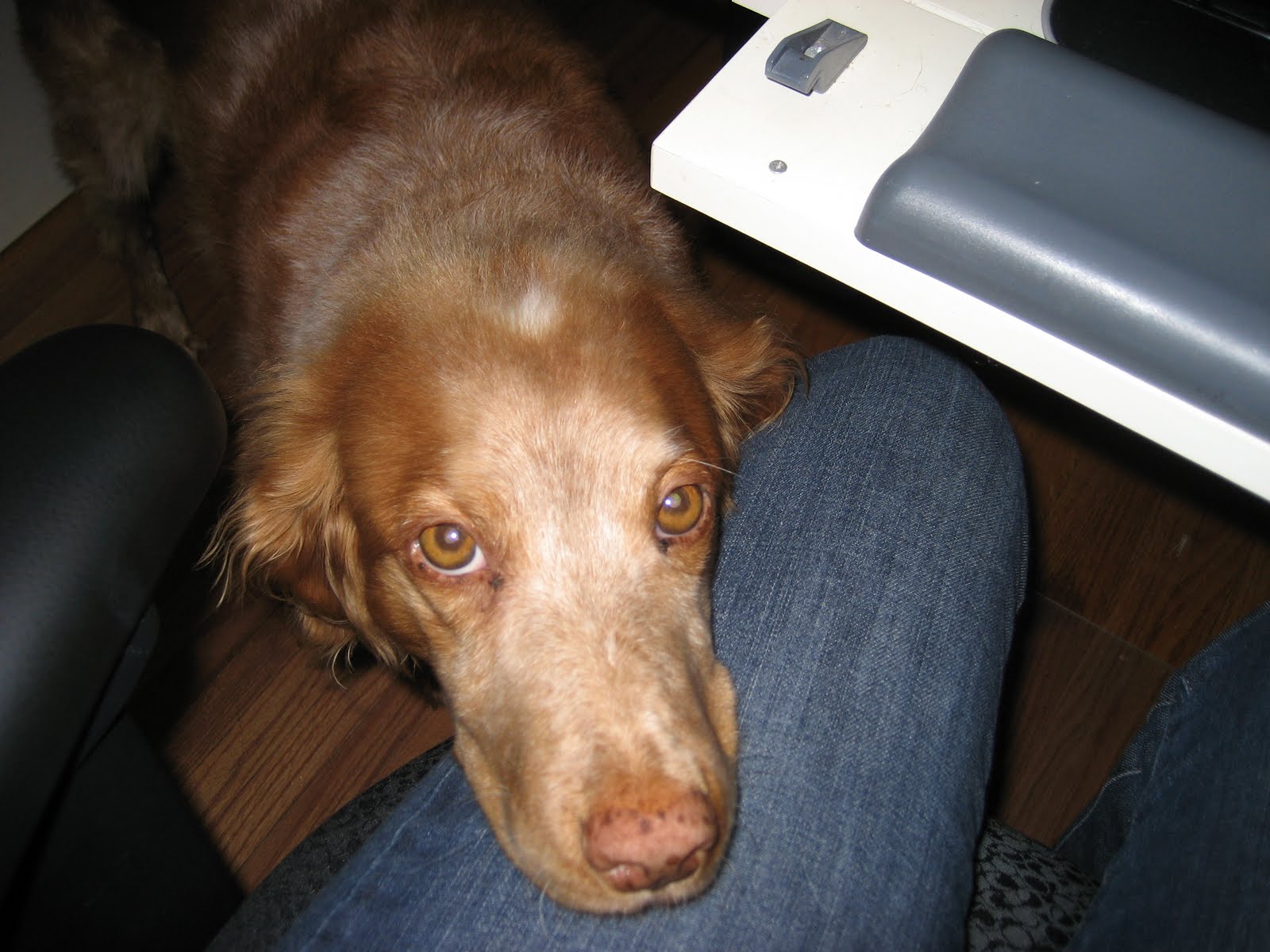
It's her way of saying, "Feed me!"
Sunday, October 31, 2010

Friday, October 29, 2010
Job dissatisfaction
This might be blasphemous to say, but I need to say it: I'm not looking forward to going back to the teaching grind next year (and let's not even start on service obligations). It's not because I'm enjoying my research and unscheduled time so much (see this post about how I'm just figuring out how to handle that unscheduled time; note how many times I mention how boring some of my work is). Nope, it's because I really kind of dread the whole package of teaching -- not just the worst parts (grading! oy, the grading!) but also the frenetic, when-will-this-semester-be-over grind, and even, I hate to say it, being in the classroom. I can't even put my finger on why -- I have always liked our students (well, most of them) and they have told me many times over that they like me -- but the excitement is definitely gone.
Maybe it's because next year I'll be facing another year of Old and Middle English, which I have to say, I kind of hate teaching. Oh, there are moments where I love it, and there were two sets of classes some years back who geeked out with me and made it awesome, but - ugh! - how can I possibly look forward to talking about weak adjectives and strong verbs and Middle English Open Syllable Lengthening...OMG. Kill me now. Horace, who just wrote a joyful post about what's cool about being a humanities professor (and whose positive post title I'm riffing only negatively) gets to talk about "the nature of time and the past in literature, about how drama and performance help us understand our very identity, how the language of advertising leaves us without a language of our own to describe our experiences of the real world." I, on the other hand, get to talk about i-mutation. Zzzzzzzz...And what's even worse is that it didn't used to bore me. But the thought of doing this over and over for the next god knows how many years is making my head explode.
And not even the thought of teaching Chaucer and Shakespeare in the spring term, or a newly designed Anglo-Saxon, Norse, and Celtic syllabus in the fall cheers me up. Something is seriously wrong with me if the thought of "The Miller's Tale," Twelfth Night, and "The Cattle Raid of Cooley" can't raise my spirits or at least make up for strong verb paradigms and brace constructions.
I have a feeling that part of what's coloring my attitude is the woeful morale at our university and especially in our soon-to-be-dissolved-and-chopped-into-three-colleges college. But I keep telling myself that that shouldn't really have an effect on my day to day experience, especially not in the classroom. Perhaps also, because I'm on sabbatical and not as crazy-busy as usual, when I witness just how burnt out and dog-tired Bullock is because of his overload of advising and service responsibilities (a situation created in part by the shrinking of his department by retirement and death without any replacements), I feel it more strongly than I would if I were distracted by a frenetic pace of my own. Or maybe my mood is a response to the bigger war on the humanities and higher ed in general here in the US and elsewhere (especially in the UK). One my Facebook friends (and who still reads this blog, I think) asked for robust language to defend the humanities. Once upon a time I could give it; now I just want to give up.
Tell me that this is what sabbatical is for -- to rejuvenate, to re-energize -- and that by next year I'll feel ready to take it all on again. Tell me that I'm just burnt out and I'm expecting to rebound too quickly. But most of all, tell me it's OK sometimes not to like my job.
Tuesday, October 26, 2010
Speaking (again) of delivering bad news to students in the humanities...
...I wonder if the author of this little movie read the post below? Of course, it could just be because it's that time of year.
SO YOU WANT TO GET A PhD IN THE HUMANITIES
And yes, I *do* question the meaning of my existence.
Sunday, October 24, 2010
Hacking sabbatical
I didn't really think of my sabbatical starting until the Fall term started up, in part because I'd had such a busy summer of professional activities that would have happened whether I was on sabbatical or not. So, for me, sabbatical started August 23. And it took me the last two months to finally figure out how to manage my time and to get into a groove. Thank dog, then, that I took the whole year, despite the reduction in salary.
My problems in getting started were threefold: 1) the major project I'm working on is in its very amorphous beginning stages and the immediate tasks at hand were and remain super dull and tedious; 2) I'd forgotten how to manage so much unscheduled time; and 3) ZOMG! The Intertubes! Let me explain point 1 and then I'll talk about how I harnessed technology (my university's admins love to throw around phrases like that) to deal with points 2 & 3 and at least ameliorate the issues in point 1, and also how I actually added to my goals for sabbatical to paradoxically make it more likely that I'll complete those goals.
Even before we get to the issues with my major project, there was another task I had to take care of by a September 15th deadline, and that was the editing of a handful of medieval texts for an inclusion in a student anthology, along with writing the introductions to them. I learn a lot from such projects, and they're one of the most important things we do as scholars, I think, even though at most places they don't count as much as original peer-reviewed research, and so I'm happy to do such projects in that sense. But, ZOMG!, it is tedious work. And I think that tedium got me off to a bad start and in bad habits. I'd edit a stanza of text and then check Facebook. Then I'd edit another stanza and play 5 games of Mah Jong. Then I'd edit another stanza and read blogs. And so on. I let it drag out until mere days before the deadline, so poof! there went a month of sabbatical.
The thing was, I was totally using that editing job as a way to procrastinate on my own research. I could have been doing both all that time, but I didn't. But finally I got that job out of the way and it was time to move on to my own research -- no more excuses. But the first problem with this project is that it's so early in its development, it's hard to know what it needs and where I should be going in terms of textual, historical, and theoretical research and reading. I'm not even sure what the size of the project is; though I proposed it as a book project in my sabbatical application, I'm starting to think it might be a Speculum-length article. Or maybe a couple of articles of shorter length. And the working thesis/argument I have now may totally change as I continue to do the primary text research. God knows that happened on my first book, which started as a project on class and economics and a specific body of literary texts and morphed into a project on gender and those texts. And before that, I just wanted to write on those texts because there hadn't been any book-length works on them in a long while and I thought I had interesting, newish ways of looking at them. That's also kind of how this project started: I kind of fell into finding my primary material, realized it was both understudied and yet potentially significant, and then started thinking about it more. But that makes it harder to know where to go with the stuff because you're not entering a widely populated critical conversation; instead, you've got to find ways to introduce it into the conversation by relating it to conversations already going on. But the question is, which ones? In practical terms, that means: which existing scholarship is going to help me figure out what's going on here? What should I be reading to help me think through this?
Meanwhile, the one task I know I need to do -- find and catalog for myself all the instances of the literary phenomenon I'm working on -- is a slow and tedious one. See, the stuff I'm working on is what I think of as an obscure subgenre of 15th and 16th century poetry, and so I have to find it by combing through reference works like the various editions of Index of Middle English Verse. I go through a reference work like that one entry after another, looking for texts that might be the kind I'm trying to study and define and then entering them into a Word file I made (so I can search it electronically). And then I've got to track down the available editions of these poems (which sometimes means getting my hands on articles in obscure 19th century German journals!); and after that, in the Spring, I'm going to look at the manuscripts of texts without editions or whose editions don't tell me enough about the manuscript contexts (and that part means another longish trip to England - so yeah!). But right now, I'm in the most boring stage. I'm only up to M in the New Index of Middle English.
As you can imagine, that work is about as interesting as reading a phone book, and so it's also a task prone to procrastination and distraction. In fact, I really should have done it a little bit at a time last year when I was teaching, because it's totally the kind of task you can work into a busy teaching year with just a few minutes a day. But I am teh lame and did not do that. And now I have to Get. It. Done so I can effectively use sabbatical time for that trip to the manuscript libraries in the UK and here in the US, too, especially since that's how I justified the necessity of my sabbatical in my application -- I said I needed to do "literary field work." But trying to do hours of that kind of work -- or heck, even one hour -- at a time is going to create diminishing returns on productivity, because the more mind-numbingly bored I become, the more mistakes I'll make and the more I'll procrastinate with those games and Facebook and so on. And furthermore, I can't spend my whole sabbatical doing work that dull. I'll go insane.
So. What to do? Well, here's how I "hacked" sabbatical to help me make better use of my time and be more productive, both in terms of what this longer-term project needs to get off the ground this year and also in terms of having something to show for my time next year. As I said above, I actually added some additional goals to my sabbatical besides this maybe-a-book project (which is the only thing I mentioned in my application for sabbatical). I had already planned to finally get to writing an article I've had brewing for a couple of years. It has its problems and roadblocks, too, but it's much further along than the nascent book project, so at least it has some shape. I also took on another editorial job, related to that one I mentioned above. I know, I know -- more tedious work. However, I think I've figured out how to deal with that, too, which I'll get to in minute. I also accepted an invitation to write a chapter in a forthcoming multi-volume guide/companion/introduction to British literature on the same genre of text as the texts I'm editing and have edited and that the article project is on, so those projects are all interrelated and will aid one another. Plus, along with editing texts for either scholarly or student editions, I think the scholarly guides to literature are another really important feature of what we do in the profession. (So next time some fool is dismissing scholarly research as something no one reads, mention a Norton Critical Edition or a Cambridge Companion to said fool and ask him where he thinks such works come from. But I digress.) Those are the projects that will go under my "professional activity" section of next year's annual merit report. But I'm also doing things for teaching, for pleasure, and for well being -- including, for instance: re-reading a bunch of the classical, medieval, and renaissance texts from my undergrad great books core curriculum; reading lots of detective fiction; trying to get back in shape; and reading introductions to English morphology, phonology, and syntax, to make me a better teacher of Old and Middle English -- and these are all part of my daily schedule.
Now, it might seem like I'm being over-ambitious, but here's why I think more tasks will help me. Remember how boring I said some of my work is? Well now, if I get bored with one task, instead of playing Mah Jong or reading Huffington Post, I just switch tasks. If I get stuck on a problem in my article project, instead of checking Facebook, I switch tasks. If I'm frustrated with all of my own projects, I can read The Illiad or about the Northern Cities Vowel shift and still feel professionally engaged in some way, but give my brain a rest. And if I'm sick of all the brain work, I get on the tread mill or on my bike, or I chase Pippi around the yard. (She doesn't play fetch; she plays keep away.)
And here's the hacking part. I've incorporated two apps to help me achieve these things. The first one is an iPhone app called Daily Deeds. I'm pretty sure I learned about this from ProfHacker, so I'll give them general credit. Anyway, it's a simple little program that lets you enter a list of tasks that you want to accomplish daily (or at least in a recurring way). And if you accomplish said task, you check it off. You can then e-mail yourself reports to show you how much you're doing something each month. In my own version, I've entered a whole bunch of tasks and sub-tasks related to all of the above (so, for instance, I have an entry that says "catalog stuff from the NIMEV," another that says "read some Classical/Med/Ren lit," another that says "read some criticism and take notes" (so it serves for *all* my projects), and one that says "run, ride bike, or walk Pippi" (to account for all physical activity in a low-pressure way, just to help myself make it a daily routine, no matter how hardcore or not). I can't tell you how satisfying it is to check something off! And it doesn't matter how short a time I spend on something -- if I do it, I get to check it off. This 'carrot,' combined with allowing myself to switch tasks the moment I get bored or frustrated, means I now -- finally -- spend at least 6 hours a day actually *working*.
And there's the other tech tool that has helped me do that. I don't have the best willpower when it comes to things like Facebook or blogs or other online distractions, but I need the web for some of the work I'm doing (using the MED and OED, for instance), so I can't use Freedom and turn off the internet entirely. So instead, I use the Leechblock extension for the Firefox browser, which allows me to select the sites to block and the times to block them. So now, from 9am to 5pm each weekday, I cannot access Facebook, HuffPo, the real estate sites around here, Blogger or Wordpress blogs, or all the other things I routinely tend to want to distract myself with..."just for minute," I'll say...and which end up sucking hours of my time each week. And often, I move downstairs with one of the books I'm reading by about 4pm, so I'm away from the computer when I'm allowed back on the sites.
So this is how I'm "hacking" sabbatical: counter-intuitively adding more tasks to make more progress on each of them; switching tasks often; rewarding myself for activity on tasks by chalking up check marks on Daily Deeds; blocking myself from my biggest online time-wasters; and now, telling you all about it so that I stick to it! Let's see if it continues to work.
Subscribe to:
Posts (Atom)


