I've been transporting more dogs on their way to foster and forever homes since I first posted about doing this. And today was a treat because I got to meet my first German Shorthaired Pointers (GSPs) in person. Someone on the NBRAN volunteer list forwarded a call for drivers for a "GSP Express" run for National GSP Rescue carrying two 2-year-old GSP females; since it was coming right through our area, I volunteered. And I fell in *love*. If it weren't for the fact that Bullock *really* doesn't want a second dog and we're not sure Pippi would be happy to have a dog friend, I'd be signing up to adopt a GSP right now. And Bullock was pretty charmed, too -- I took him along because these were young and rambunctious dogs, and I knew I wouldn't be able to drive and manage them at the same time.
Anyway, let me give you a sense of how lovable they were. Meet Blue (the black and white dog on the left) and Cora (the liver and white dog on the right), two of the sweetest love-bugs I've ever met:
They look a little scared here (and wouldn't you be in their situation?), and Cora kept a kind of curious and serious demeanor most of the time, but they were also eager to be petted and to give kisses in return, and they settled into the car almost immediately. Blue even rolled over for a belly rub as soon as she got in the car, and Cora rested her head on the back of my seat, next to my head, for most of the ride as she watched where we were going. Blue, meanwhile, rested her head on the console in between the seats -- all the better to get ear-scritches from Bullock. And they were hilariously bi-polar: in the car they were mellow and calm (Blue even slept soundly for half the ride), but out of the car during the exchanges from one driver to another, they were insane balls of excitement and energy. Blue tried to crawl over my back to get out of the car as I untethered their leashes from the seatbelts because getting out of the car was SO EXCITING she just couldn't wait! But both in and out they were full of kisses and doggy affection. Adorable! And just look at Cora's eyes and reddish-brown fur. Wouldn't she look great with Pippi? And apparently Blue's coloring is rare -- it's likely she comes from a true *German* GSP pedigree since black and white isn't yet recognized by the AKC as part of the breed standard. Or maybe she's part English Pointer (which does come in black and white). Eh, who cares -- she was a doll. It was hard to hand either of them over, and now they're already half way through the next state in their journey. Sigh.
Btw, GSPs also come in a roan variation, like Pippi, and a roan GSP is the star of that Toyota "squeaky toy" ad you may have seen. ("Roan" in this context means the colors are blended together -- so liver and white are blended on GSPs and the orange and white is blended on Pippi. An American Brittany can also be liver and white, whether roan or not.) This also give you an idea of the crazy energy of a GSP. If you have a dog, you might want to play this video when the dog isn't around. Or, play it and watch your dog possibly go nuts looking for the toy:
Anyway, before Cora and Blue, I did two more Brittany runs. I promise not to post about *every* run I do -- I'll generally stick to notable dogs. But since I could never get Toby, on that first run, to face the camera, I thought I'd give you the opposite now. Meet Silas, who wanted to know, "What's that thing you're pointing at me? Can I eat it?"
Silas was a sweet, older gentleman, and a good copilot, as you can see here:
And before Silas, there was sweet, adorable Julio, a 10-month-old who wanted nothing more than to cuddle in my lap and get belly rubs. Luckily once he was getting said belly rubs, he was pretty calm -- a bit like the effect of a snake charmer's music on a cobra -- and so I was able to drive one-handed and rub Julio's belly with another. And oh, he was so, so soft. I often say that petting Pippi, who is also very soft, is like petting a bunny, but Julio was even softer. So I guess petting him was like petting a *baby* bunny. Heavenly! Unfortunately, what I wasn't able to get from Julio was a picture, because I was driving him after dark. But here are the small photos from the adoption site:

But don't fall in love with him -- turns out his foster already has and is adopting him. Hooray for Julio!
And what would a dog post be without a bonus picture of Pippi for all of her internet fans? Here's one of Bullock's 1,000+ photos of her (no, I'm not exaggerating!), this one from last summer:
Saturday, January 29, 2011
Goggies! (That's "doggies" in LOLDog)


Thursday, January 27, 2011
Advice for a budding medievalist (in literary studies)
Yes, I'm still here. Holiday travels and events, plus getting back into the swing of organizing my unstructured time, took a toll on my blogging. Also, I was trying to decide what to write about next and dithering over it until I got an e-mail today asking me to give advice to a first year undergraduate student at another institution who's interested in medieval literature and in possibly pursuing graduate studies down the line. And I thought, "Wow, that would make a great blog post, especially since it's medieval in content and I haven't written a medieval-related post in awhile (which means that Jonathan Jarrett has probably taken me off of his blog roll or is about to!)."
So let me share a draft of what I might write to him when he writes to me (it was his professor who first contacted me on his behalf and the student hasn't gotten in touch with me) and see what you think. Please feel free to add to or argue with what I say. And since it's advice for a student at a very small college, where departments consist of 3-5 people and no classical languages are taught, perhaps in the comments we can also make suggestions for those students at bigger colleges and universities. (And note that in the letter I *gently* address the "whether you should go to graduate school at all" issue. He *is* only a freshling.) Also, if my tone is too condescending, please tell me! I'm not used to talking to first years about graduate school!
Edited to add: with some minor revisions, you could easily adapt this advice to apply to any English major. Do a few more revisions, and it could apply to any humanities major or any other liberal arts major. Feel free to use, adapt, and link!
So, here's what I might write:
Dear Stu,
I'm so glad your professor put you in touch with me. I'm happy to answer your questions and give you some general advice about what to do to pursue your interests in medieval literature now and in the future. You're already *way* ahead of the game by thinking about graduate school already as a first year student. I didn't realize that I wanted to pursue a Ph.D. until I was already out of college, and I felt like I spent the first couple of years in graduate school catching up with what I didn't know. So, in a way, the advice I'm giving you now is what I wish I had done myself as an undergraduate.
OK, first of all, you have three and a half years to explore: to find out what you love, what you're good at, and who you want to be. Don't be so focused on the goal of getting into graduate school to study medieval literature that you miss your chance to learn new things -- things you might not even yet know you'll love. You can get more advice like this about college in general and how to get most out of it from the book The Thinking Student's Guide to College: 75 Tips for Getting a Better Education by Andrew Roberts (University Chicago Press). Not all of his advice will apply to you, since the author works at a big research university (Northwestern) and bases a lot of advice on what resources students at such big places have. For example, he says not to take too many courses with any single professor, but there are only 5 professors in your English department, so that can't be helped. Also, he has an annoying habit of saying that most professors are more interested in their research than teaching. That's definitely not true at your college, which is committed to undergraduate teaching, and it's not even true of everyone at a research university like his. But most of his advice is excellent and equally applicable to you as it is to a Northwestern student.
But now, on to the more specific advice about your plans to pursue medieval literature. First of all, as an undergraduate, you shouldn't narrow yourself too much beyond the major, and your major is English literature, not only medieval literature. Make your goal being the best *English* major you can be and you'll actually be helping your chances of getting into a good graduate program. Admissions committees in Ph.D. programs don't want to see someone so focused so early that they seem unwilling to learn or incapable of making connections across a wider literary history. As professors we often have to teach outside of our specialties in surveys and introductory classes, so the better educated you are in English studies more broadly (including English literature, American literature, comparative and world literature, and rhetoric and composition), the more flexible a scholar and teacher you'll be. If your department offers a literary theory course, be sure to take that, as you'll need it in graduate school, and it will give you the tools to think with as you study and write about literature now. Start thinking of yourself now as one who studies and thinks about literature and how it works, and not just someone who reads lots of literature. And to do that really well, it helps to think about how language works, so if take a history of the English language course if it's offered. It also helps to have experience thinking about as many different genres and cultural and historical contexts as possible, so try to take a range of courses that teach you about as many periods and types of literature as possible, even ones you think you might not like. Even if you still want to be a medievalist, those other courses will help you think about how literature works, and therefore how medieval literature works, perhaps in contrast to how a novel or short story or modern play or contemporary poem works. Take the maximum credits you're allowed in your major department, but don't skimp on related fields: history, philosophy, art history, literature from other cultures and languages (more on languages in a minute), and theater (especially theater history). As you're doing all this, get to know your professors, not just in class, but out of class in their office hours and any department events. The more they know you, your work, and your goals, the better their letters of recommendation will be for you. At a small college like yours, it's really easy to know your professors and for them to know you -- take advantage of that opportunity.
And as you get further in your major, start doing research and reading criticism about the works you're writing about. Write research papers for as many classes as you can -- ones that don't just summarize what other critics have said, but that enter into conversations with them, argue with them, and get ideas from them (with all due credit, of course!). Ask your professors for advice on what to read, on how to do research (if there isn't a course on research methods), and on how to write in conversation with the criticism you find as you progress in the major. (I recommend the book They Say / I Say as a good guide to writing research papers, and librarians are *great* human resources for helping you learn to do the research.) If your college or the English department offers you the chance to write an honors thesis, take it. Graduate school and a large part of being a professor is about doing research and writing original scholarship about literature -- again, in conversation with other scholars -- so the earlier you learn to think that way and to read what others have written, the better jump you'll have on graduate school and being a scholar yourself. After all, one of the best ways to learn to do something is to imitate someone else doing it, and in reading and thinking about literary criticism, you can start using that criticism as models for your own writing.
While on your college's web site, I saw that your department offers a summer study-abroad trip to England with the professor who teaches medieval and early modern literature in English. If you can afford it, go on this trip. You get course credit and a great experience all in one, and there's nothing like being in the places you've only read about. Even if you've been to England before, being a student there is different from being a tourist, and includes opportunities you'll only really get as a student.
Now, there isn't time in four years to take every course ever offered, and you have other requirements and educational goals to meet, too (and you should aim to get that broad liberal arts education in the best sense -- don't skimp on the science and social science courses). So you should be choosy in some ways. Since you want to be a medievalist, choose courses in related fields most closely related to your interests. You'll still get the benefit of breadth, since you'll be learning how different disciplines have different goals and objects of study. If there aren't enough specifically medieval offerings in history, art history, philosophy, etc., take courses on the ancient Greek and Roman worlds (especially Roman) and on the European Renaissance. Or find out what was going on in Asia and North America while Europe was in the Middle Ages.
And take as much of a foreign language or two as you can. Be serious about learning the language beyond the required two years. Unfortunately, your college doesn't seem to offer Latin, so take French or German, or both. If you passed out of the language requirement, take another one anyway, or get better in the one you know. Most Ph.D. programs require proficiency in at least one foreign language, and sometimes two. For medievalists studying English literature, Latin, French, and German are the most useful, commonly-taught languages to know. There are intensive summer programs in Latin, if that's an option for you now (Google the phrase "intensive Latin summer courses"); you could also leave that for later, once you're in a graduate program.
And finally, start looking into graduate programs in your junior year. Most applications are due in December and January of the year before you plan to start. Of course, there's nothing wrong with taking time off from school -- I took three years -- but if you want to go straight from college, you'll really need to start getting applications ready over the summer and early fall of your senior year. While you're doing all this, talk to your professors, especially the more recent graduates of Ph.D. programs -- the ones with the title "Assistant Professor" -- and ask them about what graduate school is like, where they went, what being a professor is like (especially beyond the classroom), and how they got their jobs. I'll be honest: I don't recommend graduate school for everyone. But you're off to such an early start thinking about it, that if you start preparing now, even if you choose to go another route, you'll still have given yourself a great and enjoyable education. If by this time two years from now, in your junior year, you're still thinking about graduate school and no one has given you the "bad news" talk, get back in touch with me. And in the meantime, use the resources of your career center and learn about other career paths you might take. There are a lot of interesting careers out there you've never even heard of, as well as a lot of smart people in the world who love literature but who aren't professors and have fulfilling lives. It's good to have options.
And any time you want to ask me more advice -- especially about graduate programs for budding medievalists -- drop me a line. Best of luck and keep in touch!
Sunday, December 19, 2010
RBOC - Gray winter day edition
Blogging bullets:
- You may have noticed that I have no blog roll. That's because it was a Blogrolling blog roll, and Blogrolling has ceased to exist. That's a shame, because it was a handy system (though the ads on it in the last year or so of its existence were annoying). But I cut and pasted the blogroll before that happened, and when I get the energy for it, I'll repost an updated version of it.
- I'm thinking of changing to WordPress. Those of you who've made the move, how hard is it to move the archive of the blog? What do you like/dislike about each platform?
- I'm also thinking of claiming my blog as service/outreach when I do my 5 year post-tenure review or when I go up for full professor. Any opinions about that?
- My partner has been known as Bullock on this blog because I named him in our Deadwood-watching phase, during which time he grew a Seth Bullock-style mustache and goatee. But Deadwood is long gone and my man is clean-shaven. Plus, even though "bullock" meant "young bull" in Middle English and that's one of its meanings today, it also can mean a castrated bull, which is not the association I wish to project for my Bullock. (Though it is kind of a funny pairing with Virago.) But it would be confusing to rename him. I'm thinking maybe of just putting a "cast of characters" in the sidebar and explaining the origins of the name. Any other ideas?
- I have been remiss in telling Pastry Pirate fans that she has long been blogging elsewhere. First she was in New Zealand, working and exploring, and now she's working in Antarctica. No, really. I kind of think "Baking in Antarctica" should be the title of the blog, but since it started before her life on the Ice Planet Hoth (as I like to think of it), it's called Stories That Are True.
- Hey, cool, I managed to blog more than in 2009. Not exactly an awesome accomplishment, since I was really lame in 2009, but still an improvement. What should I blog about next?
- Our Christmas tree is up, all the Christmas shopping is done, and all but one present is wrapped (because it hasn't arrived yet)! Hooray!
- On Thursday, I wired the deposit for the studio flat in Belsize Park. It's non-refundable, so this makes it official. I'm going to be living, however temporarily, in a flat in London! I've never lived in a flat in London before! Heck, I've never lived in a flat before (American apartments, yes). How cool is that?!
- The one-week rent for the studio flat in Belsize Park (the amount of the deposit) is just over my one-month rent in my awesome two-bedroom Rust Belt Historical District apartment and only about $175 less than our monthly mortgage payment. I'll never be able to live full-time in a big, expensive city again -- I've been too spoiled by the low cost of living here in Rust Belt. But hey, now I can afford 6-week jaunts there! So, I may live in Rust Belt, but I can better afford life in the big city in small doses. This is what I keep telling myself, anyway.
- OMG, my sabbatical is half over!!! Ack!!!
- Something I realized at the various holiday parties this week: asking me "So, how's sabbatical going?" is as crazy-making for me now as "So, how's the dissertation coming?" was for me once upon a time. Also, faculty on sabbatical don't want to talk about work issues. Come on, people, surely we can talk about something else!
- Bullock is grading finals. He just said to me, "It must be Christmas time, because a student just spelled Commerce Clause like Santa Claus."
- Bullock and I are going to BullockLand for the holidays (with Pippi). I spent Turkey Week in Cowtown with my side of the family and starting this year we're alternating where we go for Christmas so that we don't have to do the crazy-making hurryhurryhurry to get to one place and then the next. That makes my going out to LA to visit Virgo Sis and go to the MLA much less stressful (so does going to MLA just to go). Of course, so does being on sabbatical, because otherwise I'd be doing MLA back-to-back with starting our Spring semester.
- Speaking of holiday plans, in case I don't blog again before we leave:

Sunday, December 12, 2010
Going to the dogs
Yesterday I drove 285 miles for two dogs named Toby and Brittany.
You see, we got Pippi from a national breed-specific rescue agency called National Brittany Rescue and Adoption Network (NBRAN), an organization run almost entirely by volunteers, and funded by donations, the good will of the volunteers who rescue, foster, and transport the dogs, and the $350 adoption fee you pay when you adopt a dog from them (which, when you think about it, doesn't really cover the expenses of a dog who's been fostered for any length of time). Anyway, Bullock and I can't really foster a dog -- Pippi doesn't get along with all dogs, and she seems well-suited to be an only dog; plus walking one of her is challenge enough -- but I wanted to help out with more than donations. So I put my name on the list for the transport drivers.
When a dog is pulled from a shelter and transferred to a foster home, or adopted into a "forever home," the dog might need to travel some distance to that home. When we adopted Pippi, she came from a foster home in our state, so her foster mom drove her to our house herself. But sometimes a Wisconsin dog might need to go to NY or a Texas dog might need to get to Pennsylvania, and so on. NBRAN will transport dogs up to about 1300 miles, and it's done with a chain of drivers who drive legs of about 60 miles each. Yesterday, on my first ever run, I drove two of them (and of course there and back again, accounting for the almost 300 miles), picking up two dogs along the way. I left the house at 7:15 am to get to the first meeting place and got back around 1pm.
First, I picked up Toby, a very handsome, mellow, sweet 5-year-old boy eager to meet new humans and dogs, but a little untrained and, sadly, deaf. But he was going to his "forever home," so his story already has a happy ending. Anyway, he was an affectionate love bug who wagged his tail and greeted me with a kiss right away. That's kind of novelty for me, as Pippi is deciding *not* the kissing kind. And when he got into my car, he decided that my lap was a great place to sit and look out the window:
Eventually I convinced him that he couldn't stay in my lap or else I wouldn't be able to drive, and he pouted:
He hid his face from me like this every time I tried to get a picture, and I didn't figure out until I dropped him off at my last meeting point that he was terrified of the camera! Poor boy! I didn't realize I was torturing him! But who would think that a dog would be terrified of a little point-and-shoot digital camera? But maybe he didn't know what it was or would do. And since he's deaf, when his head was turned, I couldn't soothe him with calming sounds or tell him he was a good boy.
Eventually he decided to move to the back seat, and at our first stopping point, we were joined by Brittany, a 9-year-old Brittany/Beagle mix. Brittany came with a crate, and I was planning to put Toby back in the front seat and Brittany in her crate in the back to keep them apart, but they got along quite well from the start. This kind of amazed me, as Pippi is such an alpha that she would have already claimed the car as her territory by this time and not wanted to share it. But here's Brittany posing for her portrait and Toby turning away, as usual:
In hindsight, I should've noticed that Toby's tail was tucked, but sometimes it hard to see that on a Brittany with a stub tail. When he wasn't hiding his face from me, he "dug" a little "hole" for himself (he scratched back the blankets and kept scratching at the upholstery until he was satisfied) and curled up and slept until we got to the next stop, where he'd excitedly greet the new people -- and the new dog -- just like he greeted me. Brittany was equally a great little traveler, settling down right away, just as in the picture (which I snapped as soon as we got in the car). It's amazing how resilient these animals can be. Occasionally she'd whine a little, but who can blame her: she was being transferred from stranger to stranger after having spent the first 9 years of her life with her family, who had to give her up because of financial disaster. Poor thing. Poor family!
I think, by the way, that's why I spend some time and money on helping companion animals -- it's as much about the people as it is about the animals. (The fact that it's NBRAN is just because we have a personal connection to them and the Brittany breed.) Anyone who has to give up their beloved pet wants to know it will find a nice home, and someone who adopts a dog (or any animal) is obviously getting something in return: love, joy, companionship, affection, and all the other benefits of pet ownership. So I'll probably do it again and again. I just hope the next dogs are just as easy as Toby and Brittany. And maybe I'll get better pictures of them!
Thursday, December 9, 2010
Moving on up...
...to Bel-el-siiiize! [Come on, sing it with me, to this tune.] To a de-luxe apartment in Bel-siiize!
OK, OK, I'm not really *moving* to London, but I am going spend a 6-week research trip from May to June in Belsize Park, a very posh neighborhood that I wouldn't normally be able to afford. In fact, the apartment I arranged through SabbaticalHomes.com is pretty darn pricey, too, and when I first started looking, I put it pretty low on my list as too expensive. But then I got a little windfall of money I wasn't expecting, which made me decide that it would be really fun to pretend for six weeks that I'm the kind of person who really could afford a swank place in Belsize Park. And it's just as well, too, because all the cheaper places that I was interested in -- the ones that weren't way out in SE23 or thereabouts -- turned out not to be available for my dates. They were listed as available, but then the owners said they already had parties interested. People! Update your listings! Stop leading me on with your promises of elegant little Bloomsbury 1-bedroom apartments for relatively reasonable prices! Or they said, sorry, but they couldn't do 6 weeks, they could only do full months. Then say so in your listing! I went through 7 possibilities before the Belsize Park person said yes, it was available for my dates and he'd be happy to rent it at the advertised price with no hidden charges. Hooray!
Thank god I don't have to look for *permanent* housing in London (or any other insanely expensive city). I'm pretty sure I'd go mad in the process or I'd be more willing to commute from Zone 6 or something. The place I'm renting has a monthly rate that's roughly three times the cost of our monthly mortgage (although at least the bills are included in the rent) for a 600 square foot loft studio (vs. our nearly 2000 square foot, four bedroom house with a yard and a garage). I know that sounds like madness, too, but for my purposes in the short terms, it's pretty much within the range of the expected. Put in these terms: it's the same per night as the Holiday Inn Express in the area charges, but I'll get to live as if it's my own house (because it will be for 6 weeks), spread out in a bigger space, cook for myself (thus saving on dinner especially), do my laundry in my own space, and so on. And out of curiosity, I looked at a real estate website offering apartments in the area, and the comparable ones had much higher rent, so I think I'm doing well for the area. The only way I've done things cheaper is to rent a student room, once at Goodenough College and once at the University of London's College Hall. But this time I'm going to be there while it's still term time, so those options aren't open to me. (Well, Goodenough might have a room available, but you have to share showers. In the summer, when few people are around, it's one thing, but I really don't want to share a shower with a hall full of students, even if they're mostly postgraduates. And last time I lived there, I was three floors up from the kitchen -- *very* inconvenient.) If it were available to me, I'd think about College Hall again; its ensuite rooms are very nice and there's a pantry or two with a fridge and microwave on every floor (though for 6 weeks, microwaved food might get sickening).
Anywho, the place I'm going to rent is swuh-ank! It's sleek and modern and all recently renovated, top to bottom, with gorgeous, gleaming dark oak floors, huge French windows letting in all sorts of light, and an open-plan kitchen that's reasonably roomy for a studio apartment. Put it this way: the minute I showed Bullock the pictures, he said, "Oh, that's NICE!" and he has pretty demanding taste. When I will the lottery (heh), I'd love a pied-a-terre just like it. I'm not the only one, it seems: I contacted one of the previous renters and she said she wished she lived there all year round. She stayed there with her husband and child, so it should be roomy enough for just me.
I promise, though, that while I'm there I'll work very, very hard at the BL and not sit around my flat pretending to be posh or hanging out with the celebrities who live in the area. And come visit me -- I'll give you the king size bed and I'll sleep on the couch!
Wednesday, December 8, 2010
I think I may be a secret geography geek
I think maybe I should chuck literature and the Middle Ages and get a degree in geography and planning and learn GIS. Oh, you think I'm kidding do you? I swear, I'm not.
Why? Because today I blew off half a day's work on things medieval because I got *obsessed* -- OBSESSED, I tell ya! -- with "Legible London," the new(ish) "pedestrian wayfinding" project by Transport for London in partnership with Applied Information Group (AIG, but not that other AIG) and Central London Partnership. (I think I'm getting the credits right -- or maybe CLP was the real impetus behind it. Or AIG.) I think a couple of hours went by as I read the research behind the project, browsed around on the project websites, and played around with Google street view maps.
(This all began as I was looking deeper into the neighborhood I might be renting in for my 6-week trip in May and June and ended up playing around on the Transport for London site, so I guess the spur to this geographic obsession was the fact that I'm going to London again for research in things medieval. So I'm not really giving up my day job. Yet. Btw, the neighborhood I might be staying in is Belsize Park. Well now, aren't I posh?)
Back to the subject of the post. If you've been to London since 2009 and have walked around the Bond Street, Southbank/Bankside or Bloomsbury/Covent Garden areas in central London (or Richmond and Twickenham areas in the outskirts), you've seen the pilot program of this project. Here's a gallery of what the maps look like -- it might ring some bells for those of you who've seen and used them.
What got me so jazzed and took up so much of my time today was reading the "Legible London wayfinding study report," done by AIG and CLP, which you can download in PDF from this page, where it is also summarized. The report is worth reading if you're interested in maps -- the visual, material objects and their design, as well as their abstractions as data, or the psychological processes of "mental mapping" -- because I swear you'll have a fun time reading it, too. You'll also be interested if you're interested in design, information technology, urban planning, initiatives to encourage walking (for health of the individual or the planet), or humans' relations to and cognitive negotiations of space. For starters, it's a beautifully presented piece of public communication. And hey, I'm not the only one who thought so -- AIG won the 2009 Design Week Award for Best Promotional Brochure for a version of it. And it's *fascinating,* especially if you've ever tried to find your own way on foot around London.
One of the recurring themes of the report is that London has no consistent wayfinding system of signage and maps for pedestrians, in contrast to the systems for drivers (not just in London, but across the UK) and public transport users. Instead, an eclectic, sometimes even contradictory, collection of different systems in different neighborhoods has built up over time, and many of them actually aren't helpful for the way most people navigate on foot. In other words, they don't give pedestrians confidence (a key term in the report), and so people give up and rely on public transport, even when it would be quicker to walk. And it's not just the tourists, but the locals, too. So, for example, someone needing to get from Charing Cross tube stop to Covent Garden might go to all the trouble of going down into the tube, taking the Northern Line one stop to Leceister Square, transferring to the Picadilly Line, and taking it one stop to Covent Garden (traveling time 8 minutes, not counting getting in and out, transferring, and waiting for the trains), when instead, they could take an 8 minute walk for free.
But the obstacles to making that walk are many, according to the report. For one thing, the destination isn't visible in real space, where it is on the iconic tube map (more on that in a minute). In fact, London has few vistas, and with the exception of a handful of tall, iconic buildings and structures, not a lot of landmarks visible from a long distance. It also doesn't have a lot of long-running avenues, but instead, a warren of streets whose names change seemingly every block, and whose street signs are often blocked, hard to find (especially for pedestrians, as they are often oriented for traffic), or missing. And so even the native Londoner might not feel confident taking the Strand northwest to a left on Bedford to Garrick to Rose to Long Acre to get there. Even if there are signs pointing toward Covent Garden, they're likely pointing to the market and you need to get near the tube stop. Or if they do point to the tube, there's only one on Bedford and you won't see it unless you're already there. Or it's one of those little narrow signs ("finger" posts) and you miss it. Or someone has intentionally or unintentionally turned it and you get turned around. Or it says "o.5 km" and you think that sounds like a long way (more on that in a minute, too). Charing Cross to Leceister Square to Covent Garden is easier and the trains do the work for you.
I can understand this lack of confidence even though I'm generally over-confident at pedestrian navigation. At the risk of sounding obnoxious here, I'm actually a pretty good navigator and reader of maps (though add mountains and up and down and I get a little thrown), and I have a pretty complex "mental mapping" system in which I try to combine information from large scale system maps with my experiential mapping of traveling in smaller segments of that space. (For example, I'm the kind of person who knows which direction a subway is going, which direction(s) the exit ramps and stairways go, and therefore, which way I'm facing when I exit a subway or tube stop.) I'm not always right, but I'm rarely "lost." If I get off track I get back on it pretty quickly and I usually know what I've done wrong.
But *man*, I once got pretty darn lost in the Covent Garden area and I blame those damn skinny little "finger" posts that the Legible London report picks on frequently. I stupidly relied on those instead of getting myself a good map and I ended up not only going in the wrong direction entirely, but also disorienting myself because of it. This must have been on my trip in 2007 before the pilot "Legible London" maps were put up! I ended up finally righting myself, but came thisclose to hopping on the tube, even though where I was going was only a 15 minute walk away (the maximum time length that the Legible London study says people consider "walking distance" and that is often faster than the tube). In other words, that incident would've made a great data point for the Legible London folks: I lacked confidence as a pedestrian and almost fell back on the tube because of pedestrian-unfriendly signage up top and the ease of use of the tube and its well-designed map.
But the tube and its iconic map are also really misleading. This I already knew, but I didn't quite realize the extent of its effect. The tube map is a fantastic work of classic design -- which the report acknowledges -- both in its aesthetic value and its use value, at least in so far as it's used to navigate the tube. But did you know vast quantities of Londoners use it as a map for above ground, too?! That's madness! In case you've forgotten what it looks like, go take a look (opens PDF). It's a gorgeous piece of mid-century modernism, isn't it? Makes you want to sit in an egg chair under an arc floor lamp, doesn't it? But it's an abstraction that's not made to scale -- there's no way of knowing how far one stop is from another and often places are suggestively represented as being closer or farther apart than they are, or in different cardinal directions from each other than they are in real space. And it does funky things to the Thames to fit the design. So, for example, it shows the Thames seemingly going East-West (as a border, not the flow of the water) from Temple to Westminster, and makes Victoria seem like it's pretty near the bank; thus, on this map, Waterloo is South of Westminster, and the Westminster Bridge thus seemingly runs North-South. Except that none of that is right. In reality, the Thames runs North-South in that stretch; Victoria is to the South-West of Westminster and not near the bank; Waterloo is to the North-East of Westminster; and the Westminster Bridge runs East-West across the Thames. So when people use this map to navigate anywhere but the tube system itself, they're going to get hopelessly confused -- as the report in fact shows. And yet, people rely on it because it's a really cool, well-designed, easy to use map -- it's just not meant for pedestrians. (And meanwhile, the A-Z guide is made with cars in mind. And it's complicated and busy and nothing like the simplicity of the tube map.) So what the Legible London project is trying to do is, they hope, create a way-finding system for pedestrians that's as intuitive and easy as the tube map.
But people have funny intuitions about things. It's not just the tube map's fault that people think the Thames runs East-West. The report points out that that's a common misconception. It doesn't say this (maybe because they didn't get language and literature people involved) but I bet it's partly because there's a neighborhood called "Southbank" and borough called "Southwark," and they are, indeed, South of the oldest parts of London, where the Thames does run roughly East-West. Language shapes us as much as iconic imagery does. And history has something to do with this, too, as "the" Southbank was once directly south of what was then the limit of the city. I've seen this effect of language, culture and history on oreintation elsewhere, too. When I lived in LaLa Land, a couple of friends wouldn't believe when I said Malibu was West of Westwood, not North of it. In their minds, they drove "up" the coast to Malibu, and "up" is north, right? And they lived on the "West Coast," so it must run north and south, right? Well, abstractly and and in big-picture sense, sort of, but really only if you're looking at it from outside of California. But actually, no, because at Pacific Palisades, it turns West and runs that way until about Point Mugu, and then it goes northwesterly until about Santa Barbara, when it starts going west again, and it pretty much alternates between northwest and west until you get to Humboldt County way up north, where it ironically straightens out. (Duuuude.)
But I digress. The point is, it's not the Tube's fault if bright people in car-dependent LA also don't know their West from their North. Let's get back to London, where people have just as many cockamamie ideas about where things are and how to get to them as SoCal people do. Lots of Londoners walk, but more would walk if way-finding signage were designed with their needs in mind. And the more people walk, according to the report, the fewer cockamamie ideas they have about where things are in relation to one another -- the better their mental map is. (OK, so that *does* explain SoCal, because as the song goes, "Nobody walks in L.A.") According the Legible London folks, one of things pedestrians need to be more confident and therefore to walk more and further is to have maps oriented "heads up" -- that is, in the same direction they are facing when they read it. Funny thing is, this actually once nearly threw me off when reading one of their signs in Southbank as I was making my way to Waterloo station. It was oriented to the South because it was facing that way, which was also the way I needed to go, but I very nearly went in the opposite direction until I noticed. But I'm used to the "north is up" convention and how to compensate for that, and most people are not, apparently. I can give that up, since there's nothing inherently right about "north is up" -- as we medievalist know, many medieval maps were oriented to the East -- and the most sensible orientation is the one most useful in context (and so north-pointing maps are useful when you're orienting by the North Star -- not so much on the street in London!).
To give you another cool example of how the new maps are designed around the needs of pedestrians: if you go back up to that "gallery" link and look at the first three pictures in it, you'll see some of those pedestrian-friendly elements. Though the maps are largely aerial, they give at least the outlines of all buildings and then 3D images of landmark buildings and popular destinations. They're also generally more detailed, because of course a walker can take in more detail than a driver. And, perhaps most important, they give distance in time measurement instead of space measurement and show maps with a 15-minute walk radius (and also a 5-minute radius) because people are more likely to walk 15 minutes away than 1.3 km (.8 miles). As their pilot programs and surveys have shown, it also makes people realize that a lot of things are closer together than they think. London is a very dense city, with a lot of sensory stimuli in a 15-minute walk, which can make it seem much bigger geographically than it is. I'm a runner (or well, I was), so I'm used to thinking in both time and distance, and I can read "1.3 miles" and know how long it will take me to get there and that that isn't a long distance. But to most people it sounds daunting, even to native Londoners. Creating a system of maps that helps people digest their city in manageable chunks--bringing it down to human scale--actually does important social and cultural service, connecting people and neighborhoods, and in a huge megalopolis like London, that's no small feat.
As new and forward-thinking and digital and innovative that AIG and this project are on many levels, I think one of the reasons I love it -- and one of the reasons I love maps of all kinds -- is that it melds the old and the new. It takes old forms of travel, forms that Chaucer's pilgrims would have known in their London and Southwark -- traveling by time (one day's ride to X town) and by itinerary (pass the old church and turn right at the next crossroads) -- and melds them with satellite images and GIS and the latest research on cognition and "mental mapping," along with forms of cartography somewhere in between (the map of a whole area, for example, instead of just the turn-by-turn itinerary that a GPS [or "SatNav" in the UK] system would give), and brings London's distant past, the near past, the present, and the future (a more walkable, 21st century London) together, much the way that the city itself is a palimpsest of time and history. I really hope this project successfully expands to the entire city and its outskirts.
Monday, December 6, 2010
Disconnecting from the social network / looking forward to social networking
I deactivated my Facebook account today. Deactivation isn't permanent -- my profile and all its contents are still there, somewhere, but those of you who are my FB friends can't see it. In fact, a lot of you now probably seem to be talking to a ghost in many of your threads.
I plan to return to FB Jan. 1 or thereabouts. I just got a little freaked out about how little time was left in the first half of my sabbatical and how much time FB was taking, despite all my leechblocking. See, the thing is, I have an iPhone, and on that phone is a Facebook app, and there's no Leechblock for the iPhone, alas. And I have no self-control. I've been tossing around this idea for awhile now, but last night, as I was curled up on the couch with a book, a glass of wine, and Pippi, while Bullock was at a job candidate's dinner, I realized how nice it was to slooooow doooooown and read for a good long time. And since I was reading a book set in Los Angeles, with many scenes in a neighborhood I knew intimately, I realized that there were other ways of being connected to the world than through Mark Zuckerberg's way of doing it. Even though what I was reading wasn't high art (it was detective fiction -- though its author's work has been promoted from the "mystery" section to the "literature" section of bookstores near you!), it felt more like a Forster or Woolf way of being connected -- like the "only connect!" motif of Howards End or the thin thread of Mrs. Dalloway. Both are vulnerable, fragile, abstract connections, of course, but that's what makes nurturing them and recognizing them important. It's not that FB prevented me recognizing these threads or of slowing down, but the moment made me realize that I could leave FB for a little while and not feel outcast or at sea or unmoored from the world or from my past. (I haven't thought this all the way out--it's really just a feeling, a hunch now--so my writing about it is a little flabby and cliche-ridden. For a blogger, I'm strangely not very good at writing about our socially networked world!)
Of course, as some of you know, the irony of all this is that I took a photo of that moment with the dog and the wine and the book (and fuzzy slippers!) with my iPhone and posted it to Facebook! Of course, I think there's something fitting that that was my last post before my hiatus. And it is just a hiatus, I promise (especially to Sisyphus, who is looking forward to beating me in our currently suspended game of Scrabble). In the meantime, most of you know where to find me at my real life, university e-mail address, and if not, there's my Dr. Virago g-mail address (see sidebar).
Meanwhile, I'm planning to go to MLA to do some old skool social networking, the face to face kind. Virgo Sis lives on the east side of the Cahuenga Pass, so I'm going to stay with her (and arrive and leave a few days before and after the conference) and take the Red Line subway from Universal City into downtown. I'll be going to all the medieval panels and to any meet-ups y'all want to plan (just let me know!), and presumably to my grad school's party, if I can find out when and where it is (it's often a big secret). I haven't looked at the program yet, so there's probably other stuff (besides the book exhibit of course!) that I'll want to go to. And I promise I'll start up Facebook again before that for easy contact. :)
And one other thing: I'm kind of hoping that less Facebook will mean more blogging. We'll see if I'm right.
Sunday, November 14, 2010
You may be a hoarder if...
...like me, you purchased bulk staples, paper clips, and pencils the year you started graduate school (for me it was 1994) AND STILL HAVE UNUSED ONES. Good god.
Even worse, I forgot where some of these were (shoved into a box labeled "office supplies" in a linen closet in our hallway) and have been mooching off of Bullock since I moved in with him. And all this time I still had one full box of 5000 staples, five 100-count boxes of paper clips, and four 12-count boxes of unused pencils. Also in the mysterious box o' supplies: a life-time supply of unused "daily schedule" sheets for the 8"x10" Day Runner I no longer use; a bunch of 3" or 4" D-ring binders; some blank composition notebooks; unused letterhead from my graduate program department (WTF, why did that even move with me to RBU???); and, my favorite, 3.5" floppy disks with with system and program backups for a computer I no longer own.
Sigh.
Updated to add: Oh wait, there's more. One of the big D-ring binders has my undergraduate institution's name on it and inside are labeled dividers with labels such as "company info/lit" and "cover letters (copies)." In other words, this was the binder I used to organize my job applications in the Spring of freaking 1991! *headdesk*
Saturday, November 13, 2010
A Ph.D. in the humanities? - A kinder, gentler xtranormal video
This is response to the now-viral video I linked to in an earlier post. This one is kinder, gentler, and more idealistic -- except when it takes a few jabs at the earlier video. It's also a lot more like the actual conversations I have with actual students. And bonus: it makes a Dr. Who reference. It's also really inspiring and I think that every time I get in a funk about the future of the university and especially the humanities, I'm going to watch this to recharge myself.
You should watch it, too.
h/t Karl at In the Middle
I'm posting this not only because I like it, but also especially for Jeffrey, meg, Flavia, and Clarissa, all of whom I know didn't like the original, cynical version (or, in meg's case, didn't like the emerging genre of xtranormal videos in which experience berates naivete).
Thursday, November 11, 2010
New desk chair!
I bought my first new desk chair for the first time since circa 1999 and it was delivered yesterday. The old one was a $49 number from Ikea, which I bought when I also purchased my giant Ikea "Anton" computer desk plus rolling CPU/printer stand and file drawers. The desk and its accessories are still going strong. The chair...eh, not so much:
 Crappy Old Desk Chair
This time, now that I'm a tenured professor on sabbatical, and therefore spending a *lot* of time in my desk chair at home, but also making a decent living, I put down serious money and got something like the comfortable, multi-adjustable chairs they gave us in the new building at RBU. (I wish I could have figured out how to get that *exact* one, because it is teh awesome! But it's made by a company that only does bulk office orders, alas.) At any rate, the one I got cost more than Anton and his pals combined, but if I use it at least as long as the cheap Ikea chair, I'll get my money's worth. And it was actually right in the middle of the price ranges at the local office supply store, so it's not exactly extravagant as far as office chairs go. And I got to pick out the fabric! And the arms! And they delivered!
Anyway, here it is, right next to Anton (ignore the wall color -- someday I intend to change it):
 Awesome New Desk Chair!
I'm still learning how it all works, which is why, in the background of the picture above, you can see the directions for the chair hanging off a bulletin board on the wall. Check out all the levers for all the adjustable stuff! Look! --
 Levers!
Right now I'm still fussing with all the adjustments and trying to find the sweet spot for my various tasks. And all this forced sitting up straight is actually making my back ache, ironically enough. Bullock swears this is normal and that I'll get used to it and be better off in the long run. At the very least, my butt is more comfortable than on that sloping piece of 11-year-old junk I had before!
*******
Bonus Pippi picture! This is what Pippi was doing for most of the time I was writing this post:
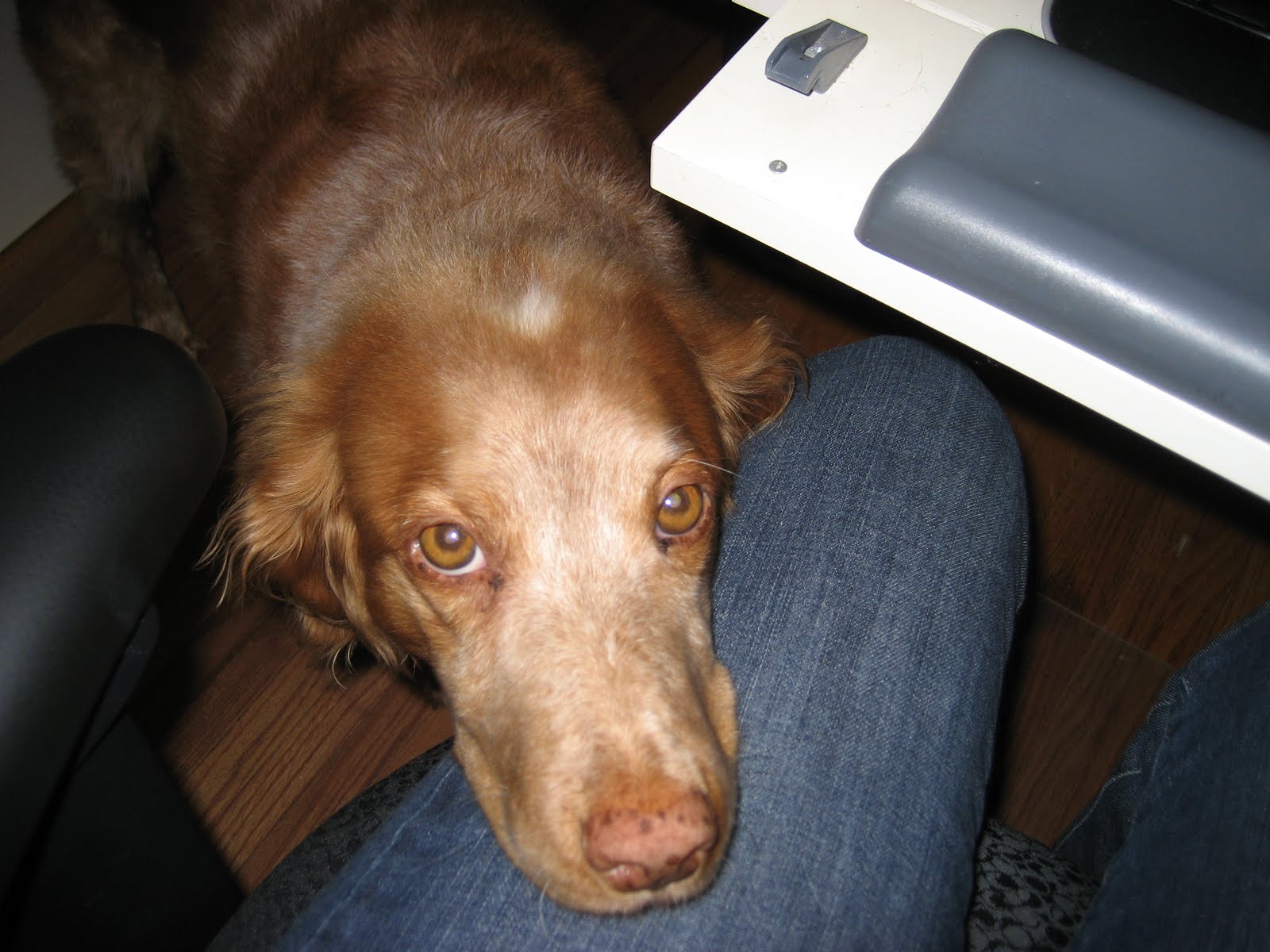
It's her way of saying, "Feed me!"
Sunday, October 31, 2010

Friday, October 29, 2010
Job dissatisfaction
This might be blasphemous to say, but I need to say it: I'm not looking forward to going back to the teaching grind next year (and let's not even start on service obligations). It's not because I'm enjoying my research and unscheduled time so much (see this post about how I'm just figuring out how to handle that unscheduled time; note how many times I mention how boring some of my work is). Nope, it's because I really kind of dread the whole package of teaching -- not just the worst parts (grading! oy, the grading!) but also the frenetic, when-will-this-semester-be-over grind, and even, I hate to say it, being in the classroom. I can't even put my finger on why -- I have always liked our students (well, most of them) and they have told me many times over that they like me -- but the excitement is definitely gone.
Maybe it's because next year I'll be facing another year of Old and Middle English, which I have to say, I kind of hate teaching. Oh, there are moments where I love it, and there were two sets of classes some years back who geeked out with me and made it awesome, but - ugh! - how can I possibly look forward to talking about weak adjectives and strong verbs and Middle English Open Syllable Lengthening...OMG. Kill me now. Horace, who just wrote a joyful post about what's cool about being a humanities professor (and whose positive post title I'm riffing only negatively) gets to talk about "the nature of time and the past in literature, about how drama and performance help us understand our very identity, how the language of advertising leaves us without a language of our own to describe our experiences of the real world." I, on the other hand, get to talk about i-mutation. Zzzzzzzz...And what's even worse is that it didn't used to bore me. But the thought of doing this over and over for the next god knows how many years is making my head explode.
And not even the thought of teaching Chaucer and Shakespeare in the spring term, or a newly designed Anglo-Saxon, Norse, and Celtic syllabus in the fall cheers me up. Something is seriously wrong with me if the thought of "The Miller's Tale," Twelfth Night, and "The Cattle Raid of Cooley" can't raise my spirits or at least make up for strong verb paradigms and brace constructions.
I have a feeling that part of what's coloring my attitude is the woeful morale at our university and especially in our soon-to-be-dissolved-and-chopped-into-three-colleges college. But I keep telling myself that that shouldn't really have an effect on my day to day experience, especially not in the classroom. Perhaps also, because I'm on sabbatical and not as crazy-busy as usual, when I witness just how burnt out and dog-tired Bullock is because of his overload of advising and service responsibilities (a situation created in part by the shrinking of his department by retirement and death without any replacements), I feel it more strongly than I would if I were distracted by a frenetic pace of my own. Or maybe my mood is a response to the bigger war on the humanities and higher ed in general here in the US and elsewhere (especially in the UK). One my Facebook friends (and who still reads this blog, I think) asked for robust language to defend the humanities. Once upon a time I could give it; now I just want to give up.
Tell me that this is what sabbatical is for -- to rejuvenate, to re-energize -- and that by next year I'll feel ready to take it all on again. Tell me that I'm just burnt out and I'm expecting to rebound too quickly. But most of all, tell me it's OK sometimes not to like my job.
Tuesday, October 26, 2010
Speaking (again) of delivering bad news to students in the humanities...
...I wonder if the author of this little movie read the post below? Of course, it could just be because it's that time of year.
SO YOU WANT TO GET A PhD IN THE HUMANITIES
And yes, I *do* question the meaning of my existence.
Sunday, October 24, 2010
Hacking sabbatical
I didn't really think of my sabbatical starting until the Fall term started up, in part because I'd had such a busy summer of professional activities that would have happened whether I was on sabbatical or not. So, for me, sabbatical started August 23. And it took me the last two months to finally figure out how to manage my time and to get into a groove. Thank dog, then, that I took the whole year, despite the reduction in salary.
My problems in getting started were threefold: 1) the major project I'm working on is in its very amorphous beginning stages and the immediate tasks at hand were and remain super dull and tedious; 2) I'd forgotten how to manage so much unscheduled time; and 3) ZOMG! The Intertubes! Let me explain point 1 and then I'll talk about how I harnessed technology (my university's admins love to throw around phrases like that) to deal with points 2 & 3 and at least ameliorate the issues in point 1, and also how I actually added to my goals for sabbatical to paradoxically make it more likely that I'll complete those goals.
Even before we get to the issues with my major project, there was another task I had to take care of by a September 15th deadline, and that was the editing of a handful of medieval texts for an inclusion in a student anthology, along with writing the introductions to them. I learn a lot from such projects, and they're one of the most important things we do as scholars, I think, even though at most places they don't count as much as original peer-reviewed research, and so I'm happy to do such projects in that sense. But, ZOMG!, it is tedious work. And I think that tedium got me off to a bad start and in bad habits. I'd edit a stanza of text and then check Facebook. Then I'd edit another stanza and play 5 games of Mah Jong. Then I'd edit another stanza and read blogs. And so on. I let it drag out until mere days before the deadline, so poof! there went a month of sabbatical.
The thing was, I was totally using that editing job as a way to procrastinate on my own research. I could have been doing both all that time, but I didn't. But finally I got that job out of the way and it was time to move on to my own research -- no more excuses. But the first problem with this project is that it's so early in its development, it's hard to know what it needs and where I should be going in terms of textual, historical, and theoretical research and reading. I'm not even sure what the size of the project is; though I proposed it as a book project in my sabbatical application, I'm starting to think it might be a Speculum-length article. Or maybe a couple of articles of shorter length. And the working thesis/argument I have now may totally change as I continue to do the primary text research. God knows that happened on my first book, which started as a project on class and economics and a specific body of literary texts and morphed into a project on gender and those texts. And before that, I just wanted to write on those texts because there hadn't been any book-length works on them in a long while and I thought I had interesting, newish ways of looking at them. That's also kind of how this project started: I kind of fell into finding my primary material, realized it was both understudied and yet potentially significant, and then started thinking about it more. But that makes it harder to know where to go with the stuff because you're not entering a widely populated critical conversation; instead, you've got to find ways to introduce it into the conversation by relating it to conversations already going on. But the question is, which ones? In practical terms, that means: which existing scholarship is going to help me figure out what's going on here? What should I be reading to help me think through this?
Meanwhile, the one task I know I need to do -- find and catalog for myself all the instances of the literary phenomenon I'm working on -- is a slow and tedious one. See, the stuff I'm working on is what I think of as an obscure subgenre of 15th and 16th century poetry, and so I have to find it by combing through reference works like the various editions of Index of Middle English Verse. I go through a reference work like that one entry after another, looking for texts that might be the kind I'm trying to study and define and then entering them into a Word file I made (so I can search it electronically). And then I've got to track down the available editions of these poems (which sometimes means getting my hands on articles in obscure 19th century German journals!); and after that, in the Spring, I'm going to look at the manuscripts of texts without editions or whose editions don't tell me enough about the manuscript contexts (and that part means another longish trip to England - so yeah!). But right now, I'm in the most boring stage. I'm only up to M in the New Index of Middle English.
As you can imagine, that work is about as interesting as reading a phone book, and so it's also a task prone to procrastination and distraction. In fact, I really should have done it a little bit at a time last year when I was teaching, because it's totally the kind of task you can work into a busy teaching year with just a few minutes a day. But I am teh lame and did not do that. And now I have to Get. It. Done so I can effectively use sabbatical time for that trip to the manuscript libraries in the UK and here in the US, too, especially since that's how I justified the necessity of my sabbatical in my application -- I said I needed to do "literary field work." But trying to do hours of that kind of work -- or heck, even one hour -- at a time is going to create diminishing returns on productivity, because the more mind-numbingly bored I become, the more mistakes I'll make and the more I'll procrastinate with those games and Facebook and so on. And furthermore, I can't spend my whole sabbatical doing work that dull. I'll go insane.
So. What to do? Well, here's how I "hacked" sabbatical to help me make better use of my time and be more productive, both in terms of what this longer-term project needs to get off the ground this year and also in terms of having something to show for my time next year. As I said above, I actually added some additional goals to my sabbatical besides this maybe-a-book project (which is the only thing I mentioned in my application for sabbatical). I had already planned to finally get to writing an article I've had brewing for a couple of years. It has its problems and roadblocks, too, but it's much further along than the nascent book project, so at least it has some shape. I also took on another editorial job, related to that one I mentioned above. I know, I know -- more tedious work. However, I think I've figured out how to deal with that, too, which I'll get to in minute. I also accepted an invitation to write a chapter in a forthcoming multi-volume guide/companion/introduction to British literature on the same genre of text as the texts I'm editing and have edited and that the article project is on, so those projects are all interrelated and will aid one another. Plus, along with editing texts for either scholarly or student editions, I think the scholarly guides to literature are another really important feature of what we do in the profession. (So next time some fool is dismissing scholarly research as something no one reads, mention a Norton Critical Edition or a Cambridge Companion to said fool and ask him where he thinks such works come from. But I digress.) Those are the projects that will go under my "professional activity" section of next year's annual merit report. But I'm also doing things for teaching, for pleasure, and for well being -- including, for instance: re-reading a bunch of the classical, medieval, and renaissance texts from my undergrad great books core curriculum; reading lots of detective fiction; trying to get back in shape; and reading introductions to English morphology, phonology, and syntax, to make me a better teacher of Old and Middle English -- and these are all part of my daily schedule.
Now, it might seem like I'm being over-ambitious, but here's why I think more tasks will help me. Remember how boring I said some of my work is? Well now, if I get bored with one task, instead of playing Mah Jong or reading Huffington Post, I just switch tasks. If I get stuck on a problem in my article project, instead of checking Facebook, I switch tasks. If I'm frustrated with all of my own projects, I can read The Illiad or about the Northern Cities Vowel shift and still feel professionally engaged in some way, but give my brain a rest. And if I'm sick of all the brain work, I get on the tread mill or on my bike, or I chase Pippi around the yard. (She doesn't play fetch; she plays keep away.)
And here's the hacking part. I've incorporated two apps to help me achieve these things. The first one is an iPhone app called Daily Deeds. I'm pretty sure I learned about this from ProfHacker, so I'll give them general credit. Anyway, it's a simple little program that lets you enter a list of tasks that you want to accomplish daily (or at least in a recurring way). And if you accomplish said task, you check it off. You can then e-mail yourself reports to show you how much you're doing something each month. In my own version, I've entered a whole bunch of tasks and sub-tasks related to all of the above (so, for instance, I have an entry that says "catalog stuff from the NIMEV," another that says "read some Classical/Med/Ren lit," another that says "read some criticism and take notes" (so it serves for *all* my projects), and one that says "run, ride bike, or walk Pippi" (to account for all physical activity in a low-pressure way, just to help myself make it a daily routine, no matter how hardcore or not). I can't tell you how satisfying it is to check something off! And it doesn't matter how short a time I spend on something -- if I do it, I get to check it off. This 'carrot,' combined with allowing myself to switch tasks the moment I get bored or frustrated, means I now -- finally -- spend at least 6 hours a day actually *working*.
And there's the other tech tool that has helped me do that. I don't have the best willpower when it comes to things like Facebook or blogs or other online distractions, but I need the web for some of the work I'm doing (using the MED and OED, for instance), so I can't use Freedom and turn off the internet entirely. So instead, I use the Leechblock extension for the Firefox browser, which allows me to select the sites to block and the times to block them. So now, from 9am to 5pm each weekday, I cannot access Facebook, HuffPo, the real estate sites around here, Blogger or Wordpress blogs, or all the other things I routinely tend to want to distract myself with..."just for minute," I'll say...and which end up sucking hours of my time each week. And often, I move downstairs with one of the books I'm reading by about 4pm, so I'm away from the computer when I'm allowed back on the sites.
So this is how I'm "hacking" sabbatical: counter-intuitively adding more tasks to make more progress on each of them; switching tasks often; rewarding myself for activity on tasks by chalking up check marks on Daily Deeds; blocking myself from my biggest online time-wasters; and now, telling you all about it so that I stick to it! Let's see if it continues to work.
Saturday, October 23, 2010
Sleepy sabbatical
One thing, at least, that I've finally figured about sabbatical is that I can sleep in. Of course Pippi sees to it that one of us is up by 7am at least (earlier in the summer when the sun is up earlier), but usually that's Bullock. I think she's figured out that he wakes easier than I do. I don't sleep much longer -- I'm usually up by 8, though today it was nearly 9 before I woke up -- but to me that seems almost decadent, since there are people on our campus with classes and meetings at 8am.
Now, you noticed that I said "finally figured" out. Yes, that's right. Given the ridiculous guilt-anxiety cycles that we academics make for ourselves, plus the conventions of the Monday-Friday work week in the white collar world in which I was raised, it took me quite some time to allow myself this sleep. (Yeah, I was forgetting that the word sabbatical is related to the word sabbath.) At first I had dreams of keeping some crazy schedule where I was up by 6 and exercising or walking Pippi by 7. Yeah, right. Now I realize my schedule can be what I want it to be (well, Pippi has to be walked *some* time by 9 or 10 am) as long as I'm still doing what I need to do.
There are other things I've finally figured out, but Pippi actually hasn't been walked yet and it's my day and she's letting me know that as I type (her chin is on my lap and she's looking up at me with her puppiest puppy-dog eyes). Time for walkies!
Tuesday, October 19, 2010
Speaking of delivering bad news to students...
...here's the pre-law version.
Bullock is our college's pre-law adviser and I used to be a paralegal once upon a time, and we couldn't stop laughing (especially during the part about Constitutional law). But New Kid, you may want to advert your eyes.
H/T Lawyers, Guns, and Money
Saturday, October 16, 2010
Help! Advice needed! (Delivering-bad-news-to-students division)
Before I get to the advice request, on a somewhat related topic I just want to say that Greg Semenza, who is a very cool guy, sent me a signed copy of the second edition of A Guide to Graduate Study in the 21st Century. And he quoted and cited this blog in the introduction as well as thanking me in the acknowledgments. (He quoted this post, which I really should put on a "Best of Virago" list in the sidebar or something. He quoted a farming metaphor that apparently I made in that post, but which seemed so hilariously out of character for me, a city/suburban girl, that I had to go back and see if I actually wrote it or if one of the commenters did. It seems I did!) So you must now all buy his book for *your* graduate students, because he is clearly a genius with good taste. And also because I said so. :)
Anyway, the advice I need is related to talking to students about grad school. Greg's book is *awesome* for students already in or accepted to Ph.D. programs, or, slightly adapted, for students in MA programs (which is how I use it). But it doesn't deal with the whole process *before* -- the making yourself competitive for grad programs, choosing them, applying to the, etc. (Let's skip, for the moment, whether anyone should be applying to Ph.D. programs in the humanities at all. I know how to have that talk.)
But here's what I don't know how to do. I don't know how to tell a student "There's no way you're going to get into ______." Or "I really can't recommend you to ____ program." Or, worst of all, "I really can't recommend you for Ph.D. programs." Many of our students, the BAs and the MAs, are often really naive about the competition out there and about the selectiveness of even the state school Ph.D. programs. The best of them, who have all the same natural gifts as the students who will get into the most competitive programs, have never had to compete for admission to anything (we're an open admission school at the undergrad level, and though our MA program is slightly selective--we do turn down some people--it's not terribly difficult to get into). And they don't have a lot of friends (or any others) who are also applying to graduate programs, so they grossly underestimate the numbers of people doing so. They've been big fish in little ponds all their lives and haven't really been pushed, either by their professors or their cohort. (We try, but really, you need a critical mass of ambitious peers to really show you what you can accomplish. And once you're at the top of a group, it's hard to see that there are higher things to aim for.) But they can't possibly see this from their vantage point. And we can tell them, but they don't always get the message. (There are obviously exceptions. But if they were all like the exceptions, I wouldn't be writing this post.) We even have a few faculty members who share the naivety (for various different reasons), and they are often wowed by these students and encourage them to apply to schools they're never going to get into (and only those schools), so we have to work against bad advice they've been given.
For example, about a year or so ago, a former student, whose work in our MA program fell about in the average range for our students, wrote to me to tell me she was going to apply to a particular Ivy League school for the Ph.D. And just that school. But she was going to visit it first to make sure it was right for her. *Headdesk* So I wrote back and gave her the statistics for the previous year's admissions (because I happen to know people at said Ivy and they could give me the cold, hard facts). To my utter shock, this did not deter her! Her response was something along the lines of "Oh, I know it's competitive, but I think I've got what it takes!" *double headdesk* And others to whom I give the bad news talk think I'm just trying to keep them down, that I'm holding them back. (What would motivate me to do that is beyond me -- our students' success is our success.)
For many, I can say a nicer version of "Fine, don't believe me. Go ahead and try." And sometimes I get them to add less glorious programs to their list (or simply more programs), and they *do* get in and go on to good things. (I basically suggest they apply to one or two "dream" schools -- it's good to dream! -- but then to a range of other, more realistic schools. Then I have to help them figure out what those are, because they have no idea.) So sometimes I can work with them and get them to where they want to be, which is in a Ph.D. program on the way to being a college professor. Ooh, and one of the first RBU students I wrote a letter for is now a tenure-track assistant professor! Hooray! So I'm not saying our students should just give it up. I'm saying they need to be more realistic. I'm *pretty* good at getting them to that point (Ms. Ivy League being the weird exception).
But where it gets tricky (and this is really where I need the advice) is with the ones who want me to write letters of recommendation. I don't think students realize we have professional reputations, that we know people at these schools they're applying to, and that our word won't mean anything (for them or for other students) if we write glowing letters for students whose work just doesn't stack up. And writing a truthful, damning letter seems passive-aggressively cruel; I think it would also make me look like an asshole to the people reading it. So the only alternative is to say, "Sorry, I can't do that." But I am such a wuss when it comes to such confrontations, especially when I like the student personally and have been working with them for some time, which is often the case (and this is really where I need your help). I make the lamest excuses just to avoid saying, "I really can't recommend you." For example, once I told a student that since the paper she'd written for me in class was a critical history and not an original argument, my recommendation wouldn't be worth much (which may be true but wasn't the real reason I was turning her down). Help me "woman up" and deliver the bad news. How would you do it?
Let's put this into a few more specific (but totally fictional) situations. How would you deal with each of them? Updated to add: How would you deal specifically with being asked to write a letter of recommendation in each of these cases? That's the key issue for me. Assume that we've already had all the "should you go to graduate school?"/"what's graduate school like?"/"what's on the other side of the Ph.D.?" type talks.
1) An MA student has mostly A- and B+ grades in hir chosen area of specialization and doesn't realize those are damning grades for an MA student applying to Ph.D. programs, and wants you to write a letter of recommendation. You gave hir an A, but in a less relevant class where earning an A might have been easier (say, a methods class or an undergrad/grad survey). [Hm, in this case, I might just go ahead and write the letter, describing the level and expectations of the class as well as hir work in it. And now that I'm not Grad Director, I might not look stupidly naive myself for recommending hir. What do you think?]
2) A student (BA or MA) is applying exclusively either to unrealistically competitive schools or to schools that rejected hir in the first round the last time ze applied and won't add less selective schools to hir list or drop the ones that didn't accept hir the first time.
3) Your department has a 0.000 batting average with getting any of your students, BA or MA, into the nationally ranked flagship school program up the road, and you know everyone in the department in your field (and in a number of other fields), and the student asking you for the letter is not even close to best of the students they've turned down.
4) The student asking you for a letter has barely survived hir Honors thesis or MA experience, kicking, screaming, procrastinating, and delaying all the way, and hir work isn't that outstanding. You know a Ph.D. program isn't right for hir *personally* as well as professionally. How do you convince hir of that when ze's got the classic combination of unrealistic goals and terrible working habits?
Thoughts?
Sunday, October 3, 2010
Random bullet points of "I'll get the hang of sabbatical yet"
- You'd think that because I'm on sabbatical, I'd be posting more. Well, clearly that's not the case. And it's bumming me out a little because after I kinda, sorta, not really came out at NCS, lots of people told me that they liked my blog and wished I'd post more and I promised I would. And I meant that. So what's up? Well, there are a couple of factors, too long for a bullet point, so maybe I'll write about them in a full post. And maybe *that* will get my blogging engine started again.
- I feel like I'm frittering sabbatical away. That's a post in the making, too.
- I really need to start exercising again. I'm trying to get back into it, and lord knows there's no time like a sabbatical year to do it, but I need to find a new thing or find a way to make running new again for me. After the Boston Marathon in 2007 I got really burnt out, plus I no longer had any more goals that really meant anything to me. That's a post brewing, too. But I'm riding my bike. Today I rode 12 1/2 miles and every time I have to go to campus, I ride it there, too. So that's something.
- The frittering, not-blogging, and not-running are part of my time management anxiety. Sabbatical is slipping away!!! Only 10 1/2 months left!!! (See counter to right.) Oh noes! Yeah, ridiculous, isn't it? But that's how I feel. WTF? What's wrong with me?
- On the positive side, I *have* been reading stuff for fun. Finally finished The Girl With the Dragon Tattoo, which I liked a lot. As a fan of crime fiction, I especially enjoyed the mash-up of various sub-genres, and the way it kept switching things up. Also, I think I need to emulate Blomkvist's schedule in Hedeby for his research routine -- it would work for my rhythms. So see, the pleasure reading may have had a therapeutic effect on the sabbatical anxieties. Maybe.
- I'm also re-reading The Iliad. At first it was because I thought I'd be teaching our European Lit to the Renaissance class next year for the first time, so I set myself a schedule to re-read all of my undergrad great books syllabus, but I may now be needed for Shakespeare. So now I'm just re-reading it for fun. Shut up! It is *too* fun! I may even continue with the plan since I might still teach that class in the future, and there's no time like sabbatical, right?
- Also, I've advanced to the Budokan concert in Beatles Rock Band and have 5-starred every song up to that point on the bass. OK, so I have to keep it on the Easy level, but I'm still pleased with myself.
- My research? Yeah, don't ask about that. The first rule of Dr. Virago's research is that you don't talk abut Dr. Virago's research.
- Seriously, it's going. Sloooooooowly, that is. Here's some advice: don't apply for a sabbatical when you're at the beginning of something. Apply for it when you have something to write -- as Dr. Crazy smartly did. Her productivity is both inspiring and also, yes, anxiety-inducing.
- If only my research were as exciting as Blomkvist's. Or that I were stranded in a small, northern Swedish town with nothing else to do. Huh, do you think Bullock would mind if I took off for Sweden for six months?
- And now, for Eileen at In the Middle, a random picture of Pippi, "the super model of dogs," as I called her at NCS. (Yes, that's right, Pippi came up in the discussion at the blogging panel at NCS. She's famous!) Here she is, hittin' the road at the end of summer (photo by Bullock, dog wrangling by me):


